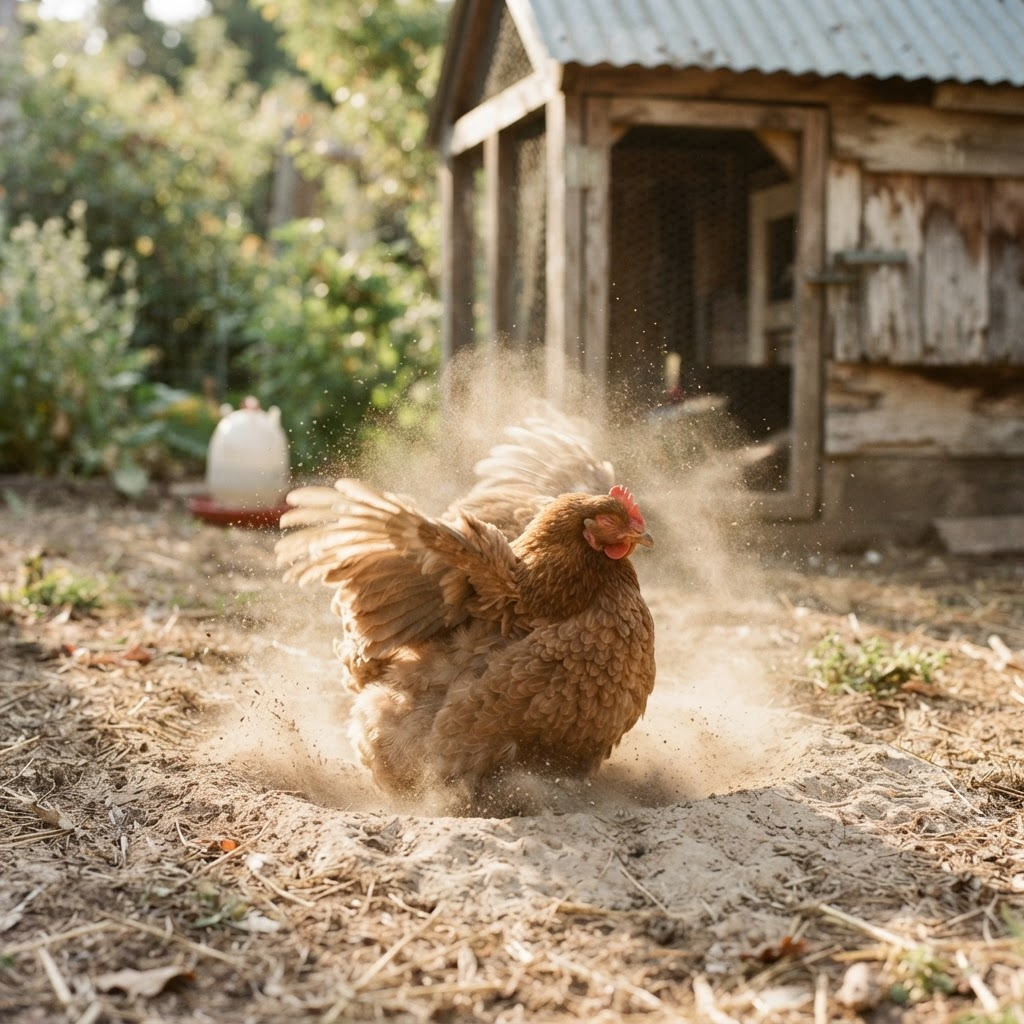
Diatomaceous earth shows up in chicken-keeping advice everywhere.
Add it to the dust bath.
Sprinkle it around the coop.
Use it for mites.
Use it for lice.
Depending on where you look, you'll find people describing it as either an essential part of chicken care or something that should never come near a flock.
The evidence lands somewhere in the middle.
Diatomaceous earth has been shown to reduce certain poultry mites and lice when hens actually dust bathe in treated material. But chickens do not need DE to perform normal dust-bathing behavior, and DE is a very fine particulate that deserves more caution than the word "natural" sometimes implies.
So the useful questions aren't simply whether DE is good or bad.
They're:
Does it actually work?
What are the risks?
And does your flock need it in the first place?
Diatomaceous Earth at a Glance
| Question | Roosted Take |
|---|---|
| Do chickens need DE to dust bathe? | No |
| Does DE work against some poultry parasites? | Yes — research supports reductions in northern fowl mites and chicken body lice under specific conditions |
| Does it work if hens don't contact it? | Research found little to no benefit to non-users of DE dust boxes |
| Is "food grade" the same as safe to inhale? | No |
| Should DE make up the entire bath? | No |
| Can soil and sand work for everyday dust bathing? | Yes |
| Should DE replace parasite identification and treatment? | No |
| Should filter/pool DE be substituted? | No |
| If you're using DE specifically as a pesticide? | Use an appropriately labeled product and follow its label |
| Main practical concern | Unnecessary airborne fine dust |
What Is Diatomaceous Earth?
Diatomaceous earth, usually shortened to DE, is made from fossilized remains of microscopic aquatic organisms called diatoms.
Their skeletons contain silica.
Most ordinary diatomaceous earth consists primarily of amorphous silicon dioxide, although small amounts of crystalline silica may also be present. The National Pesticide Information Center notes that the first pesticide products containing diatomaceous earth were registered in the United States in 1960 for control of insects and mites.
DE is typically sold as a very fine powder.
That physical structure is central to both why it can affect arthropod pests and why breathing unnecessary clouds of it isn't something I'd encourage.
How Does Diatomaceous Earth Work?
DE is not a conventional chemical poison.
NPIC explains that diatomaceous earth damages insects physically, absorbing oils and fats from the protective outer layer of the exoskeleton. Its abrasive properties accelerate that process, causing the insect to lose moisture and dry out.
DE also works best when it remains dry and relatively undisturbed.
That's why it makes sense that DE has attracted interest for poultry parasites.
But whether something can affect an insect in theory and whether it actually controls parasites on chickens are two different questions.
Fortunately, DE has been studied directly in poultry.
Does Diatomaceous Earth Work Against Chicken Mites and Lice?
For certain parasites and under specific conditions: yes.
A controlled 2012 experiment gave cage-free hens dust boxes containing sand mixed with:
- diatomaceous earth
- kaolin clay
- sulfur
Researchers compared parasite populations on birds that used the dust boxes with those that did not.
The results are useful because they're more nuanced than either side of the DE debate usually suggests.
What happened?
Among hens that actually dust bathed in the treated material, all three dusts reduced ectoparasite populations by roughly 80–100% after one week.
But DE and kaolin did not reduce parasite populations on hens that didn't use the dust boxes.
And when access to those dust boxes ended, parasite populations on the birds later recovered.
That's an important distinction.
The research supports the idea that DE can suppress certain ectoparasites when hens actually contact it through dust bathing.
It does not support the idea that you can put DE somewhere in the coop and your flock becomes parasite-proof.
What About Northern Fowl Mites Specifically?
A later 2016 experiment looked at DE dust boxes as a management strategy for northern fowl mites.
Researchers made DE-filled dust boxes available before mites were introduced to the flock.
Average mite densities stayed below economically damaging levels while those dust boxes were available.
But once the dust boxes were removed, mite populations rebounded.
Again, that's evidence of a real effect.
It's also evidence that the effect isn't permanent.
DE is a tool. Not immunity.
What Does Current Veterinary Guidance Say?
Current Merck Veterinary Manual guidance is particularly useful here because it incorporates the poultry research into practical veterinary recommendations.
For poultry lice, Merck says floor-housed birds can be provided dust boxes containing sand and an insecticidal dust such as food-grade diatomaceous earth. It describes a studied setup of roughly 50 pounds of washed play sand with approximately 6 cups of food-grade DE that markedly decreased louse burden.
Merck gives similar guidance for northern fowl mites, describing sand + DE dust boxes as effective for bird self-treatment.
But Merck immediately adds an important caution: DE should be applied only in well-ventilated areas, and the applicator should use a dust mask.
That caution belongs in the conversation just as much as the efficacy data does.
What Are the Risks of Diatomaceous Earth?
The main practical issue is airborne dust.
Think about how a chicken actually takes a dust bath.
She doesn't sit politely in the material.
She scratches. Rolls. Flaps. Kicks substrate under her wings. Shakes. And sends fine material into the surrounding air.
That matters when one of those materials is an extremely fine powder.
What Happens If DE Is Inhaled?
NPIC says people can be exposed to DE by inhaling dust during application or by entering an area before the dust has settled.
Short-term inhalation can irritate the nose and nasal passages, and very large exposures may cause coughing and shortness of breath. It can also irritate the eyes.
NIOSH likewise identifies the respiratory system as a target organ for occupational exposure to amorphous silica, including diatomaceous earth.
That does not establish that ordinary backyard exposure causes a specific lung disease in chickens. The poultry-specific inhalation data simply aren't strong enough for me to make that claim.
What it does establish is something more modest: there is no reason to create more airborne mineral dust than necessary.
That's a position I think the evidence supports without exaggeration.
Amorphous Silica vs. Crystalline Silica
This is an important distinction.
Most ordinary DE is primarily amorphous silica.
Crystalline silica is different. Long-term occupational exposure to respirable crystalline silica is associated with serious diseases including silicosis and lung cancer.
NPIC notes that ordinary DE can contain very low levels of crystalline silica but that most of the product is amorphous.
That distinction is one reason product type matters.
Why You Shouldn't Substitute Filter or Pool DE
Diatomaceous-earth products aren't all processed the same way.
High-temperature calcination can convert some amorphous silica into crystalline forms such as cristobalite. ATSDR and NIOSH materials document substantially higher crystalline-silica content in some calcined or flux-calcined forms of diatomaceous earth.
So don't use pool/filter DE simply because the bag also says "diatomaceous earth."
For flock use, product formulation and intended application matter.
Does "Food Grade" Mean Safe to Breathe?
No.
This is one of the most important misconceptions around DE.
NPIC explains that food-grade DE may be used in certain food or feed applications, including as an anti-caking material.
But that does not mean a concentrated dust application for pest control has the same exposure profile.
NPIC specifically warns that food-grade products that are not labeled for pest control may not have been evaluated for the risks or effectiveness of that use.
Their recommendation is straightforward: if you're using DE as a pesticide, select an appropriately labeled pesticide product and follow the directions and required precautions.
What to Use in an Everyday Chicken Dust Bath
This is where I think the conversation becomes much simpler.
You don't need DE for a chicken to dust bathe.
Merck describes normal dust bathing as chickens creating a depression in soft, dry material such as dirt, sand, or wood shavings, working that material through their feathers, and shaking it out. The substrate helps absorb excess oils from the skin and feathers.
For an everyday backyard setup, I'd start with dry soil and clean sand.
The important properties are:
- dry
- loose
- easy to dig through
- deep enough for a hen to roll in
- sheltered from persistent moisture
That's the actual dust bath.
Everything beyond that is an addition.
For the full setup, see our Chicken Dust Bath Guide: What to Put In It, How to Make One & What to Avoid.
So Should You Add DE "Just in Case"?
For a normal flock with no evidence of mites or lice? I don't see a compelling reason.
The research showing a benefit was specifically looking at ectoparasite control.
That's different from saying DE is required for everyday feather care.
If your objective is simply, "I want my chickens to have a good place to dust bathe," soil and sand already accomplish that.
If your objective becomes, "I think my chickens have northern fowl mites," now DE belongs in a different conversation.
That's parasite management.
If You Choose to Use Diatomaceous Earth
If you decide that DE makes sense for your situation, I'd use a few basic principles.
Know Why You're Using It
Don't use it because every DIY dust-bath graphic includes it.
Use it because you have an actual reason.
Use the Right Product
If you're using DE specifically to control pests, NPIC recommends choosing a product with a pesticide label and following that label.
The label tells you:
- approved uses
- where it can be applied
- how much to use
- exposure precautions
- required protective equipment
Keep the Area Ventilated
This isn't just our preference. Merck explicitly says DE used around poultry should be applied only in well-ventilated areas.
Minimize Dust Clouds
NPIC specifically recommends being mindful of activities that can re-aerosolize DE, including air movement and high-traffic situations.
So don't:
- pour it from shoulder height
- blow it around the coop
- use fans while applying it
- shake clouds directly around your hens
- assume more powder means more benefit
Protect Yourself
Follow the product label.
Merck recommends a dust mask during application, while NPIC notes that pesticide labels may call for a dust mask, eye protection, and protective clothing depending on the product.
Diatomaceous Earth vs. Kaolin Clay
This section matters because it would be easy for us to criticize DE's fine-particle nature while ignoring that kaolin is also a fine mineral powder.
And Zen Dust contains kaolin. So we should be transparent about that.
Kaolin was included alongside DE and sulfur in the same 2012 poultry dust-box experiment.
Hens that actually used kaolin-containing dust boxes also experienced substantial reductions in ectoparasites after one week. Like DE, kaolin did not reduce parasite populations on birds that did not use the box, and those populations later recovered.
That is interesting research.
But we do not use it to market Zen Dust as a mite or lice treatment.
And kaolin is not "dust-free."
NIOSH describes kaolin as a powder with inhalation as an exposure route and maintains occupational limits for both total and respirable kaolin dust.
That's why our standard should be consistent:
DE is a fine particulate. Kaolin is a fine particulate. Airborne mineral dust should be minimized rather than celebrated.
The difference is not that one powder is automatically dangerous and the other magically isn't.
The real questions are: What is the material being used for? How much exposure are we creating? What does the evidence actually support?
That's a much more credible way to approach both ingredients.
Where Does Zen Dust Fit?
Zen Dust is not a diatomaceous-earth product.
And we do not position it as a treatment for mites or lice.
It's designed as a botanical addition to the dust-bathing area your chickens already use.
The bath itself can remain simple — dry soil + sand — with Zen Dust worked lightly into that existing substrate as part of the flock-care routine.
The fact that kaolin has been studied in parasite research doesn't change what we sell it as.
If your flock has parasites, treat that as a parasite problem — not a product-marketing opportunity. Identify what's actually affecting your birds and choose an appropriate management strategy.
What DE Cannot Replace
Even where DE has research behind it, it doesn't eliminate the rest of parasite management.
Inspection
You still need to look closely at your birds.
Identification
A northern fowl mite is not the same thing as a poultry red mite, chicken body louse, or scaly-leg mite.
Environmental Management
For example, poultry red mites feed on birds at night and spend much of the daytime hiding in the coop environment — including cracks, roosts, and nest-box areas.
Appropriate Treatment
Sometimes another control method or labeled product may be more appropriate.
Biosecurity
Parasites can enter a flock on infested birds, equipment, and other carriers.
DE can be one tool. It isn't the entire toolbox.
How Do I Know If My Chickens Have Mites or Lice?
Possible warning signs include:
- excessive scratching or preening
- irritated skin
- damaged feathers
- visible insects
- eggs or nits attached to feather shafts
- dirty or crusted feathers around the vent
- decreased egg production in significant infestations
- anemia or weakness in severe blood-feeding mite infestations
Chicken body lice and their eggs can often be found around the vent, breast, thighs, or under the wings.
Northern fowl mites commonly concentrate around the vent and can produce thickened, crusty, soiled feathers in that area.
Poultry red mites behave differently: they feed primarily at night and hide in the structure of the coop during daylight hours.
That's exactly why identification matters.
If the first thing you're noticing is missing feathers, start with Why Is My Chicken Losing Feathers? Molting vs. Other Common Causes.
When Parasites Become More Than an Annoyance
Heavy poultry-louse infestations can reduce egg production and weight gain and can contribute to skin irritation and secondary infections.
Heavy poultry-red-mite and northern-fowl-mite infestations can reduce egg production, affect feed efficiency, contribute to anemia, and in severe cases cause death.
So if you're seeing:
- weakness
- pale combs
- substantial weight loss
- heavy visible infestation
- wounds or skin damage
- a major production drop
- birds that aren't improving
don't treat it as a cosmetic coop problem.
A veterinarian familiar with poultry can help determine what's actually going on and which treatment is appropriate.
Is Diatomaceous Earth "Natural"?
Yes. But that doesn't answer the safety question.
"Natural" tells you where something came from.
It doesn't tell you:
- how much to use
- where to use it
- how much to inhale
- whether it's appropriate for your particular problem
That's the same standard we should apply to every flock-care ingredient — including the ones we sell ourselves.
The Bottom Line: Should You Put Diatomaceous Earth in a Chicken Dust Bath?
Here's where I land after looking at the evidence.
Does DE work?
It can. Controlled poultry studies have shown meaningful reductions in northern fowl mites and chicken body lice when hens actually use DE-containing dust boxes.
Is DE completely harmless?
No material should be treated that way. DE can become airborne, inhaled dust can irritate the respiratory tract, and current veterinary guidance specifically calls for ventilation and a dust mask during application.
Do chickens need DE in their regular dust bath?
No. Normal dust bathing occurs perfectly well in soft, dry substrates such as soil and sand.
Should you use it?
That depends on why you're considering it.
For an ordinary everyday bath, I'd keep it simple.
For a known parasite problem where DE is an appropriate labeled option, the research says it can be useful.
That's a much more accurate answer than either "every chicken needs DE" or "DE never works." The evidence supports neither extreme.
Diatomaceous Earth & Chicken Dust Bath FAQ
Do chickens need diatomaceous earth in their dust bath?
No. Chickens naturally dust bathe in soft, dry substrates such as dirt and sand. DE is not required for the behavior.
Does diatomaceous earth work for chicken mites?
It has evidence for certain mites. Studies have shown DE-containing dust boxes can suppress northern fowl mite populations when hens use them. That should not be generalized automatically to every mite species or every infestation.
Does DE work for chicken lice?
Yes, research has shown reductions in chicken body lice among birds that used DE-containing dust boxes.
Is food-grade DE safe for chickens?
"Food grade" does not mean risk-free or safe to inhale. NPIC distinguishes low-level food/feed uses from concentrated pest-control applications and recommends selecting an appropriately labeled pesticide product when DE is being used for pest control.
Can DE irritate the lungs?
In people, inhaled DE can irritate the nose and respiratory passages, and Merck specifically calls for ventilation and respiratory protection during poultry application. There isn't enough chicken-specific inhalation research to responsibly claim a particular poultry lung disease from ordinary backyard use.
How much DE should go in a chicken dust bath?
I would not publish a universal DIY ratio. If you're using DE specifically as a pesticide, follow the directions on an appropriately labeled product. Merck describes specific experimental sand/DE mixtures, but that's evidence from studied setups — not permission to invent a one-size-fits-all backyard dosage.
Can I use pool-grade diatomaceous earth?
No. Some filter-grade DE is calcined or flux-calcined, processes that can substantially increase crystalline-silica content. Don't substitute it for a product intended for the application you're considering.
Is kaolin clay safer than DE?
I wouldn't make that broad claim. Kaolin and DE are different materials, but both can exist as fine airborne particulates. NIOSH recognizes inhalation exposure limits for kaolin as well. The sensible principle for either is to minimize unnecessary airborne dust.
Does Zen Dust contain DE?
No. Zen Dust contains kaolin clay and botanicals and is positioned as a dust-bath addition — not as a parasite treatment.
Keep Reading
Build the everyday bath first: Chicken Dust Bath: What to Put In It, How to Make One & What to Avoid
Need a container or setup idea? Chicken Dust Bath Container Ideas: 10 Easy DIY Setups
Seeing unexplained feather loss? Why Is My Chicken Losing Feathers? Molting vs. Other Common Causes
Keeping the whole coop clean? How Often Should You Clean a Chicken Coop? Daily, Weekly & Deep-Clean Schedule