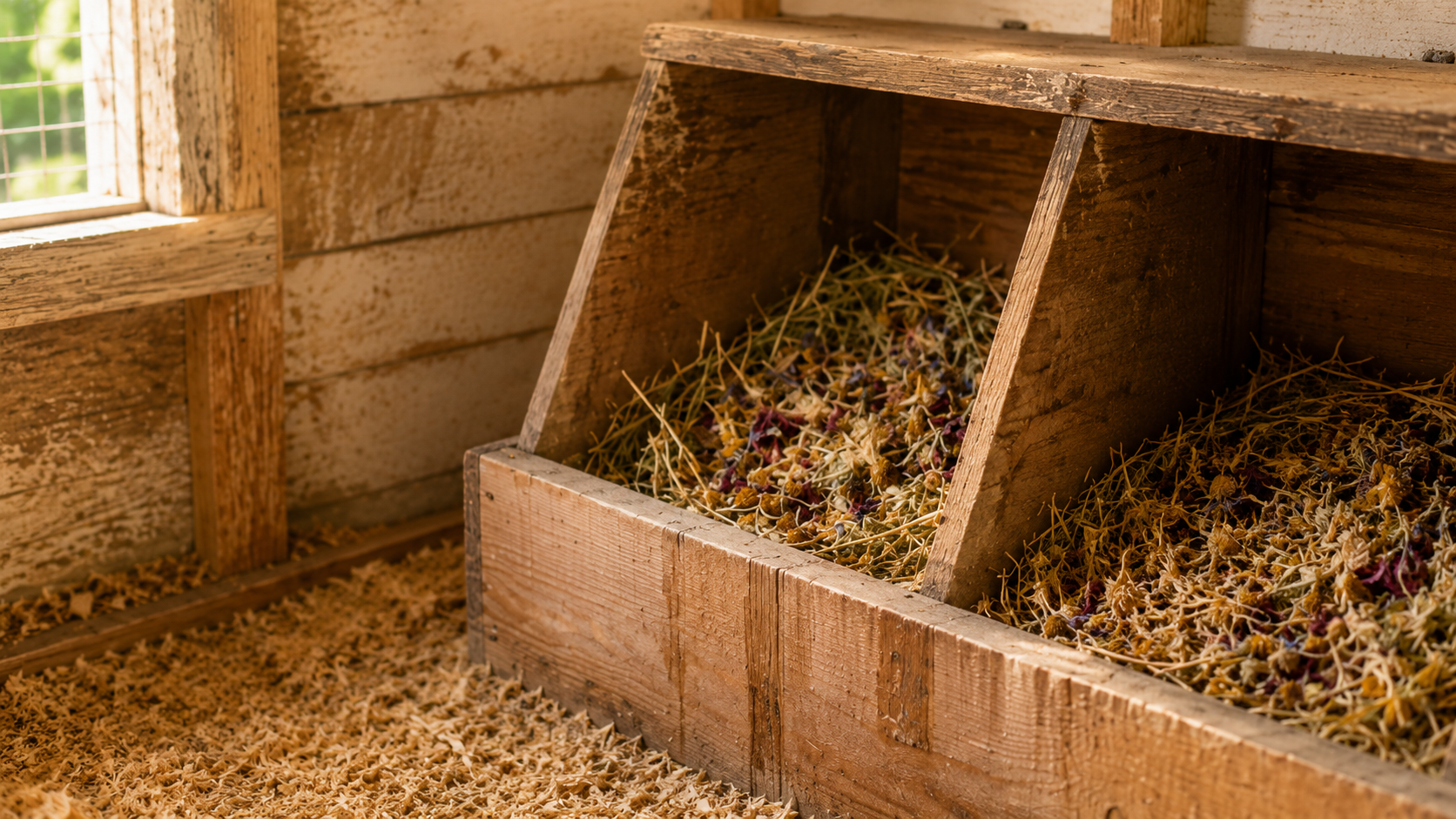
Dried lavender, rosemary, mint, rose petals, and other herbs have become common additions to backyard chicken nesting boxes.
They look beautiful. They smell fresh. And they fit naturally into the kind of intentional flock-care routine many backyard chicken keepers enjoy.
But there is an important question behind all of that:
Do chicken nesting herbs actually work?
The answer depends entirely on what you mean by *work*.
That distinction is important.
And it's how we think nesting herbs should be used at Roosted.
Nesting Herbs: What the Evidence Actually Supports
| Claim | What the Evidence Says |
|---|---|
| Hens can smell herbs | Chickens are capable of detecting odors and forming associations with familiar scents. |
| Herbs make hens calmer | Not established for dried herbs placed in nesting boxes. |
| Herbs increase egg production | Some herbs have been studied *in feed*, but that does not establish the same effect from nesting-box use. |
| Herbs repel mites and lice | Not reliably established for ordinary dried nesting herbs. |
| Herbs improve egg quality | Some dietary studies exist, but again, feeding an herb is very different from placing it in a nest. |
| Herbs make a good nesting box | Herbs are optional. Nest design, seclusion, cleanliness, dryness, and appropriate nesting material matter much more. |
| Essential oils are a stronger version | No. Concentrated essential oils create additional safety concerns for birds and should not be treated like dried herbs. |
The biggest lesson is simple:
Nesting herbs should not be sold or used as if they are a veterinary treatment.
What Are Chicken Nesting Herbs?
Chicken nesting herbs are dried botanical materials added in small amounts to the bedding inside a nesting box.
Common examples include lavender, rosemary, mint, chamomile, calendula, rose petals, and lemon balm.
They're usually mixed lightly into materials such as pine shavings, hemp bedding, straw, or another suitable nesting substrate.
The herbs themselves are not the bedding.
Your hen still needs a nesting surface that cushions the egg, stays dry, and gives her somewhere comfortable to settle.
If you're still building the basic setup, start with our Chicken Nesting Box Guide: Size, Dimensions, How Many You Need & Where to Put Them.
So, Do Nesting Herbs Work?
If you're asking:
"Will adding dried herbs make my nesting boxes smell pleasant and add botanical variety?"
Yes. That's a reasonable expectation.
If you're asking:
"Will nesting herbs cure mites, increase laying, prevent disease, or scientifically reduce stress?"
We don't currently have good direct evidence to make those claims.
That's where a lot of backyard-chicken advice gets ahead of the research.
There is real poultry research involving herbs.
But much of it studies herbs in a very different context.
What Does the Research on Herbs and Chickens Actually Show?
This is where we need to separate three different ideas: herbs in chicken feed, concentrated essential oils, and dried herbs sitting in nesting-box bedding.
Those are not interchangeable.
Dietary Herb Research
Researchers have studied herbs such as rosemary, lavender, mint, thyme, and others as dietary additives for poultry.
For example, one study added lavender and spearmint essential oils directly to laying-hen diets. Lavender supplementation showed some effects on egg production, while mint produced different results.
Other research has investigated rosemary leaf powder incorporated into a hen's feed and reported effects on certain production, egg-quality, antioxidant, or gut-health measures.
That research is interesting.
But it doesn't tell us what happens when you put a handful of dried rosemary into a nesting box.
The route of exposure is completely different.
A hen eating a controlled quantity of an herb in a formulated diet is not the same as a hen sitting beside that herb while laying an egg.
Can Chickens Smell Herbs?
Yes.
Chickens have a functioning sense of smell, and research has demonstrated that chicks can distinguish odors and develop preferences associated with familiar scents.
One study found that chicks exposed to certain odors during rearing later responded differently to those familiar scents.
That tells us something useful: botanical scent isn't irrelevant to a chicken.
But it still doesn't prove that lavender in a nesting box makes adult hens calmer, causes them to lay more eggs, or makes them prefer that nest.
Those would require more specific research.
What Do Hens Actually Care About in a Nest?
This is where the scientific evidence is considerably stronger.
Research on laying hens has found that nest characteristics such as seclusion, enclosure, location, nesting surface, and nesting material can influence which nests hens choose.
In one nest-preference study, most hens chose an enclosed nest box over a more exposed litter tray.
Another experiment found that hens strongly preferred certain secluded corner nests and changed their nesting behavior when the quality of the preferred nest surface was altered.
Research has also demonstrated that the amount and type of nesting material can influence nest selection.
That's useful because it gives us a hierarchy.
What matters most?
Good nesting-box design, then clean, dry, comfortable nesting material, then optional additions such as dried botanicals.
I would never try to fix a poor nesting setup by adding more herbs.
What Should Nesting Herbs NOT Be Expected to Do?
This is probably the most important section of this entire guide.
Nesting Herbs Are Not a Mite or Lice Treatment
You'll see plenty of claims online that certain herbs "repel parasites."
That doesn't mean sprinkling those herbs into a nesting box gives your flock reliable mite or lice control.
If you suspect external parasites, identify the problem and treat it appropriately rather than relying on aromatic bedding additions.
The same goes for our products.
Roosted does not position nesting herbs as a treatment for mites, lice, or other parasites.
Nesting Herbs Are Not Proven to Increase Egg Production
The fact that researchers have studied rosemary, lavender, or other botanicals in feed does not mean placing them underneath a laying hen increases egg production.
How often your hens lay is affected much more clearly by factors such as breed, age, nutrition, daylight, season, molting, broodiness, stress, and overall health.
For more on that, read How Often Do Chickens Lay Eggs? Daily, Weekly & Yearly Expectations.
Nesting Herbs Are Not Proven Sedatives
"Lavender is calming" is repeated constantly in human wellness and chicken-keeping content.
That's not enough evidence for us to tell you that dried lavender in your nesting box will measurably reduce stress in a hen.
Could scent influence behavior? Chickens clearly perceive odors.
But "they can smell it" and "it clinically reduces stress" are not the same claim.
We would rather be accurate than turn a nice backyard ritual into something it hasn't been proven to be.
Are Nesting Herbs Safe for Chickens?
This is another place where we need nuance.
There is not a widely established scientific formula saying *"use exactly X grams of dried lavender per square foot of nesting box."*
So there isn't an evidence-based nesting-herb dosage I can give you.
For backyard use, the conservative approach is to treat dried botanicals as a small addition to the nesting material, not something that overwhelms the box.
And there's an important distinction between:
Dried herbs
and
Concentrated essential oils
They are not the same thing.
What About Essential Oils?
This is where I would be much more cautious.
Bird respiratory systems are particularly sensitive to airborne irritants and fragrances.
The Merck Veterinary Manual specifically warns that birds are at high risk from essential-oil exposure because of their unique respiratory anatomy and sensitivity to fragrances and aerosolized particles.
That's why we would not recommend turning the nesting box into an aromatherapy diffuser.
Avoid essential-oil diffusers in the coop, heavily scented sprays, concentrated oils applied directly to nesting material, perfume-style products, or trying to make the coop smell intensely fragrant.
A chicken coop doesn't need to smell like a spa.
It needs to be clean, dry, ventilated, and appropriate for chickens.
How to Use Dried Nesting Herbs
There isn't an evidence-based universal dosage, so keep the approach simple and conservative:
- Start with proper bedding. Pine shavings, hemp, nesting pads, or another suitable dry nesting material should make up the actual nest.
- Use a light amount of dried botanicals. Scatter or mix a small amount through the upper layer rather than packing the nest with herbs.
- Keep everything dry. Remove botanicals along with the bedding if the nest becomes wet, soiled, or moldy.
- Watch your hens. If birds begin avoiding a box after you've changed the bedding or added something new, remove the addition and see whether their normal behavior returns.
The nesting box should still look predominantly like a nesting box.
Not a bowl of potpourri.
How Much Is Too Much?
Because there isn't a standardized research-backed dosage, I wouldn't pretend there is a magic number.
Use enough to add a little botanical variety. Not enough to overpower the bedding, create excessive dust, make the nest intensely fragrant, reduce cushioning, or cause hens to avoid the box.
If you open the coop and the first thing you notice is a wall of fragrance?
That's not what we're going for.
Which Herbs Are Commonly Used in Nesting Boxes?
Backyard keepers commonly use dried botanicals such as lavender, rosemary, mint, chamomile, rose petals, calendula, and lemon balm.
But "commonly used" should not be confused with "clinically proven."
That's why I prefer evaluating a botanical blend by more practical standards:
- Is it properly dried?
- Is it clean?
- Is it free of obvious mold?
- Is it being used in a reasonable amount?
- Does it complement rather than replace the nesting material?
- Are we avoiding unsupported medical claims?
Those questions matter more than an enormous list of supposed herbal benefits.
Can Nesting Herbs Encourage Hens to Use the Nesting Box?
Maybe — but I'd give the nest itself most of the credit.
Hens demonstrably care about nesting location, seclusion, surface, and material. Research has repeatedly shown preferences for certain nest designs and nesting substrates.
So if your chickens are laying under bushes, behind feed bins, in corners of the coop, or somewhere else entirely, don't reach for herbs first.
Check box location, privacy, accessibility, bedding, cleanliness, number of boxes, height, and whether another hen is monopolizing the preferred nest.
Our Chicken Nesting Box Guide walks through those factors.
Can Nesting Herbs Keep Eggs Cleaner?
Not directly.
Clean bedding keeps eggs cleaner.
If adding herbs makes you pay more attention to the nesting-box routine and encourages you to refresh the bedding regularly, that's useful.
But dried lavender doesn't magically clean an egg.
Good nest hygiene does.
That means removing manure, broken egg material, wet bedding, and heavily soiled nesting material when you find it.
For the broader coop routine, see How Often Should You Clean a Chicken Coop? Daily, Weekly & Deep-Clean Schedule.
Where Does Roosted Nested Fit?
This evidence-first approach is exactly how we want to position Nested.
Nested isn't meant to replace bedding. It isn't medicine. And we don't want to tell you that your hen needs herbs in order to lay an egg.
Nested is a dried botanical nesting-box addition for chicken keepers who enjoy making their flock-care routine a little more intentional.
Our blend uses dried botanicals such as rose petals, lavender, lemon balm, chamomile, rosemary, and mint.
The idea is simple: build a good nest first, then add botanicals if they're part of the routine you enjoy.
That's it.
No miracle claims required.
Do Chickens Need Nesting Herbs?
No.
A hen can live a perfectly good life and lay perfectly good eggs without ever seeing a rose petal.
What she actually needs is much more basic: a safe coop, suitable nutrition, clean water, enough space, good ventilation, appropriate nesting boxes, clean and dry nesting material, and proper care.
Nesting herbs are optional.
And I actually think saying that makes them easier to understand.
They're not something your chicken needs. They're something you may choose to incorporate into the way you care for your flock.
When I Would Skip Nesting Herbs
I would leave them out if your nesting area is damp or moldy, if a bird has respiratory trouble, if you are using concentrated fragrances or oils instead of ordinary dried botanicals, if you're unsure what plant material you're using, or if hens begin avoiding the nest after you've added them.
I'd also skip herbs if you're adding them specifically because you're trying to treat a medical or parasite problem.
Fix the actual problem instead.
The Bigger Lesson About "Natural" Chicken Care
Natural doesn't automatically mean proven, and it doesn't automatically mean harmless.
That's a standard we want to keep throughout Roosted.
There are plenty of traditional flock-care practices that people enjoy and have used for generations. That's fine.
But when evidence is limited, we should say evidence is limited. When research applies to a dietary supplement instead of a nesting box, we should say so. When something hasn't been shown to treat a condition, we shouldn't call it a treatment.
There is still plenty of room for beautiful, thoughtful chicken keeping without pretending every botanical is medicine.
The Bottom Line: Do Chicken Nesting Herbs Work?
It depends on what you expect them to do.
If you want a botanical addition that brings scent, texture, and a little more intention to your nesting-box routine? Nesting herbs can fit that role.
If you expect them to cure parasites, increase egg production, prevent disease, scientifically calm hens, or replace good nesting-box management, the evidence isn't there.
The strongest evidence around nesting behavior still points us toward the fundamentals: a clean, dry, comfortable, appropriately located and suitably furnished nest.
Get that right first.
Everything botanical comes after.
And that's exactly where we think it belongs.
Chicken Nesting Herbs FAQ
Do chickens need herbs in their nesting boxes?
No. Herbs are optional. Suitable nesting boxes and clean, dry nesting material are far more important.
Do nesting herbs keep mites away?
There isn't strong direct evidence showing that ordinary dried nesting herbs provide reliable mite control. If you have mites, use an appropriate parasite-management strategy rather than relying on herbs.
Does lavender calm chickens?
Chickens can detect odors, but there is not strong direct evidence showing that dried lavender placed in a nesting box measurably calms laying hens.
Do nesting herbs make chickens lay more eggs?
There isn't good evidence that herbs placed in nesting boxes increase egg production. Some herbs have been studied when fed to laying hens, but those findings shouldn't be applied automatically to nesting-box use.
Can I put essential oils in a chicken nesting box?
I wouldn't recommend it. Birds are particularly sensitive to fragrances and aerosolized essential oils, and concentrated essential-oil exposure carries different risks from ordinary dried plant material.
How often should I replace nesting herbs?
Treat them as part of the bedding. If the nesting material becomes dirty, wet, moldy, or heavily soiled, remove the herbs with it and replace the nesting material as needed.
Can I use fresh herbs?
I prefer fully dried botanicals for nesting-box use because introducing additional moisture into a nest works against one of our primary objectives: keeping the laying area clean and dry.
What is the best thing to put in chicken nesting boxes?
Start with appropriate nesting material — not herbs. Our guide to what to put in chicken nesting boxes compares bedding, nesting pads, botanicals, and materials to avoid.
Keep Reading
Build the nesting area first: Chicken Nesting Boxes: Size, Dimensions, How Many You Need & Where to Put Them
Choosing nesting material: What to Put in Chicken Nesting Boxes: Best Bedding, Herbs & What to Avoid
Waiting for your pullets to lay: When Do Chickens Start Laying Eggs? Age, Signs & What to Expect
Keeping the nesting area clean: How Often Should You Clean a Chicken Coop? Daily, Weekly & Deep-Clean Schedule