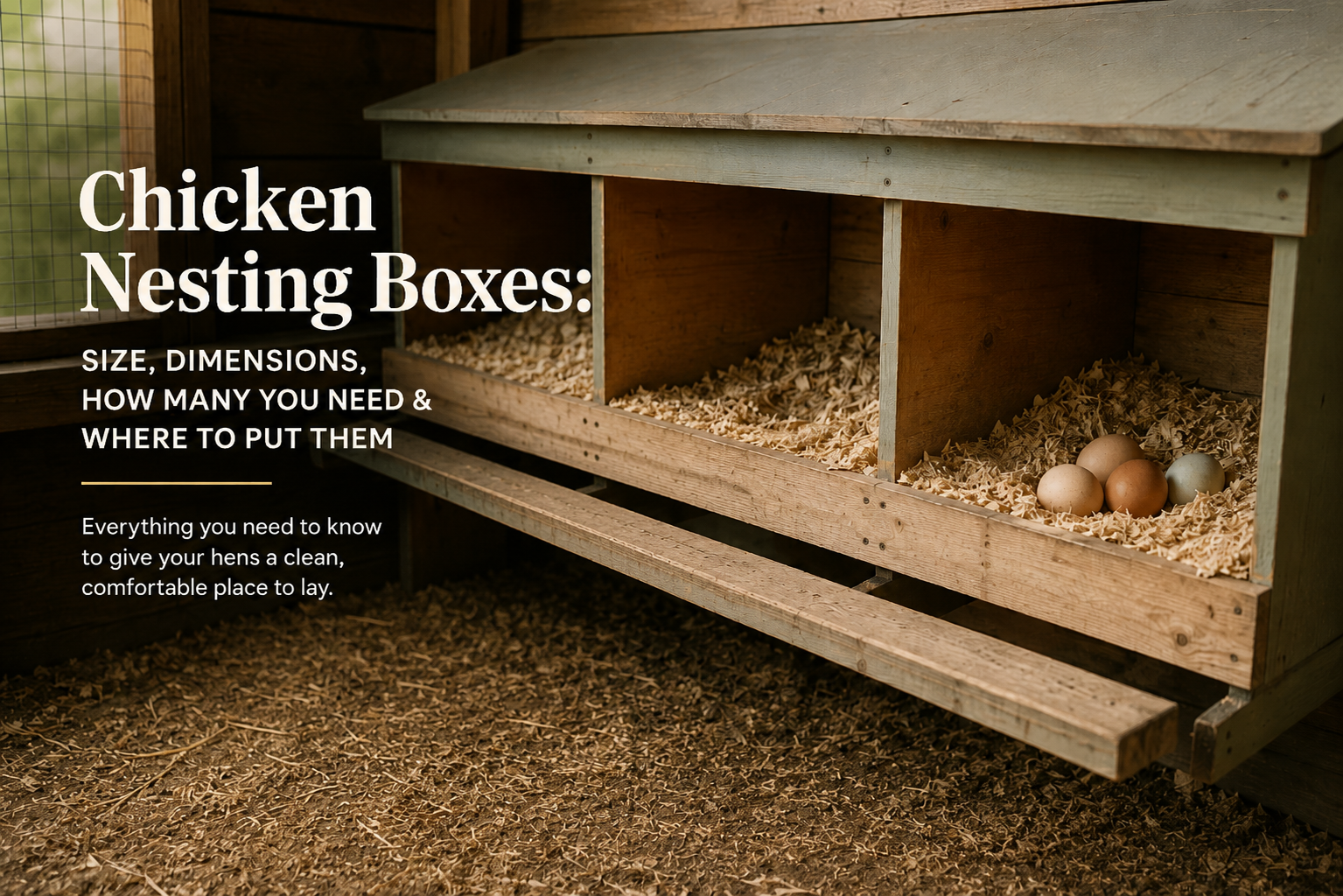
A good nesting box doesn't need to be complicated.
It needs to be large enough for a hen to settle comfortably, private enough that she wants to use it, easy enough for her to reach, and clean enough to protect the eggs she leaves behind.
Get those basics right and most hens will handle the rest.
Get them wrong and you may find eggs under bushes, behind feed bins, on the coop floor, or somehow crammed into the one nesting box every hen has collectively decided is the only acceptable option.
This guide covers the entire setup: nesting box size, dimensions, how many boxes you need, height, placement, bedding, and the mistakes that cause hens to ignore them.
Chicken Nesting Box Setup at a Glance
| Question | Good Starting Point |
|---|---|
| Box width | About 12–14 inches |
| Box height | About 12–14 inches |
| Box depth | About 12–16 inches |
| Boxes per hens | Roughly 1 box per 4 hens |
| Height from floor | Around 18–24 inches |
| Location | Darker, quiet, secluded area |
| Compared with roosts | Nesting boxes should be lower |
| Front lip | About 3–4 inches |
| Inside the box | Clean, dry nesting material |
| Best time to install | Before pullets begin laying |
These aren't rigid laws.
Breed size, coop design, accessibility, and flock behavior all matter.
The goal isn't to build a nesting box to an exact fraction of an inch.
The goal is to create a place your hens consistently choose over every other corner of the property.
What Is a Chicken Nesting Box?
A nesting box is a designated place where a hen can settle down and lay an egg.
That's really it.
It doesn't need to be elaborate, expensive, or particularly pretty from the chicken's point of view.
What hens tend to appreciate is a nesting area that feels:
- quiet
- relatively dark
- protected
- comfortable
- dry
- easy to enter
University Extension guidance consistently recommends placing nests in quieter, more secluded areas rather than directly across from bright windows or in heavily trafficked parts of the coop.
The box also serves an important purpose for you.
A good nesting setup makes eggs easier to:
- find
- collect
- keep clean
- protect from breakage
Without appropriate nests, hens may simply choose their own.
And their standards for convenient egg-collection locations are not always the same as yours.
What Size Should a Chicken Nesting Box Be?
There isn't one universal nesting-box dimension used by every poultry authority.
Penn State recommends nests be at least 12 × 12 inches and says larger birds should have additional room. Oregon State uses approximately 12 × 12 × 12 inches, while Mississippi State gives a recommendation of 14 inches wide × 12 inches high × 16 inches deep.
That gives us a useful range.
The important part is that your hen can enter the box, turn or settle into position, and sit comfortably.
Standard Chicken Nesting Box Dimensions
For many common backyard breeds, something close to 12" W × 12" H × 12" D works well.
That gives a hen enough room to settle without making the nest unnecessarily large.
Think breeds along the lines of typical medium-sized backyard layers.
Nesting Box Dimensions for Large Chickens
Larger hens need more room.
If your birds look cramped in a standard 12-inch box, size up.
Something closer to 14" W × 14" H × 14–16" D may be more comfortable.
The exact number matters less than watching the bird.
If she has to squeeze awkwardly through the opening or can't comfortably settle into the nest, the box is too small.
Penn State specifically recommends increasing nesting area for larger birds.
Can a Chicken Nesting Box Be Too Big?
Yes.
Bigger isn't automatically better.
A giant communal box can encourage more than one hen to climb inside at the same time, increasing traffic around the eggs and potentially increasing breakage.
Penn State specifically cautions against making individual boxes so large that multiple birds routinely try to occupy them together.
You want it roomy enough for one hen — not the chicken equivalent of a studio apartment.
How Many Nesting Boxes Do You Need?
This is one of the most common nesting-box questions.
And no: you do not need one box for every chicken.
Most backyard recommendations fall around one nesting box for every 4–5 hens. University of Minnesota Extension recommends one box per 4–5 birds, while Oregon State uses roughly one per four birds.
For Roosted's planning purposes, I would use:
as the simple rule of thumb.
Then adjust based on flock behavior.
Nesting Box Calculator
| Number of Hens | Nesting Boxes I'd Plan For |
|---|---|
| 1–4 hens | 2 if space allows |
| 5–8 hens | 2 |
| 9–12 hens | 3 |
| 13–16 hens | 4 |
| 17–20 hens | 5 |
| 21–24 hens | 6 |
| 25–28 hens | 7 |
| 29–32 hens | 8 |
Why two boxes for a tiny flock? Because chickens are chickens.
One hen can decide to sit in a box for what feels like half the morning while another wants to lay. A second option gives a small flock some flexibility.
Penn State takes an even more generous approach with small flocks, recommending two nests for the first four hens and then another nest for every four additional hens.
So don't stress over whether a four-hen flock technically needs one box or two. If you've got space for two, I'd build two.
Why Do All My Chickens Use the Same Nesting Box?
You can build four identical nesting boxes. Same dimensions. Same bedding. Same height. Same everything.
And then watch six hens wait in line for Box #3 while the other three sit completely empty.
This is extremely common.
Hens can develop strong preferences for particular nesting locations. If too many birds keep using one nest, the resulting traffic and accumulation of eggs can increase the chance of breakage.
If one box becomes the flock favorite:
- keep it especially clean
- collect eggs regularly
- check whether the other boxes are brighter or more exposed
- make sure all boxes have similar bedding
- make sure the unpopular boxes aren't harder to access
But don't assume something is wrong merely because your chickens refuse to distribute themselves evenly.
They didn't receive the architectural plans.
Where Should Chicken Nesting Boxes Be Located?
Location matters almost as much as size.
The best nesting area is usually quiet, slightly darker, dry, protected, away from heavy traffic, and separate from where chickens sleep.
Penn State recommends nests be placed in darker, secluded areas and away from bright windows and heavily trafficked spaces.
Good Locations
- A nesting-box wall inside a sheltered coop
- A darker side wall away from the main door
- An exterior-access nesting-box system that remains enclosed and weatherproof
- A quieter corner away from feeders, waterers, and roosting traffic
Poor Locations
- Directly across from a bright sunny window
- Underneath the roosting bars
- Next to a frequently opened door
- In an area that gets wet during rain
- Somewhere predators or rodents can gain access
How High Should Chicken Nesting Boxes Be?
Around 18–24 inches above the floor is a good general starting range for standard backyard hens.
Several Extension recommendations place nesting boxes around 24 inches above the floor, while University of Maine educators suggest around 18 inches with the roosting bars positioned higher.
So I would think about 18–24 inches high rather than obsessing over one exact number.
The birds still need to be able to get in and out safely.
For heavier breeds or birds with limited jumping ability, consider:
- a lower installation
- a landing perch
- a small ramp
Oregon State specifically recommends providing a landing pole or ramp when elevated nesting boxes would otherwise be difficult to access.
Should Nesting Boxes Be Higher or Lower Than Roosting Bars?
Lower.
This is an important one.
Chickens naturally seek higher locations when they settle down to sleep.
University of Maryland Extension specifically recommends placing roosts higher than nesting boxes.
The idea is simple: the roosting bar is the bedroom, and the nesting box is the egg-laying room.
If your nesting boxes are the highest, most attractive sleeping spot in the coop, don't be surprised if your chickens turn them into beds.
And chickens poop while they sleep. A lot.
Which means your nice clean nesting box quickly becomes something else entirely.
Don't Put Nesting Boxes Under the Roosts
Even if your hens aren't sleeping inside the boxes, putting the boxes directly beneath a roost creates another problem: everything that happens on the roost happens over the nesting area.
Extension recommendations advise separating the two areas and avoiding placing roosts over the nests.
Cleaner nests generally mean cleaner eggs.
Separate the bedroom from the egg-laying area whenever your coop layout allows it.
Should Nesting Boxes Have a Front Lip?
Yes.
A small lip across the front helps keep bedding and eggs inside.
Penn State recommends approximately a 3–4 inch front lip on the nesting box.
It helps prevent the hen from kicking every last piece of nesting material onto the coop floor while she's arranging the nest to her exact specifications.
Which she will attempt to do anyway.
Should Nesting Boxes Have a Sloped Roof?
If chickens can stand on top of the boxes, a sloped top is a smart design choice.
Oregon State recommends a roof sloped around 45 degrees to discourage hens from roosting on top of the nesting boxes.
Flat surfaces inside a chicken coop have a tendency to become perches.
If you don't want chickens sleeping there, design accordingly.
What Should You Put Inside Chicken Nesting Boxes?
The short answer: clean, dry, comfortable nesting material.
Common options include:
- pine shavings
- nesting pads
- hemp bedding
- other clean, dry materials suitable for nesting
The bedding needs to cushion the egg and help keep the nesting area clean and dry.
Rather than duplicate that entire subject here, we built a dedicated guide comparing the options: What to Put in Chicken Nesting Boxes: Best Bedding, Herbs & What to Avoid.
That's where we get into bedding types, nesting pads, botanicals, and materials I'd leave out of the box.
How Much Bedding Should Be in a Nesting Box?
You want enough material to cushion the eggs without filling the box so deeply that half of it gets kicked onto the floor every time a hen turns around.
Extension recommendations generally call for roughly 2–3 inches of clean, dry nesting material.
The more important test is practical. Can the egg land on a cushioned surface? Is the material dry? Is there enough bedding left after the hen has rearranged it?
If yes, you're in good shape.
When Should You Give Pullets Nesting Boxes?
Don't wait until you find the first egg on the floor.
Have the nesting area ready before laying begins.
University of Maryland Extension recommends giving laying birds access to nests around 19–20 weeks of age, ideally allowing young pullets to discover them a week or two before laying starts.
That gives them time to learn where eggs go.
If your birds are approaching that age, our guide to when chickens start laying eggs and the signs to watch for walks through the first-egg timeline.
Why Won't My Chickens Lay in the Nesting Boxes?
Before blaming the chickens, look at the boxes from their perspective.
Is the box too bright?
Hens generally prefer quieter, dimmer nesting areas.
Is it hard to reach?
An elevated box may need a landing perch or ramp.
Is it dirty?
Manure, broken eggs, wet bedding, or a heavily soiled nest can make another location more appealing.
Is another hen occupying it?
Especially common with small flocks and broody hens.
Is the box near the roost?
Too much activity or contamination can make the location less attractive.
Is there somewhere else that feels better?
This is the big one. Your hen may have discovered a dark corner, an empty bucket, a hay pile, tall grass, a shelf, the space underneath something, or one specific bush she has decided belongs to her.
If hens suddenly appear not to be laying, check for hidden nests before assuming egg production has stopped.
For other causes of reduced egg production, see Why Are My Chickens Not Laying Eggs? 8 Common Reasons to Check.
Can Nesting Boxes Sit on the Floor?
They can, but I wouldn't make floor-level boxes my first choice for a standard coop.
Elevating nesting boxes helps separate the laying area from floor litter and general coop traffic, and several Extension sources recommend nests around 18–24 inches above the floor.
The exception is accessibility.
If you keep breeds that struggle to jump or fly, safe access matters more than an arbitrary height measurement.
Design for your birds.
DIY Chicken Nesting Boxes vs. Store-Bought Boxes
Your chickens do not care whether their nesting box came from a beautiful custom coop builder or was repurposed from something sitting in the garage.
What matters is whether it works.
Nesting boxes can be built from or adapted from wood, plastic tubs, buckets, milk crates, purpose-built plastic nesting boxes, or metal nesting systems.
University of Florida Extension specifically mentions repurposed buckets and milk crates as possible nesting-box materials.
Wooden Boxes
Pros: easy to custom-build, looks great in a finished coop, and can be built directly into the structure.
Cons: harder to thoroughly wash, seams can collect debris, and untreated wood absorbs moisture.
Plastic Boxes
Pros: easy to remove, easy to wash, lightweight, and inexpensive.
Cons: may need to be secured, and some shapes don't retain bedding well.
Metal Boxes
Pros: durable, easy to clean, and common in larger nesting systems.
Cons: less customizable, can feel more commercial, and edges and temperature exposure need consideration.
There isn't a single best material. I'd prioritize easy to clean, easy for hens to access, and easy for you to collect eggs from.
Exterior Nesting Boxes vs. Interior Nesting Boxes
Both can work.
Interior Nesting Boxes
These sit entirely inside the coop. They're simple and protected, but they use interior floor or wall space.
Exterior-Access Nesting Boxes
These project outside the coop while allowing hens to enter from inside. They can make egg collection incredibly convenient because you can access the eggs without walking through the coop.
But they need to be weatherproof, predator-resistant, securely latched, and properly flashed or sealed against rain.
Convenience is great. A leaking nesting box isn't.
How Often Should You Clean Chicken Nesting Boxes?
Check them regularly.
You don't necessarily need to strip every perfectly clean nesting box on a rigid schedule.
Instead, remove:
- manure
- broken egg material
- wet bedding
- heavily soiled bedding
- feathers and debris when they accumulate
Then replenish the nesting material as needed.
Penn State emphasizes keeping the nesting environment clean and dry because dirty and damp nests contribute to dirty eggs and potential contamination.
For the rest of your coop routine, see our daily, weekly, and deep-clean chicken coop schedule.
How Often Should You Collect Eggs?
At least daily. Twice daily is even better when possible.
Frequent egg collection helps reduce:
- dirty eggs
- broken eggs
- overcrowded favorite boxes
- opportunities for hens to discover and eat broken eggs
Extension recommendations commonly suggest collecting eggs at least once daily and preferably twice.
If every hen in the flock has decided to use one particular box, frequent collection becomes even more useful.
8 Common Chicken Nesting Box Mistakes
1. Building One Box Per Hen
You don't need 12 boxes for 12 hens. Start around one per four hens.
2. Making the Boxes Too Small
If a hen can't comfortably enter and settle, give her more room.
3. Making Them Huge
A giant box can turn into a crowded communal nest and increase egg traffic.
4. Putting Boxes in Bright, Busy Areas
Think secluded rather than center stage.
5. Making Nesting Boxes Higher Than the Roosts
If the box becomes the highest comfortable spot, your hens may decide it's a bed.
6. Putting Boxes Under Roosting Bars
Your eggs deserve better.
7. Not Providing Enough Bedding
Eggs need cushioning.
8. Waiting Until Hens Start Laying
Have the boxes ready before the first eggs arrive so pullets can learn where they're supposed to go.
The Simple Nesting Box Formula
If you're building a coop and don't want to overcomplicate this, start here:
- Size: about 12 × 12 × 12 inches or slightly larger
- Quantity: about 1 box per 4 hens
- Height: roughly 18–24 inches off the floor
- Location: quiet, dim, dry, and away from roosts
- Roosting bars: higher than the nesting boxes
- Front: a 3–4 inch lip
- Inside: 2–3 inches of clean, dry nesting material
That's enough to build a very functional backyard nesting setup. Then let your chickens tell you whether anything needs adjusting.
Chicken Nesting Box FAQ
How many nesting boxes do I need for 6 chickens?
I'd use 2 nesting boxes for six hens. One box per 4–5 hens is generally adequate, and two gives the flock another option when one nest is occupied.
How many nesting boxes for 8 chickens?
2 boxes is a good starting point.
How many nesting boxes for 10 chickens?
I'd plan for 3 boxes.
How many nesting boxes for 12 chickens?
Around 3 nesting boxes using the one-box-per-four-hens rule.
How many nesting boxes for 20 chickens?
About 5 nesting boxes is a practical starting point. Watch how the flock actually uses them and add capacity if several nests consistently become overcrowded.
What is the standard size for a chicken nesting box?
Around 12 × 12 × 12 inches is a common starting dimension for standard hens. Extension recommendations vary somewhat, and larger breeds should have additional room.
How high should nesting boxes be?
Around 18–24 inches above the floor is a good general range for standard hens. Accessibility for your particular breeds should still guide the final height.
Should nesting boxes be lower than roosting bars?
Yes. Keeping roosts higher helps encourage hens to sleep on the roost rather than inside the nesting boxes.
Do chickens share nesting boxes?
Absolutely. Multiple hens commonly use the same nesting box at different times, and many flocks develop a favorite nest even when several identical boxes are available.
Do roosters need nesting boxes?
No. Nesting boxes are for hens laying eggs.
Can two chickens lay in the same nesting box?
They can, although you generally don't want to intentionally design individual nests around multiple hens occupying them simultaneously. Excess traffic can increase the chance of broken or dirty eggs.
Do nesting boxes need doors?
No. The hen needs an accessible opening. Some keepers temporarily block nesting boxes after laying hours if birds develop a habit of sleeping inside them, but normal nesting boxes don't require individual doors.
When should I add nesting boxes for pullets?
Have them ready before the first eggs arrive. Around 19–20 weeks is a reasonable target for many pullets, with earlier access useful if they're approaching laying age.
The Bottom Line
A chicken nesting box doesn't need to be elaborate.
For most backyard flocks, start with a box around 12 inches square, provide roughly one nest for every four hens, place the boxes somewhere quiet and relatively dark, and keep them below and away from the roosting area.
Then keep the bedding clean and dry.
That's the foundation.
Your hens may still decide one box is dramatically better than every other box for reasons known only to them. That's normal.
What matters is that they have a safe, comfortable place to lay and you know where to find the eggs when they're done.
Keep Reading
- Ready to fill the boxes? What to Put in Chicken Nesting Boxes: Best Bedding, Herbs & What to Avoid
- Waiting on your first eggs? When Do Chickens Start Laying Eggs? Age, Signs & What to Expect
- Egg production suddenly slowed? Why Are My Chickens Not Laying Eggs? 8 Common Reasons to Check
- Keeping the nesting area clean? How Often Should You Clean a Chicken Coop? Daily, Weekly & Deep-Clean Schedule
- Budgeting your setup? How Much Do Chickens Cost? Chicks, Coop Setup & Monthly Costs
- Hens sleeping in the boxes at night? Chickens Sleeping in Nesting Boxes? Why It Happens & How to Stop It
Sources & Further Reading
- Penn State Extension — Small Scale Poultry Housing
- University of Minnesota Extension — Raising Chickens for Eggs
- University of Maryland Extension — Housing Requirements
- Oregon State University Extension — Backyard Chicken Coop Design
- Mississippi State University Extension — Management of Egg Producing Hens