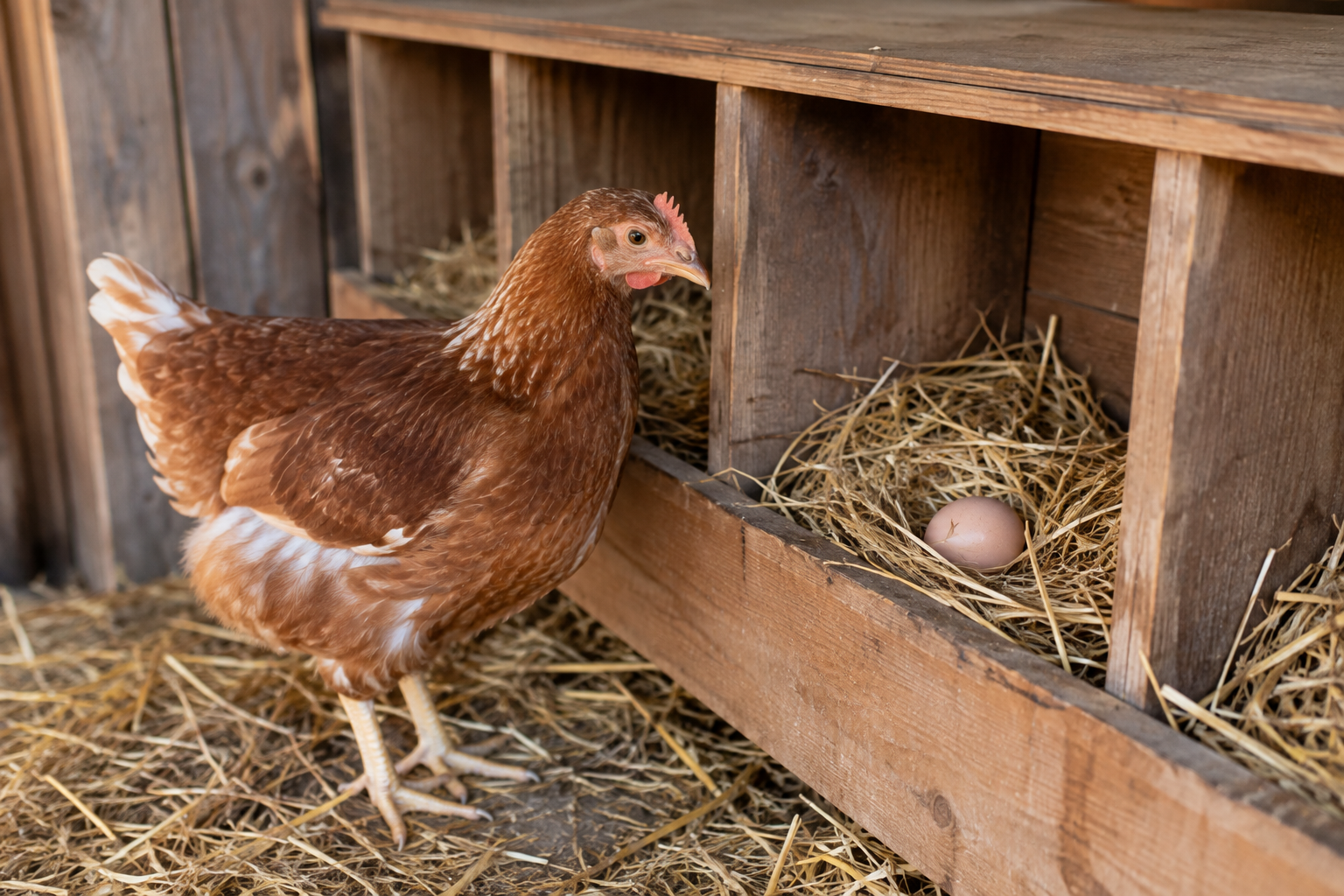
If you have a flock of young hens, waiting for that first egg can feel like it takes forever. You check the nesting boxes every morning, notice every little change in behavior, and start wondering whether today might finally be the day.
So, when do chickens start laying eggs?
Most hens begin laying somewhere around 18 to 24 weeks of age, although the exact timing depends on breed, time of year, nutrition, health, and the individual chicken. Some breeds may start a little earlier, while larger or slower-maturing breeds can take 6 months or longer.
The good news is that chickens usually give you a few clues before that first egg arrives.
What Is a Pullet?
A young female chicken that has not yet reached full maturity is commonly called a pullet.
You'll hear this term often when people talk about chickens approaching laying age. Once your pullets reach roughly four to six months old, you'll probably start watching closely for signs that egg production is getting close.
And there are several.
7 Signs Your Chicken Is Getting Ready to Lay Eggs
Your chickens cannot tell you their first egg is coming, but their bodies and behavior often can.
1. Her Comb and Wattles Become Larger and Redder
One of the easiest changes to notice is the comb.
Young pullets often have smaller, pale pink combs. As they approach laying age, the comb and wattles usually become:
- larger
- more developed
- brighter red
This change is associated with the hormonal changes happening as the reproductive system matures.
If you suddenly look at one of your pullets and think, "When did her comb get so red?" you may be getting close.
2. She Starts Checking Out the Nesting Boxes
A pullet that previously ignored the nesting boxes may suddenly become very interested in them.
You may notice her:
- walking in and out of the boxes
- sitting inside for short periods
- rearranging bedding
- scratching around
- checking several different boxes
This does not necessarily mean an egg is coming that exact day, but nesting-box curiosity is a good sign that things are moving in the right direction.
Making sure your boxes are comfortable before laying begins can also help your hens develop good nesting habits. If you're still setting yours up, read our guide on what to put in chicken nesting boxes.
3. She Begins the "Squat"
This is one of the classic signs of a pullet approaching maturity.
If you reach toward your chicken and she suddenly crouches low to the ground, holds her wings slightly away from her body, and stays still, you may be seeing what chicken keepers commonly call the submissive squat.
It often appears as a pullet reaches reproductive maturity.
Not every chicken does it, so don't worry if you never see this behavior.
4. Her Appetite May Increase
Making eggs takes a lot of resources.
As pullets approach laying age, you may notice them eating more consistently as their bodies prepare for egg production.
This is also why proper nutrition becomes especially important as chickens move into their laying stage.
Once your flock begins laying, they should have access to an appropriate complete layer feed or another feeding program designed to provide laying hens with the nutrients they need.
5. She Becomes More Vocal
Some chickens get noticeably noisier as they approach laying age.
You might hear:
- more frequent clucking
- unusual vocalizations
- pacing and talking around the nesting area
- the famous post-egg "egg song"
The first time you hear a young hen proudly announcing something from the coop, checking the nesting boxes is probably worthwhile.
6. Her Body Begins Looking More Mature
Young pullets often have a smaller, narrower appearance.
As they mature, their bodies begin filling out and taking on the shape of an adult hen.
You may notice a fuller abdomen and broader overall appearance compared with just a few weeks earlier.
7. She Starts Spending More Time Around the Coop
Pullets that previously spent most of the day exploring the run may begin returning to the coop and inspecting quiet areas.
Sometimes the first egg ends up exactly where you hoped.
Other times it ends up:
- under a roost
- behind a feeder
- in the corner of the coop
- under a bush
- somewhere else that makes absolutely no sense
Young hens are still figuring the whole process out.
What to Do Before Your Chicken Lays Her First Egg
A little preparation goes a long way once your pullets get close to laying age. A few simple things to have in place:
- Prepare clean, dry, private nesting boxes before laying starts — here's how to set up your chicken nesting boxes.
- Make sure pullets always have access to fresh water.
- Continue feeding a complete diet appropriate for their age and life stage.
- As they reach laying maturity, make sure their nutrition is appropriate for laying hens.
- Watch for secret nesting locations if birds free-range or have access to hidden areas.
Do Different Chicken Breeds Start Laying at Different Ages?
Yes.
Breed can make a noticeable difference in when a chicken begins laying.
Breeds developed heavily for egg production generally mature sooner than many larger or slower-growing breeds.
Some high-production breeds may begin around 16 to 20 weeks, while heavier heritage breeds may not begin until 22 to 28 weeks or later.
That means comparing two different breeds in the same flock is not always useful.
You may have one pullet laying regularly while another the exact same age has not produced her first egg yet.
That can be completely normal.
What Will a Chicken's First Egg Look Like?
Do not be surprised if the first few eggs look a little strange.
A young hen's reproductive system is still getting into rhythm, so early eggs may be:
- smaller than normal
- unusually shaped
- slightly wrinkled
- longer or rounder than expected
- inconsistent in size
You may even occasionally encounter an egg with an unusual shell as laying begins.
In many cases, things become much more consistent as the hen matures and establishes a regular laying cycle.
And yes, those tiny first eggs are every bit as exciting as chicken keepers make them out to be.
Why Hasn't My Chicken Started Laying Yet?
This guide is about pullets that haven't laid their first egg yet. If your hen has laid eggs before and suddenly stopped, that is a different situation — see our guide to why chickens stop laying eggs and the common causes to check.
If your chicken has reached the typical laying age but you still aren't seeing eggs, don't immediately assume something is wrong.
Several factors influence when laying begins.
Breed
As we mentioned above, some chickens simply mature later.
A six-month-old pullet from a slower-growing breed may still be perfectly within her normal developmental timeline.
Time of Year
Daylight plays an important role in egg production.
If your pullets reach maturity during late fall or winter, shorter daylight hours can delay the beginning of consistent laying.
This is one reason two chickens that are the same age can begin laying at very different times depending on when they were hatched.
Nutrition
Growing pullets need balanced nutrition as they develop.
Once hens begin laying, producing eggs requires substantial amounts of protein, calcium, energy, vitamins, and minerals.
A complete feed appropriate for the bird's age and life stage should make up the foundation of the diet rather than treats or kitchen scraps.
Stress
Changes in a chicken's environment can affect normal behavior and egg production.
Common stressors may include:
- moving to a new coop
- predator pressure
- extreme heat
- flock bullying
- overcrowding
- adding new chickens
- sudden routine changes
Giving chickens a secure, comfortable environment allows them to settle into their normal routines.
Hidden Eggs
Sometimes your chicken is laying.
You just haven't found the evidence.
If hens free-range or have access to hidden areas, check:
- underneath shrubs
- behind equipment
- inside sheds
- underneath porches
- corners of barns
- tall grass
- tucked-away areas around the coop
A determined hen can choose some surprisingly creative nesting locations.
If you are seeing mature laying behavior but finding no eggs, a secret nest is worth investigating.
How Many Nesting Boxes Do Young Hens Need?
You don't need one nesting box for every chicken.
Hens frequently decide that one particular box is the best box in the entire coop and then line up to use it while several perfectly good boxes sit empty.
What matters most is providing enough clean, comfortable nesting space for the size of your flock.
Nesting boxes should generally be:
- clean
- dry
- relatively dark and private
- easy for hens to access
- filled with appropriate nesting material
Getting the nesting area ready before your pullets begin laying can help encourage them to use the boxes instead of developing a favorite spot behind the feed bin.
What Should You Put in a Chicken Nesting Box?
The main goal is to create a comfortable place that protects eggs and encourages hens to return to the same location.
Common nesting materials include:
- pine shavings
- straw
- hemp bedding
- nesting pads
- other clean, dry bedding materials
Whatever you choose, keep the nesting area clean and replace dirty or damp material when necessary.
For a more detailed breakdown, see our guide to the best bedding, herbs, and materials to put in chicken nesting boxes.
What Happens After the First Egg?
Do not expect your new layer to immediately produce one perfectly shaped egg every morning.
Young hens commonly need time to develop a consistent laying rhythm.
You might get one egg, then nothing for two days, then another egg, then three eggs fairly close together, then another break.
Over time, production generally becomes more predictable.
The number of eggs a hen ultimately lays depends heavily on her breed, age, season, nutrition, environment, and individual biology. For a full breakdown of what to expect, see how often chickens lay eggs — per day, week, and year.
Hatching your own chicks? Most pullets need roughly 5–6 months after hatch before that first egg, so start with the Chicken Hatch Date Calculator to find hatch day, then count forward to estimate when your new layers may begin.
How Long After the First Egg Until Chickens Lay Regularly?
There is no exact timetable.
Some pullets settle into a regular pattern fairly quickly, while others take several weeks.
Early production can be inconsistent because the reproductive system is still maturing.
Rather than worrying about whether your new layer produces an egg every single day, pay attention to the overall trend.
If she is active, eating normally, behaving normally, and gradually beginning to produce eggs, she is probably just getting started.
When Should You Be Concerned?
A pullet starting later than another chicken is not automatically cause for concern.
However, it's worth taking a closer look if a chicken is well beyond the expected maturity range for her breed and you notice other signs that something may be wrong, such as:
- unusual lethargy
- significant weight loss
- persistent diarrhea
- difficulty walking
- abnormal breathing
- a dramatic change in appetite
- signs of parasites or illness
If you are concerned about a chicken's health, a veterinarian familiar with poultry can help determine whether there is an underlying issue.
The Bottom Line: When Do Chickens Start Laying Eggs?
Most chickens begin laying eggs at around 18 to 24 weeks old, but there is plenty of normal variation.
Rather than watching the calendar alone, watch your chickens.
A brightening comb, nesting-box curiosity, squatting behavior, increased vocalization, and a more mature appearance can all signal that the first egg is getting closer.
And when that first tiny egg finally appears in the nesting box, take the picture.
You've earned it.
Chicken Egg-Laying FAQ
Can chickens start laying eggs at 4 months old?
Yes. Some early-maturing chickens can begin laying at around four months, although many will take longer.
Is 20 weeks normal for a chicken to start laying?
Yes. Around 20 weeks falls right in the common laying window for many breeds.
Can a chicken take 7 months to lay its first egg?
Yes. Some slower-maturing breeds can take six or seven months or longer, especially if they reach maturity when daylight hours are decreasing.
Do chickens lay eggs immediately after they start squatting?
Not necessarily. The submissive squat can be a sign that a pullet is approaching reproductive maturity, but it does not give you an exact countdown to the first egg.
Why is my 6-month-old chicken not laying?
Breed, season, nutrition, stress, individual maturity, and hidden nesting spots can all play a role. First determine what is typical for your chicken's breed and look for other signs that she is approaching maturity.
Are first eggs smaller?
Often, yes. A pullet's first eggs are commonly smaller than the eggs she will produce once fully mature.
Do chickens need a rooster to start laying eggs?
No. Hens lay eggs whether or not a rooster is present. A rooster is only necessary if you want the eggs to be fertilized for hatching.
Have a pullet getting close? Estimate her first-egg window with the First Egg Calculator →
Keep Reading
Planning the budget first? How Much Do Chickens Cost? Chicks, Coop Setup & Monthly Costs
Wondering how many eggs to expect? How Often Do Chickens Lay Eggs? Daily, Weekly & Yearly Expectations
Raising a slower-maturing breed? Silkie Chickens: Eggs, Temperament, Lifespan & Complete Care Guide