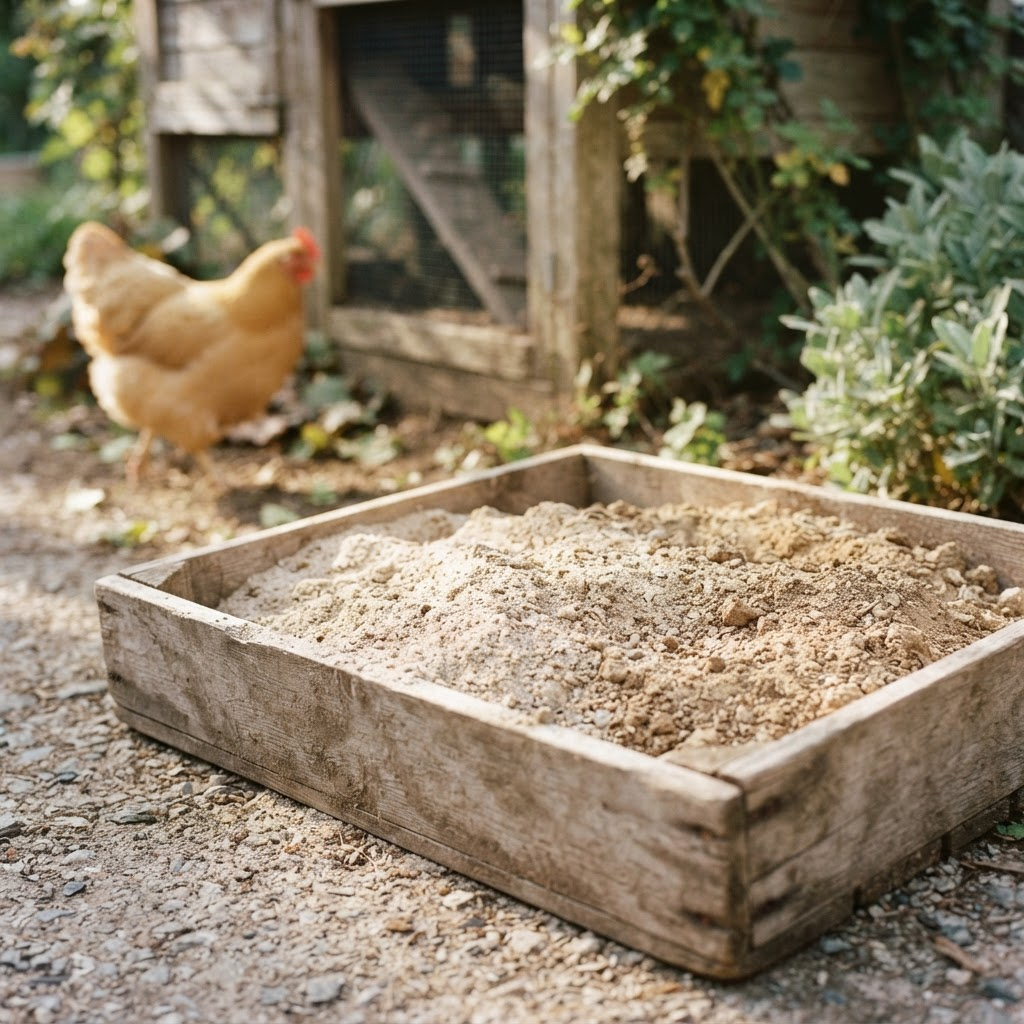
Walk into the sand aisle at a home-improvement store and a simple chicken project suddenly gets confusing.
Play sand.
All-purpose sand.
Masonry sand.
Concrete sand.
Paver sand.
River sand.
Fine sand.
Coarse sand.
They all look close enough in the bag.
But are they actually interchangeable for a chicken dust bath?
Not quite.
The best sand for a chicken dust bath isn't determined by a magic product name. What matters more is whether the sand is clean, dry, loose, appropriately sized, and low enough in loose fines that it doesn't create an unnecessary cloud every time your hens start kicking.
Sand Choices at a Glance
| Sand Type | Would I Use It? | What to Know |
|---|---|---|
| Washed construction/concrete sand | Good choice | Mixed particle sizes, generally drains well |
| Washed all-purpose sand | Usually | Product varies, so inspect texture and dustiness |
| Washed play sand | Can work | Not automatically unsafe; choose a clean product that isn't excessively dusty |
| Masonry sand | Depends | Often finer; avoid if it behaves like powder |
| River sand | If clean | Natural mixed grains can work well if uncontaminated |
| Very fine/powdery sand | Not my first choice | More airborne fines and not proven to be better |
| Polymeric paver sand | No | Contains binding additives designed to harden |
| Beach sand | Not ideal | Salt, debris, and contamination can be unpredictable |
| Sand contaminated with chemicals | No | Keep fertilizers, pesticides, oils, and other contaminants out of the bath |
The important word in several of those descriptions is washed.
We'll come back to why.
Why Do Chickens Like Sand for Dust Bathing?
Because sand has several physical characteristics that work well with the behavior.
When a chicken dust bathes, she scratches a depression, settles into the substrate, rolls onto her side, kicks material underneath her wings, works particles through her feathers, and eventually stands up and shakes everything back out.
Merck Veterinary Manual describes chickens naturally dust bathing in soft, dry material such as dirt, sand, and wood shavings. The substrate helps absorb excess oils from the skin and feathers.
Sand works particularly well because appropriately sized particles can move between the feathers instead of simply sitting on top.
And chickens appear to agree.
Do Chickens Actually Prefer Sand?
The research says sand is one of their preferred dust-bathing substrates.
A 2020 meta-analysis examining floor-substrate preferences found that chickens preferred sand and peat moss for dust bathing more than the other substrates analyzed.
The European Food Safety Authority reached a similar conclusion in its review of laying-hen welfare research, noting that hens generally prefer fine-structured materials such as sand or peat over larger-particle substrates such as straw or wood shavings.
So using sand isn't simply backyard-chicken tradition.
There is good behavioral evidence behind it.
What Makes Sand Good for a Chicken Dust Bath?
I would evaluate sand based on five characteristics.
1. It should be dry
Dust bathing doesn't work particularly well in a mud pit.
EFSA notes that when litter becomes too wet or caked, chickens may be unable to perform functional dust-bathing behavior.
2. It should stay loose
Your hen has to be able to scratch, dig, roll, and kick through it.
Material that packs into a hard layer isn't doing the job well.
3. It needs smaller particles
Dust-bathing material needs particles small enough to move through the plumage.
EFSA's review concluded that good dust-bathing substrates contain small particles capable of getting between feathers.
But — and this is important — that does not mean the finer the sand, the better.
4. It shouldn't behave like flour
If pouring the sand creates a giant airborne cloud, I don't consider that an advantage.
You want material your chicken can bathe in. Not material that disappears into the air.
5. It should be clean
Avoid material contaminated with:
- pesticides
- fertilizer
- oil
- chemicals
- mold
- animal waste
- unknown industrial residue
A dust bath puts the material directly against the bird's skin, feathers, eyes, and respiratory environment.
Keep it simple.
What Is the Best Sand for a Chicken Dust Bath?
For the average backyard flock, my practical choice would be clean, washed construction or all-purpose sand with mixed grain sizes.
Why?
Because it generally gives you a useful balance:
- small enough particles to work through feathers
- larger grains that keep the substrate open and loose
- better drainage than extremely fine material
- less of the flour-like feel that some very fine sands can have
I would mix it with ordinary clean, dry soil rather than filling the entire bath with sand.
A simple starting point is:
If your native soil is already loose and sandy? You may need less added sand.
If you have heavy clay soil that packs into hard clumps? You may want more.
Let the finished texture guide you.
What Grain Size Is Best for a Chicken Dust Bath?
This is where a lot of chicken advice becomes more confident than the actual evidence.
There is not currently a scientifically established ideal grain-size range for backyard chicken dust baths.
EFSA notes that sand used in studies has ranged from very fine particles below 0.03 mm up to coarse sand around 2 mm, but the existing research doesn't establish one optimum size.
The major chicken substrate meta-analysis reached a similar problem: most studies simply didn't report enough information about grain size to determine exactly how it affects preference.
So I wouldn't tell you "chicken dust-bath sand must be exactly 0.7–1.4 mm."
We don't have evidence for that.
Is Finer Sand Always Better?
No.
And this is a particularly interesting part of the research.
A 2014 laying-hen preference study tested several loose substrates, including rough construction sand at approximately 0.5–5 mm and fine shell sand with particles smaller than 0.5 mm.
The very fine shell sand was actually the least preferred material for dust bathing, pecking, and scratching among the four loose substrates tested.
That doesn't prove that construction sand between 0.5–5 mm is the universal perfect chicken substrate.
Different properties besides particle size were involved.
The researchers specifically discussed particle size, material density, particle heterogeneity, and how long material remained in the feathers as possible influences on hen preference.
But the study gives us a useful reality check:
That's why I like a natural mixed-grain sand rather than an ultra-fine powder.
Construction Sand vs. Play Sand
This is probably the comparison most backyard keepers actually care about.
Construction Sand
Labels vary. You may see construction sand, concrete sand, builder's sand, or coarse sand.
These products often contain a broader range of grain sizes than very finely screened products.
A mixed texture can be useful for keeping a soil-and-sand bath loose.
Play Sand
This gets unfairly simplified online.
You'll sometimes see "never use play sand for chickens."
I don't think the evidence supports a universal statement like that.
In fact, current Merck Veterinary Manual guidance describing studied poultry parasite dust boxes specifically references washed play sand as the sand component used with food-grade diatomaceous earth.
That doesn't mean every bag of play sand is identical.
It means "play sand" itself is not automatically disqualified.
Look at the actual product.
If it is clean, washed, relatively low in loose airborne dust, and stays loose when dry, it can function as a dust-bathing substrate.
So Why Do I Still Prefer Washed Construction Sand?
Because I like the broader texture for a backyard soil-and-sand mixture.
Very uniformly fine sand isn't necessary.
And the 2014 preference research gives us some reason not to assume an extremely fine product is automatically superior.
So if I'm standing in the store choosing between a very powdery-feeling fine sand and a washed mixed-grain construction sand, I'm taking the latter.
But I'm making that recommendation based on practical substrate characteristics — not because the word *construction* is magically healthier for chickens.
What Does "Washed Sand" Mean?
Washing removes some of the silt, clay, extremely fine particles, and debris from processed sand.
That can make the finished material cleaner and less prone to behaving like dusty powder.
It doesn't mean washed sand contains zero fine particles.
Nor does it guarantee that every washed product is identical.
But washed is a useful thing to look for when you're comparing bags.
What About Silica in Sand?
This needs the same nuance as our discussion of diatomaceous earth.
Crystalline silica is a natural component of many sands and rocks.
OSHA notes that sand, stone, concrete, and mortar commonly contain crystalline silica.
But ordinary grains of sand are not the same thing as respirable crystalline-silica dust.
OSHA describes respirable crystalline silica as particles at least roughly 100 times smaller than ordinary sand grains, commonly generated during activities such as cutting, grinding, drilling, crushing, and abrasive blasting.
Heavy occupational exposure to respirable crystalline silica is associated with serious diseases including silicosis, lung cancer, COPD, and kidney disease.
That doesn't mean "sand is dangerous to chickens because it contains silica." That would be an enormous oversimplification.
Sand is literally one of the substrates chickens consistently prefer for dust bathing.
The practical lesson is simpler: minimize unnecessary airborne fines.
Don't deliberately choose an excessively powdery substrate. Don't create huge dust clouds while pouring it. And provide reasonable ventilation.
What About Sand That Says "Silica Sand"?
Again, the important issue is the physical product and exposure, not simply whether the mineral quartz exists in it.
Most natural sand contains some crystalline silica.
What I care about in a chicken dust bath is whether the product is clean, appropriate for ordinary consumer use, not contaminated, not chemically treated, and not full of loose respirable-looking dust.
If a sand is intended for specialized industrial blasting or another application that creates or involves large amounts of fine dust? That's not what I would buy for chickens.
Can You Use Masonry Sand?
Possibly.
Masonry sand is typically more finely screened than concrete-type sand.
That can create a nice smooth substrate.
But products vary. I would physically inspect it.
If it feels like sand, fine. If it pours like powder, I'd choose something with a broader particle distribution.
The label alone isn't enough.
Can You Use River Sand?
Clean river sand can work.
Natural river sand often contains a range of rounded particles.
But make sure you know where it came from.
I wouldn't scoop material from an unknown drainage channel, roadside ditch, or potentially contaminated waterway and dump it into the coop.
Bagged washed material removes a lot of uncertainty.
Can You Use Beach Sand?
It wouldn't be my first choice.
Beach sand may contain salt, shells, organic matter, debris, and contaminants depending on where it comes from.
Could thoroughly cleaned sand function as sand? Of course.
But when clean bagged material is inexpensive and predictable, I don't see much benefit to introducing the extra variables.
Avoid Polymeric Paver Sand
This one is straightforward.
Polymeric sand is not ordinary loose sand.
It's designed with additives that bind when activated, helping lock paving joints together.
That's the opposite of what we want.
Your chicken's dust bath needs to remain loose, diggable, and friable — not turn into landscaping material.
Skip polymeric sand.
Avoid Sand With Unknown Additives
I would also skip products containing fragrances, chemical treatments, binding agents, unknown recycled material, fertilizers, or pesticides.
You don't need any of it.
This is dirt for chickens to roll around in. Simple is good.
Should You Use Only Sand in a Chicken Dust Bath?
You can.
But for a backyard setup, I usually prefer soil + sand rather than 100% sand.
Why?
Natural soil gives the bath additional fine material, a more natural texture, and variation in particle size, while sand helps loosen heavy soil, improve drainage, and reduce compaction.
Together, they make a very practical base.
And this is important: the sand is part of the dust bath. It does not need to become the entire dust bath.
How Deep Should the Sand Be?
There isn't a research-backed backyard number you must hit.
Instead, think about what the hen needs to do.
She needs enough substrate to scratch a depression, settle into it, roll onto her side, kick material through her feathers, and toss a surprising percentage of your carefully prepared mixture outside the container.
A few inches of loose substrate is generally far more useful than a thin layer over a hard bottom.
If your hens immediately hit plastic or wood as soon as they start scratching? Add more.
Keeping the Sand Dry Matters More Than Finding the Perfect Brand
You could buy the world's greatest chicken dust-bath sand.
Leave it underneath a roof drip.
Now you have mud.
Dust bathing requires dry, friable substrate.
EFSA specifically notes that wet or caked litter prevents chickens from performing functional dust-bathing behavior normally.
So prioritize a covered location, good drainage, protection from roof runoff, removing persistently wet material, and loosening compacted areas — before obsessing over whether Brand A's sand is slightly better than Brand B's.
What If the Sand Keeps Packing Down?
First determine why.
It's getting wet
Fix the shelter or drainage.
Your soil is very clay-heavy
Increase the sand proportion.
The container doesn't drain
Move it or modify the setup.
Organic debris has built up
Remove contaminated or decomposing material.
Don't immediately add more exotic ingredients. Fix the physical problem first.
Where Does Zen Dust Fit?
After the base is right. That's the important part.
Zen Dust isn't designed to replace the soil or sand in your chicken's dust-bathing area.
Think soil + sand = the bath, then Zen Dust = an optional botanical addition.
Zen Dust combines kaolin clay with dried botanicals and can be worked lightly into the top of the existing bathing substrate.
But I would never tell someone to fix a wet, poorly drained, compacted dust bath by adding Zen Dust.
Build the bath correctly first. Then decide what extras belong in your routine.
Do You Need Anything Besides Soil and Sand?
Not necessarily.
A chicken can perform normal dust-bathing behavior with a very simple substrate.
That's something I want Roosted's dust-bath content to stay consistent about.
You do not need eleven ingredients, a complicated Pinterest recipe, or a bag of every powder in the feed store.
Start with dry soil + good sand. Then make intentional additions only when you understand what they're for.
If you're considering diatomaceous earth specifically, read Diatomaceous Earth in Chicken Dust Baths: Does It Work, Is It Safe & Should You Use It?.
A Simple Sand-Buying Checklist
Standing in the store? Use this.
Look for:
- Clean sand
- Washed if available
- Mixed fine-to-medium grain texture
- Loose when dry
- Minimal visible loose powder
- No chemical additives
- No polymeric binders
- No obvious contamination
Skip:
- Material that pours like flour
- Polymeric paver sand
- Industrial blasting media
- Chemically treated products
- Unknown recycled material
- Wet or moldy material
- Anything you're unsure about
You don't need a bag that says CHICKEN DUST BATH SAND on the front.
You need sand with the right physical characteristics.
The Bottom Line: What Is the Best Sand for a Chicken Dust Bath?
If I were setting up a backyard dust bath today, I'd choose clean, washed construction or all-purpose sand with a natural mix of fine-to-medium particles.
Then I'd mix it with clean, dry soil.
I would not chase the finest sand I could find.
Research tells us chickens prefer fine-structured dust-bathing substrates such as sand and peat, but it does not establish one perfect grain size.
And at least one controlled preference study found extremely fine shell sand under 0.5 mm less attractive than other tested loose substrates, including a rougher construction sand containing particles from approximately 0.5–5 mm.
So think small enough to work through feathers but substantial enough to remain a useful, loose substrate.
Then keep it dry.
That's considerably more important than finding a magical bag of "chicken sand."
Chicken Dust-Bath Sand FAQ
What kind of sand is best for a chicken dust bath?
A clean, washed construction or all-purpose sand containing a mix of fine-to-medium particles is a good practical choice. Mixing it with clean, dry soil creates a useful everyday dust-bathing base.
Is play sand safe for chicken dust baths?
Play sand is not automatically unsuitable. Merck Veterinary Manual cites poultry studies using washed play sand in chicken dust boxes. Products vary, so choose clean material that isn't excessively powdery.
Should I use fine or coarse sand for chickens?
Neither extreme is ideal as a blanket rule. Chickens generally prefer relatively fine-structured substrates, but the evidence does not establish one perfect grain size. I prefer a mixed-grain sand containing smaller particles without behaving like loose powder.
Is construction sand safe for chickens?
Clean, washed construction sand can make a good dust-bathing substrate. A controlled laying-hen preference study included rough construction sand with particles ranging approximately 0.5–5 mm. Avoid assuming every construction product is identical — check the label and material.
Can chickens use plain dirt for a dust bath?
Yes. Chickens naturally create dust baths in soft, dry dirt. Sand is useful because it can help loosen heavy soil and improve the physical texture of a dedicated bathing area.
Is silica sand dangerous for chickens?
Most natural sand contains crystalline silica. The established serious human health hazard involves inhaling respirable crystalline-silica particles, particularly in occupational situations where materials are cut, ground, drilled, or crushed. For a chicken dust bath, choose clean sand that doesn't contain excessive loose fines and minimize unnecessary airborne dust.
Can I use masonry sand?
Potentially. Because masonry sand is often relatively fine, inspect the actual material. If it remains loose and sandy rather than creating excessive powder, it may be suitable.
Can I use beach sand?
It wouldn't be my first choice because salt, organic debris, and contamination can be unpredictable. Clean bagged sand is usually easier to evaluate.
Can I use paver sand?
Ordinary loose sand may vary, but avoid polymeric paver sand, which contains binding additives designed to harden.
How much sand should I mix with dirt?
There is no scientifically established backyard ratio. A simple starting point is roughly equal parts sand and dry soil, then adjust based on your native soil and how the bath behaves.
Does Zen Dust replace sand?
No. Zen Dust is designed as an optional addition to an existing dust-bathing substrate. Your soil and sand create the bath itself.
Keep Reading
Build the complete bath: Chicken Dust Bath: What to Put In It, How to Make One & What to Avoid
Considering DE? Diatomaceous Earth in Chicken Dust Baths: Does It Work, Is It Safe & Should You Use It?
Need something to hold the bath? Chicken Dust Bath Container Ideas: 10 Easy DIY Setups
Seeing feather loss? Why Is My Chicken Losing Feathers? Molting vs. Other Common Causes