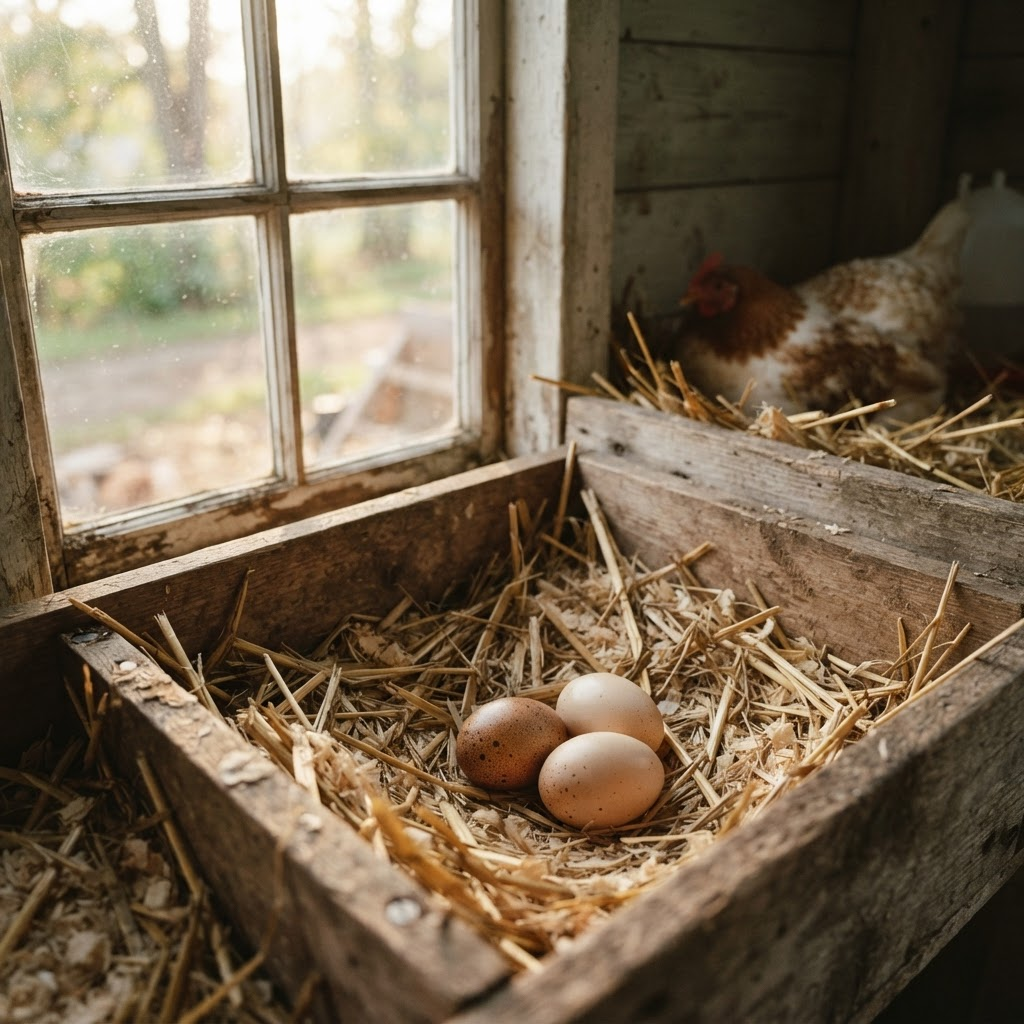
If you've ever checked the nesting boxes first thing in the morning and found nothing, then come back a couple of hours later to a full basket, you've already seen how chicken egg-laying works.
Most hens don't lay at exactly the same time every day.
But they also aren't completely random.
In general, most chicken eggs are laid during the morning, with many backyard flocks producing the majority of the day's eggs by late morning. Penn State Extension notes that most flocks lay a majority of their eggs by around 10:00 a.m.
Egg-Laying Time at a Glance
| Time of Day | What You May See |
|---|---|
| Early morning | Some hens begin laying soon after daylight |
| Mid-morning | Usually the busiest nesting-box period |
| Late morning | Many flocks have produced most of the day's eggs |
| Around noon | Still completely normal for some hens |
| Afternoon | Less common, but healthy hens can absolutely lay later |
| After dark | Not the usual pattern for laying hens |
The important thing is not whether every hen follows the same clock.
It's whether her pattern makes sense over time.
What Time Do Chickens Usually Lay Eggs?
For most backyard flocks, morning is prime egg-laying time.
Penn State Extension says most flocks will lay the majority of their eggs by about 10:00 a.m., while University of Maine Extension notes that changing when hens receive light can shift how many eggs are produced before noon.
That doesn't mean you should expect every hen to walk into a nesting box at 8:17 every morning.
A flock might look more like this:
| Hen | Monday | Tuesday | Wednesday |
|---|---|---|---|
| Hen A | 7:30 AM | 8:30 AM | 9:30 AM |
| Hen B | 9:00 AM | 10:15 AM | 11:15 AM |
| Hen C | 10:30 AM | 11:30 AM | No egg |
| Hen D | 8:15 AM | 9:15 AM | 10:30 AM |
That's much closer to how biological systems behave.
Why Do Chickens Usually Lay Eggs in the Morning?
Part of the answer comes from the hen's egg-production cycle.
An egg takes approximately 24 to 26 hours to form and move through the reproductive tract. During that process, the yolk moves through the oviduct while the albumen, membranes, and shell are added.
Much of that process happens while the hen is resting overnight. University of New Hampshire Extension describes much of egg formation as occurring overnight, which helps explain why nesting boxes are often busy in the morning.
Light also plays an important role in the reproductive cycle.
Hens respond strongly to photoperiod — the amount and timing of daylight — which is why seasonal changes can influence both egg production and laying patterns.
So morning laying isn't just a habit.
It's connected to the hen's internal biological rhythm.
Why Does My Hen Lay Later Every Day?
This is one of the most useful things to understand about chicken egg production.
A hen's body takes slightly longer than one day to complete an egg.
So if she lays at 7:30 a.m. Monday, she might lay at 8:30 a.m. Tuesday, then 9:45 a.m. Wednesday, then 11:00 a.m. Thursday.
Eventually her reproductive timing shifts far enough that she doesn't ovulate for the next day's egg during the appropriate biological window.
She skips a day.
Then the next laying sequence may begin earlier again.
Research on avian reproduction describes this pattern: successive ovulations occur slightly later until the hen misses the daily ovulatory window, resulting in a pause day.
Can Chickens Lay Eggs in the Afternoon?
Yes.
An afternoon egg is not automatically unusual.
Although chickens generally lay more eggs in the morning than the afternoon, individual hens can lay later depending on where they are in their laying sequence. Historical poultry research has long documented that morning laying is more common overall, not that afternoon laying never occurs.
This is especially easy to notice when you're tracking one specific hen.
She may begin a sequence early in the morning and then gradually move later over the next several days.
So finding an egg at 1:00 p.m. or 2:30 p.m. doesn't automatically mean anything is wrong.
It's the overall pattern that matters.
Do Chickens Lay Eggs at Night?
Usually, no.
Most egg laying occurs during daylight hours.
The hen's reproductive cycle is tied to her daily light-dark rhythm, and the timing of ovulation is influenced by that circadian system.
That means the normal pattern is roost and rest at night, become active after daylight, then use the nesting box during the day — rather than laying eggs while sleeping on the roost.
If you find an egg underneath the roost first thing in the morning, it's worth considering whether it was actually laid there very early or whether a young pullet is still figuring out where to lay.
If your birds are just reaching maturity, see When Do Chickens Start Laying Eggs? Age, Signs & What to Expect.
What Determines What Time a Hen Lays Her Egg?
Several things can shift a hen's laying schedule.
| Factor | How It Can Affect Timing |
|---|---|
| Where she is in her laying sequence | Successive eggs may come later each day |
| Light schedule | Earlier artificial morning light can shift more laying before noon |
| Season | Changing daylight can alter reproductive patterns |
| Age | Young pullets may have less predictable early laying patterns |
| Breed/genetics | Individual laying rhythms vary |
| Stress | Changes in routine or environment can disrupt normal behavior |
| Broodiness | A broody hen may stop laying altogether |
| Molting | Production may slow or stop during a major molt |
Not every change in egg timing is important.
But if egg timing changes along with a major reduction in production or changes in the hen's behavior, it's worth paying closer attention.
Does Artificial Light Change What Time Chickens Lay Eggs?
It can.
University of Maine Extension specifically notes that the earlier supplemental lights come on in the morning, the more eggs tend to be laid before noon.
That's one reason two identical flocks can have different laying schedules if they're managed under different lighting programs.
For backyard keepers using natural light only, sunrise and seasonal day length become much more influential.
For keepers using supplemental winter lighting, the artificial "morning" effectively becomes part of the hen's biological day.
That doesn't mean you should start changing lighting merely to get earlier eggs.
It just explains why lighting can influence when the nesting boxes get busy.
What Time Should You Collect Chicken Eggs?
I wouldn't build your routine around one exact clock time.
Instead, think late morning plus later in the day.
Penn State recommends collecting eggs early and often, noting that most eggs have been laid by around 10:00 a.m. and that collecting at least twice daily is advisable, particularly during extreme temperatures.
A practical backyard routine could be:
- Late morning: collect the main batch after most hens have laid.
- Late afternoon: collect again before evening chores are finished.
That gives you a good chance of catching both the morning layers and any hens running later in their laying sequence.
Why Collect Eggs More Than Once a Day?
The longer eggs remain in the nesting box, the more opportunity there is for them to become:
- dirty
- cracked
- stepped on
- broken
- exposed to excessive heat or cold
- discovered by a hen that develops an egg-eating habit
Penn State specifically recommends frequent collection because eggs left longer in the nest are more likely to become dirty, broken, or lose interior quality.
This matters even more when every hen in the flock has decided one specific nesting box is the best box in existence.
Should You Collect Eggs More Often in Summer?
In very hot weather, more frequent collection is reasonable.
Eggs sitting inside a hot nesting box can be exposed to high temperatures for hours, particularly if your coop heats up during the afternoon.
Arizona Cooperative Extension recommends collecting eggs frequently — at least once or twice daily — to reduce exposure to heat, cold, and moisture.
And while you're checking those boxes, pay attention to the hens too.
If summer temperatures are high, our guide to keeping chickens cool and recognizing heat stress covers what to watch for.
What About Winter?
Cold weather gives you the opposite problem.
Eggs can freeze.
University of Alaska Fairbanks Extension notes that collecting eggs at least twice daily is advisable and that more frequent collection may be necessary during winter extremes to prevent freezing.
So the ideal collection routine isn't exactly the same in August as it is in January.
That's another reason I prefer know your flock plus know your weather over one rigid rule.
How Long Does a Hen Stay in the Nesting Box Before Laying?
This varies.
Some hens walk in, get comfortable, lay, announce the event to everyone within hearing distance, and leave.
Others seem to be making a full morning appointment out of it.
The time a hen spends sitting in the nest before laying doesn't necessarily tell you how close the egg is.
What matters more is whether she eventually lays normally and leaves the nest.
A hen that remains committed to sitting for long periods, becomes defensive, flattens herself over the nest, and keeps returning even after eggs are removed may be becoming broody, which is a different behavior altogether.
Why Are My Hens Lining Up for One Nesting Box?
Because apparently identical nesting boxes are not actually identical to chickens.
One box may feel darker, quieter, more protected, easier to enter, better positioned, or already "approved" by another hen.
Once a flock develops a favorite box, morning laying time can look like a checkout line.
If your nesting setup needs work, our Chicken Nesting Box Guide covers size, dimensions, quantity, height, and placement.
Does the Time of Day Tell You Which Hen Laid Which Egg?
Sometimes.
If you regularly observe your flock, individual hens may develop recognizable patterns.
You may learn that the brown hen lays early, the blue-egger usually lays around 10, and one hen runs late.
But don't expect it to remain perfectly predictable.
Because the laying cycle shifts, a hen's timing can move later from one day to the next.
Egg color, shape, and size are often more useful clues when trying to identify which hen produced which egg.
What If My Hen Suddenly Starts Laying Much Later?
One late egg isn't meaningful by itself.
Look at the bigger picture.
If she's still eating normally, active, maintaining normal body condition, using the nesting box, and producing eggs at roughly her usual frequency, a change in laying time may simply reflect her normal cycle.
But if later laying happens alongside a significant drop in egg production, you'll want to consider season, molt, broodiness, stress, nutrition, hidden nests, or illness.
Our guide to why chickens stop laying eggs walks through the major causes.
What Time Do Pullets Lay Their First Eggs?
There isn't a special "first egg hour."
A pullet can produce her first egg at different points during the day.
Early laying patterns may also be less predictable while her reproductive system settles into a normal rhythm.
So if your pullets look ready and the nesting boxes are still empty at 9:00 a.m., don't assume today isn't the day.
Check again later.
If you're waiting for that milestone, see When Do Chickens Start Laying Eggs? Age, Signs & What to Expect.
How Does This Connect to How Often Chickens Lay?
The two questions are closely related.
How often a hen lays tells you her production frequency.
What time she lays reflects where she is inside that roughly 24–26 hour egg-production rhythm.
Because each egg takes slightly longer than one day to complete, frequency and timing naturally affect one another.
For the full explanation of daily, weekly, and yearly production, read How Often Do Chickens Lay Eggs? Daily, Weekly & Yearly Expectations.
The Bottom Line
Most chickens lay their eggs during the morning, and many backyard flocks will have produced the majority of the day's eggs by late morning.
But don't expect every hen to follow the exact same schedule.
An egg takes roughly 24–26 hours to form, which means a hen may lay progressively later over several days until she eventually pauses and begins a new laying sequence.
So if your hen lays at 8 a.m. one day, then 9 a.m., then 10:30 a.m., that's not necessarily strange.
That's chicken biology doing what chicken biology does.
Learn the rhythm of your own flock, check the nesting boxes more than once when practical, and use changes in the overall pattern — not one late egg — as your guide.
Chicken Egg-Laying Time FAQ
Do chickens lay eggs at the same time every day?
Usually not. Because an egg takes roughly 24–26 hours to form, a hen's laying time can shift slightly later from one day to the next.
What time do most chickens lay eggs?
Most eggs are laid during the morning. Penn State notes that most flocks lay the majority of their eggs by around 10:00 a.m.
Can a chicken lay an egg in the afternoon?
Yes. Afternoon laying is less common overall than morning laying, but it can be completely normal for an individual hen.
Can chickens lay eggs at night?
Nighttime laying is not the usual pattern. Egg production is tied to the hen's daily light-dark cycle, and eggs are normally laid during daylight hours.
Why does my chicken lay later each day?
Because each egg takes slightly longer than 24 hours to produce. Successive ovulations occur later until the hen eventually misses the daily ovulation window and takes a pause day.
What is the best time to collect eggs?
Late morning is a useful first collection because many eggs have already been laid. A second collection later in the day helps catch afternoon layers and reduces how long eggs sit in the nest.
How many times a day should I collect chicken eggs?
Collecting at least twice daily is advisable, particularly during extreme hot or cold weather.
Do chickens lay earlier if the lights come on earlier?
Supplemental lighting can shift laying patterns. University of Maine Extension notes that earlier morning lighting results in more eggs being laid before noon.
Keep Reading
Want to know how many eggs to expect? How Often Do Chickens Lay Eggs? Daily, Weekly & Yearly Expectations
Waiting for the first egg? When Do Chickens Start Laying Eggs? Age, Signs & What to Expect
Production suddenly changed? Why Are My Chickens Not Laying Eggs? 8 Common Reasons to Check
Setting up the laying area? Chicken Nesting Boxes: Size, Dimensions, How Many You Need & Where to Put Them