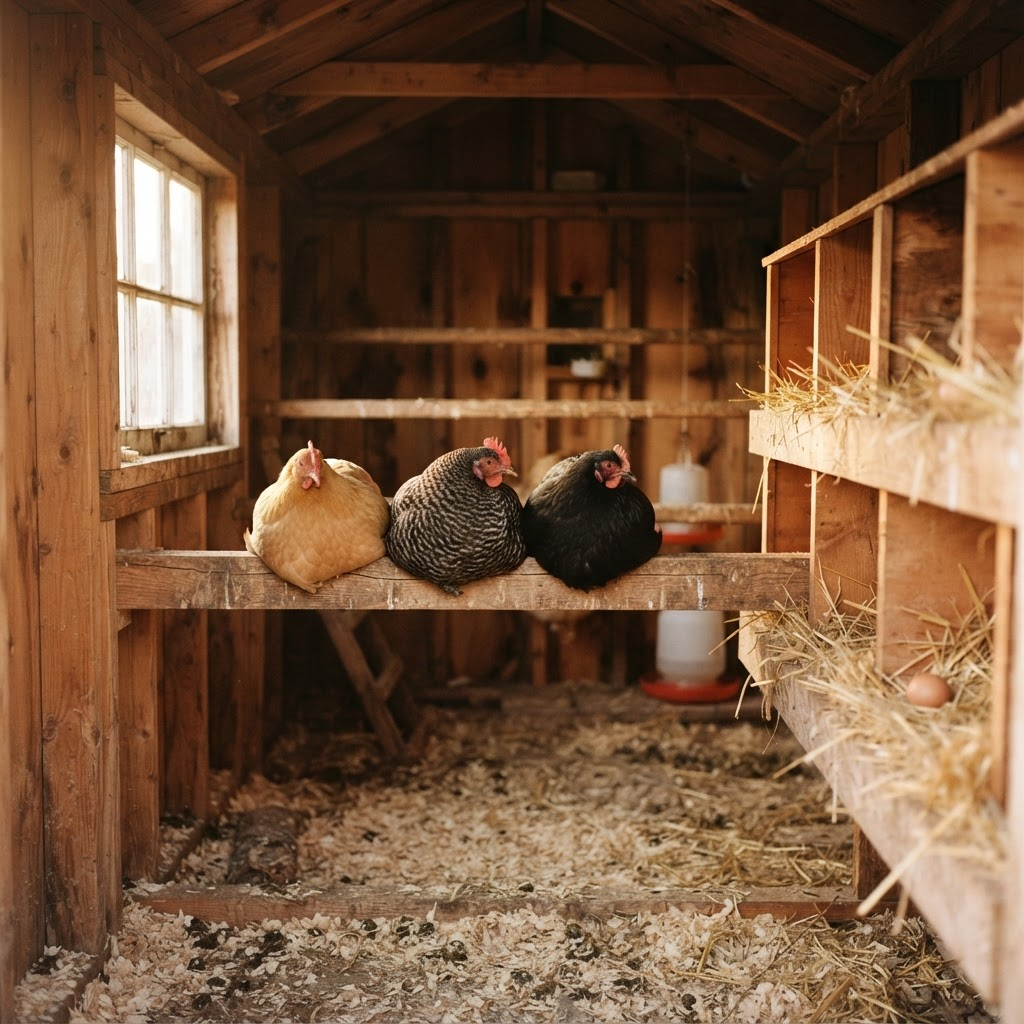
You walk into the coop first thing in the morning and immediately know what happened.
The nesting boxes are full of droppings. The bedding is flattened. And one or more hens clearly spent the night where they're supposed to *lay eggs*.
It's frustrating — but it's also useful information.
Chickens are strongly motivated to perch at night. If they're consistently choosing a nesting box instead, something about the roost, flock dynamics, or coop layout is often making the nest box feel like the better sleeping spot.
The good news? This is usually a management problem you can fix.
Why Sleeping in Nesting Boxes Matters
A chicken sleeping in a nesting box isn't automatically a health emergency. The bigger problem is what happens overnight.
Chickens produce manure while they sleep. So a hen spending eight hours inside the nesting box can leave droppings directly in the bedding where eggs will be laid the next morning. That can mean dirty eggs, more frequent nest-box cleaning, contaminated bedding, cracked or soiled eggs, and more work for you.
Penn State specifically recommends keeping roosts away from nesting areas because sleeping birds can quickly contaminate nesting boxes and contribute to dirty and broken eggs.
The goal is simple: nesting boxes are for laying, and roosts are for sleeping.
Chickens Sleeping in Nesting Boxes: Causes at a Glance
| Possible Cause | What to Check | Practical Fix |
|---|---|---|
| Roost is too low | Nest box is as high or higher | Raise the roost |
| Not enough roost space | Birds packed together at night | Add more perch length |
| Roost is uncomfortable | Thin, slippery or unstable perch | Improve perch design |
| Roost is hard to reach | Heavy/young birds struggle to get up | Lower it or add a ramp |
| Draft hits the roost | Strong airflow at sleeping height | Redirect the draft |
| Bullying | Same bird repeatedly displaced | Add roost space / escape options |
| Young birds | Pullets recently moved into coop | Establish a consistent roosting routine |
| Poor coop layout | Nest boxes are the safest/highest location | Rework roost/nest placement |
| Habit | Setup is fixed but behavior continues | Temporarily block nests after laying |
Why Do Chickens Want to Roost at Night?
Chickens don't sleep on perches because humans trained them to. Perching is part of their natural behavior.
The Merck Veterinary Manual describes perching as a highly motivated behavior and notes that chickens are especially motivated to perch at night because elevated sleeping positions historically provided protection from predators. That's why healthy adult chickens usually seek an elevated sleeping location when one is available.
University of Maryland Extension puts it simply: chickens tend to roost on the highest point available inside the house. That fact explains a lot of nesting-box problems.
If your nesting box is higher, easier to reach, more enclosed, or more comfortable than the roost, the chicken isn't being stubborn. She may simply be choosing what looks like the best overnight sleeping location.
Cause #1: The Roost Is Too Low
This is probably the first thing I'd inspect. Chickens generally prefer elevated sleeping locations, so if the top edge or interior of the nesting box feels higher than the roost, you've unintentionally created competition between the two.
University of Maryland Extension specifically recommends keeping roosts higher than the nesting boxes because hens tend to select the highest available perch.
That doesn't mean the roost should be dangerously high. Penn State's current small-flock guidance recommends standard chicken roosts around 18–24 inches above the floor, while Oregon State gives a general recommendation around two feet for many backyard setups. Breed matters, too — very heavy or less agile birds may need lower roosts.
How to Check
Stand inside the coop and compare roost height to nesting-box height. Then ask: which one looks like the higher, safer sleeping location to a chicken? If the answer is the nesting box, I'd start there.
Cause #2: There Isn't Enough Roost Space
Maybe the roost is perfectly positioned, but there simply isn't room for everybody.
At sunset, chickens usually begin arranging themselves along the roost, and flock hierarchy matters. The dominant hens aren't necessarily going to politely divide the perch into equal sections. Merck describes chickens as highly social animals that establish a stable dominance hierarchy — the familiar pecking order. If lower-ranking birds repeatedly get pushed off the perch, the nesting boxes may become their backup sleeping area.
How Much Roost Space Do Chickens Need?
Recommendations vary somewhat. Penn State recommends approximately 6 inches of perch space per standard chicken. University of Minnesota recommends around 9 inches per chicken for winter roosts so birds have enough space without overcrowding. Oregon State gives a broader range of approximately 5–10 inches per bird.
For a normal backyard flock, I'd rather provide extra roost space than design around the absolute smallest number.
For example, six hens with only 3 feet of perch have just 6 inches each (36 inches ÷ 6). That may technically meet some recommendations, but adding more room gives birds options. If you have mixed breeds, large-bodied hens, bullying, or multiple roosting preferences, I'd rather build longer.
Cause #3: The Roost Is Uncomfortable
Height doesn't matter much if the perch itself is unpleasant. Ask: Is it slippery? Unstable? Extremely narrow? Difficult to grip? Does it flex or wobble? Is it made from cold metal?
Merck notes that perch size, material and height influence chicken preference, and that chickens generally prefer elevated perches with appropriate dimensions and stable footing. University of Minnesota recommends wooden boards such as a 2 × 4 or 2 × 2 rather than cold metal or plastic for winter roosting. Oregon State similarly recommends wood and warns that perches that are excessively small or round can contribute to foot problems.
For most standard backyard hens, a sturdy wooden perch with enough width for secure footing and slightly softened or rounded edges works well. It doesn't need to look fancy — it needs to feel stable.
Cause #4: The Roost Is Difficult to Reach
Sometimes the perch is excellent once a chicken gets there. The problem is getting there. This matters especially with young birds, heavy breeds, older hens, injured birds, and birds with mobility limitations.
Penn State specifically cautions against very high perches because chickens can injure themselves getting onto or jumping down from them. Oregon State also notes that certain breeds may require lower roosts, giving Silkies as an example of birds for which lower perches may be more appropriate.
So don't respond to nest sleeping by automatically putting the roost six feet in the air. The goal is higher than the nest box, but comfortably accessible.
If birds clearly struggle to reach the sleeping perch, you might lower the roost, create staggered roost levels, add a stable ramp, or provide an intermediate step. Make the correct sleeping location easier to use.
Cause #5: A Draft Is Hitting the Roost
This is especially worth checking in winter. A roost can be high enough, long enough, and comfortable enough, and still be a terrible place to sleep if cold air blows directly across it.
University of Minnesota recommends inspecting chicken coops for cracks and openings that create cold drafts. Oregon State similarly emphasizes adequate ventilation without drafts, noting that good ventilation should exchange stale air without directing airflow at the birds.
If the nesting box is dark, enclosed and protected while the roost sits directly beside a drafty opening, the hen's decision makes sense.
Test the Roost at Night
Go into the coop when conditions are cold or windy. Put your hand where the chickens actually sleep — can you feel a strong stream of air? You can also hold a small strip of tissue near the perch.
You're not trying to eliminate air movement, because chicken coops need ventilation. You're looking for concentrated airflow directly across sleeping birds. Our full guide explains the difference: Chicken Coop Ventilation: How Much Does Your Coop Need?
Cause #6: Bullying Is Pushing a Hen Off the Roost
This one is easy to miss. You check the coop after dark: three hens are happily sleeping on the perch, one is inside the nesting box. You assume she doesn't understand roosting. But what happened 20 minutes before you arrived?
Chicken social hierarchies can determine access to preferred locations. Merck notes that chickens form dominance relationships and that aggressive pecking can occur as birds establish or maintain hierarchy — and it specifically notes that providing perches gives targeted birds somewhere to escape.
A subordinate hen may try to roost, get displaced, try again, get pecked, and eventually decide she's sleeping over there instead.
How to Diagnose This
Watch the flock during the 30–60 minutes around bedtime. Don't only look after they've settled. Look for birds guarding sections of the roost, repeated pecking, one hen attempting to climb up and being pushed off, frantic movement between roosts, or a particular bird repeatedly leaving the perch. That's much more informative.
The fix is usually to add more perch space and/or add another appropriately positioned roost. Don't force every bird to negotiate one tiny preferred sleeping strip — more options can reduce conflict.
Cause #7: Young Chickens Haven't Established the Habit Yet
Chicks begin showing perching behavior surprisingly early. Merck reports chicks beginning to perch at approximately 10 days of age, while University of Minnesota says pullets over roughly 6 weeks old can be provided with roosts.
But moving young birds from a brooder to a completely new coop means they're suddenly learning where the food is, where the water is, where the nest boxes are, where the roost is, and where they're supposed to settle at night. Some young birds may initially choose the most enclosed, familiar-looking place — often the nesting box.
If they're healthy and physically capable of perching, make the roost easy to reach, make sure it's clearly higher and more attractive than the nests, gently place them on the roost after dark for several nights if necessary, and prevent a nesting-box sleeping habit from becoming established.
I wouldn't panic because a recently moved pullet spent her first night inside a box. I'd pay attention if the behavior keeps happening.
Cause #8: The Coop Layout Makes the Nest Box the Best Bedroom
Sometimes nothing is wrong with the chicken. The building is simply telling her to sleep there.
Imagine this layout. The nesting boxes are high, dark, enclosed, protected from airflow, and full of soft bedding. The roost is lower, exposed, narrow, beside a window, and crowded. Which would you choose? Exactly.
University of Maryland recommends separating nesting and roosting areas specifically to discourage birds from sleeping in the boxes. Penn State likewise recommends keeping nesting areas separated from roosts and locating nests away from the roosting zone. Good coop design makes the desired behavior the easiest behavior.
How to Stop Chickens Sleeping in Nesting Boxes
Here's the order I'd work through.
Step 1 — Make sure the roost is higher than the nest boxes. This solves a surprising number of problems, because chickens tend to prefer elevated sleeping locations.
Step 2 — Provide enough roost length. Aim for plenty of room for everyone to settle. Don't build to the absolute minimum if you have space available.
Step 3 — Make the roost comfortable. Use sturdy wood, suitable width, stable mounting, and accessible height. Avoid slippery surfaces, narrow wire, unstable poles, and excessive height.
Step 4 — Check for drafts, particularly around the roost itself. Don't confuse ventilation with direct cold airflow.
Step 5 — Watch bedtime. Don't diagnose social problems at noon; watch what actually happens as the flock chooses sleeping spots.
Step 6 — Help young birds learn. If pullets are new to the coop, calmly placing them on the roost after dark for several evenings can help establish the routine.
Step 7 — Make the nest boxes less available at night. If everything else is correct but the behavior has become habitual, temporarily block the nesting boxes after laying is finished. University of Maryland Extension specifically recommends this when birds insist on sleeping inside them — one of the few behavioral fixes here with very direct Extension support.
Should You Block Nesting Boxes at Night?
Yes — temporarily, if necessary. But timing matters. You do not want to block the boxes while hens still need them for laying.
A practical routine is: after laying has finished, block access; the chickens go to roost and use the proper perch; early the next morning, reopen the boxes. Repeat until the sleeping habit changes.
Depending on your setup, you can block them with a lightweight board, a hinged cover, a temporary panel, or a removable insert. The exact mechanism doesn't matter much — it simply needs to keep chickens out without creating a safety hazard.
Don't Leave Nest Boxes Blocked in the Morning
This sounds obvious — until someone forgets. Hens need nesting areas when they're ready to lay. Merck describes nesting as a hormonally driven sequence in which a hen searches for and settles into a suitable nesting site before laying. So if you're blocking nest boxes overnight, make reopening them part of your morning routine. An automatic or hinged design can make that easier.
Clean the Nesting Boxes After Birds Sleep in Them
Once you fix the sleeping issue, reset the nesting area. Remove droppings, wet bedding, and heavily soiled material, and replace it with clean, dry nesting material.
Penn State recommends keeping roughly two inches of clean, dry nesting material in nest boxes, with pine shavings preferred in its current small-flock guidance. This helps return the box to its actual job: protecting clean eggs. For our complete nesting-material guide, see What to Put in Chicken Nesting Boxes: Best Bedding, Herbs & What to Avoid.
How Many Nesting Boxes Do You Need?
Lack of nesting boxes usually isn't what makes hens sleep in them. But since you're already evaluating the setup, check the number anyway.
Penn State recommends two nests for the first four hens, then one additional nest for every four additional hens. Other Extension recommendations commonly use roughly one box for every 4–5 hens.
And yes — you can build four beautiful boxes and the hens may still all want the same one. That's chickens. Our complete setup guide: Chicken Nesting Boxes: Size, Dimensions, How Many You Need & Where to Put Them.
Could a Broody Hen Be Sleeping in the Nest Box?
Yes — and this is an important distinction. A hen that enters the box at night, sleeps there, and leaves normally during the day may simply have a sleeping-location problem.
A broody hen behaves differently. She may remain in the nesting box for long periods, sit on eggs, return immediately when removed, become defensive, flatten herself over the nest, and reduce normal activity. Merck notes that broody hens may remain sitting even when eggs aren't present and may continue brooding for weeks without intervention.
So if she's spending day and night inside the box, consider broodiness rather than simple nighttime roosting.
Could Illness Make a Chicken Sleep in the Nesting Box?
Potentially. A chicken choosing an unusual isolated sleeping location may occasionally be telling you something else. Merck notes that sick birds may withdraw from the flock, reduce eating or drinking, appear droopy, close their eyes, pull their head into their shoulders, and show decreased production.
So if one bird suddenly starts sleeping in a nesting box and looks abnormal during the day, don't assume it's just a roost-design issue. Look at the whole bird.
Watch more carefully if the hen also has lethargy, poor appetite, reduced drinking, abnormal droppings, breathing changes, injury, lameness, significant weight loss, or persistent isolation. Sleeping somewhere unusual by itself doesn't diagnose disease, but a sudden behavior change combined with other symptoms deserves attention.
Can Old Chickens Start Sleeping in Nesting Boxes?
Yes. An older hen may have comfortably reached the roost for years and then gradually find it more difficult. Think about arthritis or joint discomfort, foot problems, previous injuries, declining mobility, and heavier body condition.
If an older hen suddenly stops using a high roost, don't immediately assume she's forgotten the rules. Ask whether she can still comfortably get up and down. You may need a lower safe roost, a ramp, intermediate steps, or a separate accessible sleeping perch. The goal isn't to win an argument with the chicken — it's to create a suitable sleeping location.
What If Only One Chicken Sleeps in the Nesting Box?
That actually gives you useful information. If five hens roost normally and one sleeps in the nest, the coop-wide roost design may not be the entire issue.
Pay attention to that specific bird. Is she lowest ranking? Older? Injured? New? Being pushed off? Broody? Can she physically reach the roost? Watch bedtime — the answer is often visible.
What If the Whole Flock Sleeps in the Nesting Boxes?
Now I'm much more suspicious of the setup. If nearly everyone chooses the nests, inspect roost height, roost comfort, access, drafts, layout, and whether the birds even recognize the roost as the preferred sleeping location. An entire flock making the same choice is a pretty strong review of your interior design. Listen to them.
Common Mistakes When Fixing Nest-Box Sleeping
- Blocking the boxes without fixing the roost. You removed their preferred bedroom but didn't give them a better one.
- Raising the roost too high. Higher isn't infinitely better — birds still need to safely get up and down.
- Ignoring breed size. A lightweight Leghorn and a heavy Brahma may not want identical roost arrangements.
- Using an uncomfortable perch. A narrow or unstable perch can make a beautifully positioned roost useless.
- Forgetting about drafts. Check the environment from the bird's position.
- Assuming it's always behavioral. Broodiness, mobility issues or illness can occasionally change where a bird rests.
- Ignoring the pecking order. Watch bedtime before deciding the hen is simply stubborn.
- Leaving dirty bedding in the nest. Once birds stop sleeping there, clean it out so tomorrow's eggs land in clean material.
- Blocking boxes too early. Some hens lay later in the day — make sure laying is actually finished.
- Expecting the habit to change instantly. If a bird has spent weeks sleeping in one place, it may take several nights of consistency to establish a different routine.
A Simple Roosted Troubleshooting Checklist
If chickens are sleeping in nesting boxes, check these in order.
Roost height: the roost is higher than the nesting boxes, but isn't dangerously high.
Roost capacity: every bird has enough perch space, and birds aren't packed tightly together.
Roost design: the perch is stable, the surface is comfortable, and birds can easily reach it.
Environment: no strong draft crosses the roost, and ventilation is still adequate.
Flock behavior: no bird is consistently being pushed off, and new or young birds know where to settle.
Nesting boxes: the boxes are separated from the sleeping area, the nest boxes aren't the highest attractive location, and the boxes can be temporarily blocked after laying if necessary.
If those are all correct, you're probably well on your way to solving the problem.
What I Would Do Tonight
If I discovered my chickens were sleeping in the nest boxes tonight, I'd do this. First, watch them go to bed — don't guess, observe. Check which birds enter the boxes: one, or the whole flock? Inspect the roost: is it high enough, long enough, stable, and accessible? Check the airflow by standing where they sleep. Watch for bullying, especially birds being repeatedly displaced. Place healthy, capable birds onto the roost after dark, particularly young birds learning the setup. Clean the nesting boxes tomorrow to remove overnight droppings. And block the boxes after laying tomorrow if necessary, then reopen them the next morning.
Simple. No sprays, no complicated product, no giant coop renovation unless the setup actually needs one.
The Bottom Line: Why Are Chickens Sleeping in Nesting Boxes?
Chickens are strongly motivated to perch at night. So when they consistently sleep inside a nesting box instead, ask: why does the nesting box feel like the better roost?
Most often, investigate a roost that's too low, not enough roost space, an uncomfortable perch, difficult access, drafts, flock bullying, young-bird habits, poor coop layout, or a habit that developed before the setup was corrected.
The basic fix is to make the roost the obvious best place to sleep. Put it above the nesting area, give everyone enough room, make it stable and accessible, protect it from direct drafts, and watch flock dynamics. And if the habit persists after you've corrected the setup, temporarily close the nesting boxes once laying has finished for the day.
Your goal isn't just to keep chickens out of the nesting boxes. It's to give them a better place to spend the night. Do that, and the nesting boxes can go back to what they're actually for: clean eggs.
Chickens Sleeping in Nesting Boxes FAQ
Why are my chickens sleeping in the nesting boxes?
The most common reasons include an improperly positioned roost, inadequate perch space, uncomfortable or difficult-to-reach roosts, drafts, social pressure, or an established habit. Chickens naturally prefer elevated sleeping locations.
Is it bad for chickens to sleep in nesting boxes?
The behavior itself isn't necessarily dangerous, but chickens defecate while sleeping. That quickly soils nesting material and can lead to dirtier eggs.
How do I stop chickens sleeping in nesting boxes?
Start by making sure the roost is higher than the nesting boxes, comfortable, accessible, and large enough for the entire flock. Then address drafts or bullying. If the habit continues, block access to the nesting boxes after laying is finished and reopen them in the morning.
Should roosts be higher than nesting boxes?
Yes. University of Maryland Extension recommends keeping roosts higher than nesting boxes because chickens tend to sleep at the highest suitable location.
How much roost space does a chicken need?
Extension recommendations commonly fall around 6–10 inches per standard bird, depending on breed, climate and setup.
Can I block nesting boxes at night?
Yes. If hens have already finished laying for the day, temporarily blocking nest boxes can help discourage nighttime sleeping. Reopen them before laying begins the next morning.
Why is only one hen sleeping in the nesting box?
Watch that bird individually. She may be lower-ranking, unable to comfortably reach the roost, broody, older, injured, or simply accustomed to the nest box.
Why are my pullets sleeping in nesting boxes?
Young birds adjusting to a new coop may not yet have established a consistent sleeping routine. Make sure their roost is accessible and appropriate for their size and age.
Could my chicken be broody instead of sleeping?
Yes. A broody hen generally remains committed to the nesting area for extended periods during the day as well as at night. A chicken that simply sleeps in the nest but leaves normally each morning is more likely dealing with a roosting habit or setup issue.
Should I put nesting boxes below the roosts?
Generally, yes — the sleeping perch should be the more attractive elevated resting location. Also keep the nesting and roosting areas separated when possible.
Keep Reading
Setting up the nesting area correctly? Chicken Nesting Boxes: Size, Dimensions, How Many You Need & Where to Put Them
Choosing nesting material? What to Put in Chicken Nesting Boxes: Best Bedding, Herbs & What to Avoid
Checking your coop size? How Much Space Do Chickens Need? Coop & Run Size Chart + Calculator
Dealing with airflow near the roost? Chicken Coop Ventilation: How Much Does Your Coop Need?
Planning your first flock? How Many Chickens Should I Get? A Practical Flock Size Guide for Beginners