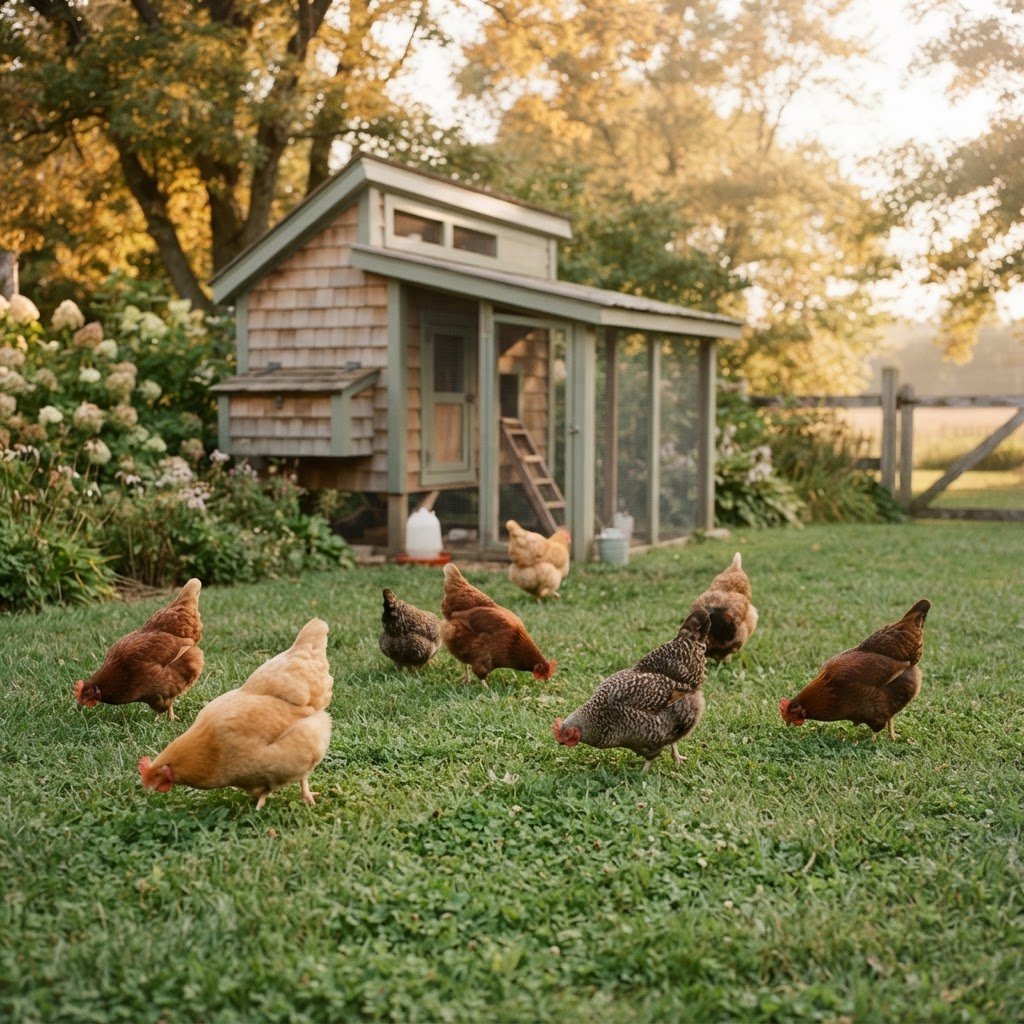
Buying your first chickens creates a surprisingly difficult question:
How many should you actually get?
Three sounds manageable.
Six sounds like a nice little flock.
Ten doesn't sound *that* different from six.
And then someone tells you chickens are social, someone else tells you you'll want more eggs, and suddenly you're pricing a coop for twelve birds before you've owned your first hen.
For most beginners, there is a much simpler way to decide.
Start with the number of eggs your household actually uses, then work backward through space, budget, time, and the needs of the chickens themselves.
Beginner Flock Size at a Glance
| Flock Size | Best For | What I'd Consider |
|---|---|---|
| 1 hen | Not recommended as a normal setup | Chickens are highly social |
| 2 hens | Possible, but not my preferred starting point | If one is lost, you're immediately left with one |
| 3 hens | Smallest flock I'd intentionally start | Manageable and social |
| 4 hens | Small households / first-time keepers | Excellent beginner size |
| 5–6 hens | Most families wanting regular eggs | My overall beginner sweet spot |
| 7–8 hens | Egg-heavy households | More feed, manure and infrastructure |
| 10+ hens | Large households / serious hobby flocks | Plan housing, budget and management first |
These are Roosted planning recommendations, not biological minimums established by a single scientific study. Your correct number may be different.
How Many Chickens Should a Beginner Get?
If you've never owned chickens before and asked me to pick one number, I'd start with 4–6 hens.
Oregon State Extension specifically recommends that new backyard keepers start small rather than beginning with 10–20 birds while they're learning the realities of chicken care (OSU Extension Service).
Four to six gives you enough birds to experience a real flock without dramatically scaling coop size, run size, feed use, bedding, manure, cleaning, egg surplus, and health monitoring all at once.
It also gives you time to discover whether you actually enjoy keeping chickens. That's something worth knowing before building housing for twenty.
Why I Wouldn't Start With One Chicken
Chickens aren't solitary animals.
The Merck Veterinary Manual describes chickens as highly social and notes that they naturally organize into small groups with established social hierarchies — the familiar pecking order (Merck Veterinary Manual). They also perform social behaviors together, including dust bathing.
So I wouldn't intentionally design a normal backyard setup around one chicken.
A chicken may occasionally need temporary isolation because of illness, injury or flock management. That's different from deliberately keeping one bird as its permanent social environment.
What About Two Chickens?
Two is certainly better than one. But it isn't my favorite number for someone starting from scratch.
The biggest practical problem is simple: if something happens to one bird, the other immediately becomes a lone chicken. With three or more, you have more resilience within the group.
That's why 3 hens is the smallest flock I'd intentionally recommend starting with. Again, that's a practical Roosted recommendation, not a scientific rule saying chickens biologically require exactly three companions.
How Many Chickens Do I Need for Eggs?
This is where your decision gets much easier.
First figure out how many eggs your household actually uses every week — not how many you *think* you'll eat once you own chickens. Look at what you're already buying. One dozen? Two dozen? Three dozen?
Then estimate production. Penn State notes that a hen needs roughly 24–26 hours to produce an egg and that many hens may lay around 4–6 eggs per week, although production varies significantly by individual bird, breed and management (Penn State Extension).
Commercial egg-type birds can produce roughly 200–280 eggs annually under good management, while heritage and less production-focused breeds may lay substantially fewer (Penn State Extension).
That means you shouldn't calculate 1 chicken = 7 eggs every week forever. It doesn't work that way. For a fuller picture of laying frequency, see How Often Do Chickens Lay Eggs? Daily, Weekly & Yearly Expectations.
A Simple Egg-to-Chicken Calculator
For beginner planning, I like using about 4 eggs per hen per week as a conservative planning number during normal productive periods.
Then: desired eggs per week ÷ 4 = approximate number of productive hens. And round up.
Example: You Use One Dozen Eggs Per Week
12 eggs ÷ 4 = 3 hens. Three productive hens may cover that amount during good laying periods. I'd probably still consider 3–4 hens because production isn't constant.
Example: You Use Two Dozen Eggs Per Week
24 ÷ 4 = 6 hens. That puts you right in the 5–6 hen range, depending on breed and whether occasional shortages matter.
Example: You Use Three Dozen Eggs Per Week
36 ÷ 4 = 9 hens. Now you're entering 8–10 hen territory. At that point, housing and feed requirements become much more important parts of the decision.
Chicken Flock Size by Eggs Wanted
| Eggs You Want Per Week | Starting Flock I'd Consider |
|---|---|
| 6 eggs | 3 hens |
| 12 eggs / 1 dozen | 3–4 hens |
| 18 eggs | 4–5 hens |
| 24 eggs / 2 dozen | 5–6 hens |
| 30 eggs | 6–8 hens |
| 36 eggs / 3 dozen | 8–10 hens |
| 48 eggs / 4 dozen | 10–12 hens |
These are planning estimates. They assume reasonably productive laying breeds during good laying periods, and they are not guaranteed weekly production numbers.
Why You Shouldn't Size the Flock for Peak Production
Suppose you have six young productive hens. During an excellent laying period you might receive close to 30+ eggs in a week.
Then winter arrives. One hen molts. Another goes broody. Day length falls. A couple birds skip days. Suddenly your egg basket looks very different.
Penn State notes that breed, diet, lighting and the individual bird all affect laying frequency, while Merck notes that naturally lit backyard flocks can dramatically reduce or stop laying during shorter-day periods and molt (Penn State Extension; Merck Veterinary Manual).
So size your flock around average useful production rather than the absolute maximum a young hen can produce.
How Many Chickens Should I Get for a Family of 2?
Household size isn't actually the best measurement. Two people who eat eggs every morning may use more than a family of four that eats them occasionally.
But as a general starting point, 3–4 hens works well for many two-person households. That creates a real social flock without producing an overwhelming quantity of eggs.
How Many Chickens for a Family of 4?
For many families, 4–6 hens is an excellent range.
If your family regularly uses 1–2 dozen eggs per week, that flock can be a very good fit. If everyone eats eggs every morning or you bake frequently, you may lean toward six.
How Many Chickens for a Family of 5 or More?
I'd start thinking about 6–8 hens and then calculate based on actual egg use. A large family consuming several dozen eggs every week might reasonably keep 8–12 hens.
But household size should never override the other constraints. Twelve hens require twelve-hen infrastructure.
Household Size Starting Guide
| Household | Flock I'd Consider |
|---|---|
| 1 person | 3 hens |
| 2 people | 3–4 hens |
| 3 people | 4–5 hens |
| 4 people | 4–6 hens |
| 5–6 people | 6–8 hens |
| Large / egg-heavy household | 8–12+ hens |
Use this as a starting point, then calculate using your actual weekly egg consumption.
Your Available Space May Decide the Number for You
You may want ten chickens. Your property may have room for six. In that case, you have room for six.
Merck's backyard-poultry guidance notes that space requirements vary by bird size and activity level and gives approximately 1.5–2 square feet indoors and 8–10 square feet in outside runs as minimum general guidance for laying hens (Merck Veterinary Manual).
For Roosted's backyard planning system, we intentionally use a roomier rule of thumb for standard hens:
- 4 square feet of usable coop space per hen
- 10 square feet of run space per hen
So a six-hen flock starts around 24 sq ft coop and 60 sq ft run.
Our full calculator is here: How Much Space Do Chickens Need? Coop & Run Size Chart + Calculator.
Work Backward From the Space You Have
Already own a 40-square-foot run? 40 ÷ 10 = 4 hens using our planning target.
Have an 80-square-foot run? 80 ÷ 10 = 8 hens.
Then check the coop. Your flock capacity is determined by the most limiting part of the setup, not whichever measurement gives you the biggest number.
Don't Forget Equipment
Ten hens don't just take up ten times the body space of one hen. They also need enough feeder access, water access, roost space, nesting capacity, ventilation, and dust-bathing area.
Penn State warns that inadequate feeder or watering access can allow lower-ranking chickens to be excluded by birds higher in the pecking order (Penn State Extension). The flock has to function as a system.
How Much Feed Will Your Flock Use?
Every chicken you add creates a recurring feed expense.
Mississippi State Extension says an average laying hen consumes around ¼–⅓ pound of feed per day, depending on size, weather and productivity (MSU Extension). That's approximately 7.5–10 pounds per hen per month.
So flock size has a very predictable effect on feed consumption.
Monthly Feed Use by Flock Size
| Hens | Approx. Feed Per Month |
|---|---|
| 3 | ~23–30 lb |
| 4 | ~30–40 lb |
| 5 | ~38–50 lb |
| 6 | ~45–60 lb |
| 8 | ~60–80 lb |
| 10 | ~75–100 lb |
| 12 | ~90–120 lb |
Six hens may consume roughly a 50-pound bag each month. Twelve hens may consume around two. That's worth knowing before bringing them home.
More Chickens Also Mean More Than Feed
Each additional bird also increases bedding use, manure, coop wear, run wear, water consumption, parasite-management workload, health-care exposure, and equipment capacity.
The bird itself is often one of the cheapest parts of chicken ownership. Our complete budget breakdown: How Much Do Chickens Cost? Chicks, Coop Setup & Monthly Costs.
Budget Should Limit Your Flock Size
This is an important one.
If your budget comfortably supports four hens but twelve would require buying an undersized coop, skipping predator protection, overcrowding the run, buying lower-quality feed, or postponing necessary care, then get four chickens.
You can always decide later whether expanding makes sense. Starting too large makes nearly every management problem more expensive.
Chickens Require Daily Care
A larger flock doesn't necessarily take six times longer than a smaller flock. You're still walking outside to feed, check water, collect eggs, observe the flock, and secure the coop whether you own four hens or eight.
But larger flocks create larger jobs. More chickens mean more manure, more feed to move, more bedding, larger structures, more health observations, and more eggs to collect and use.
Penn State emphasizes that chickens require daily care and monitoring and recommends having a plan for their care whenever you travel (Penn State Extension).
So ask yourself: *Do I want chickens?* — and also, *How much chicken management do I actually want?* Those are different questions.
Does Breed Change How Many You Need?
Not every chicken produces the same number of eggs.
Penn State reports that commercial production-oriented birds may produce roughly 200–280 eggs annually, while heritage or purebred birds can produce significantly fewer depending on the breed and strain (Penn State Extension).
So if your primary goal is maximum eggs from a small flock, breed selection matters. Six high-production layers could give you considerably more eggs than six less-production-focused heritage hens.
Don't Choose Chickens Only by Egg Count
Production isn't everything. Also consider temperament, climate tolerance, adult size, broodiness, egg size, breed availability, appearance, and personality.
Maybe you would rather keep six different breeds because you enjoy your flock. That's a perfectly reasonable reason to keep chickens. You aren't running an egg factory.
Do You Need a Rooster?
No. Hens lay eggs without a rooster. Penn State specifically notes that a rooster is not required for egg production (Penn State Extension).
A rooster is necessary if you want fertile eggs for hatching. But adding a rooster also changes flock dynamics, local ordinance considerations, noise, breeding, and space planning.
So don't include a rooster simply because you think hens need one in order to lay. They don't.
Check Local Chicken Limits Before Choosing a Number
Your ideal flock might be eight. Your city may allow six. Or your HOA may allow none.
Both Penn State and Merck recommend checking local ordinances, zoning requirements and association rules before establishing a backyard flock (Penn State Extension). Check this before buying the birds.
Especially investigate maximum number of hens, rooster restrictions, coop setbacks, enclosure requirements, permits, and HOA restrictions. The flock-size calculation doesn't matter much if local rules answer the question for you.
Should Beginners Start With Chicks or Started Pullets?
This doesn't necessarily change the final flock size, but it does change the experience.
Chicks give you the full raising experience, but require a brooder, heat, starter feed, more equipment, and months before eggs.
Started pullets cost more upfront, but they're older, closer to laying, and eliminate much of the brooder stage.
If your goal is simply "I'd like four hens producing eggs in my backyard," four started pullets may be much easier than beginning with a large box of baby chicks. For timing expectations, see When Do Chickens Start Laying Eggs? Age, Signs & What to Expect.
Should You Buy Extra Chicks?
Be careful with this logic: "I want six hens, so I'll buy twelve chicks just in case." Now you potentially own twelve chickens.
Sexing isn't perfect, and health losses can happen, but don't dramatically oversize your order unless you already have a plan for extra birds.
Decide what flock size you actually want, what your housing supports, and what you'll do with unexpected roosters before ordering.
Should You Start Larger So You Don't Have to Add Chickens Later?
There's an argument for this. Introducing new birds to an established flock can disrupt the existing social hierarchy. Merck notes that changes such as adding or losing flock members can disrupt an established pecking order (Merck Veterinary Manual). There are also biosecurity concerns whenever new birds enter an existing flock.
So if you know you ultimately want six hens, I would generally rather start with approximately six than deliberately start with two and add another two every few months.
If you plan to grow the flock by hatching your own chicks, the Chicken Hatch Date Calculator builds the full 21-day incubation calendar — candling days, Day 18 lockdown and expected hatch — from the day you set the eggs.
But that doesn't mean buy twelve because you *might* eventually want twelve. Build a flock you can comfortably handle now.
What If I Want Different Egg Colors?
This is where flock size mysteriously begins expanding. You planned four hens. Then you want brown eggs, blue eggs, green eggs, dark chocolate eggs, and cream eggs. Suddenly four becomes seven.
There's nothing wrong with choosing breeds for egg color. Just remember that each egg color comes attached to an entire chicken. And that chicken requires floor space, run space, feed, water, roost space, and care for years.
How Long Are You Committing to These Birds?
Chickens don't disappear when peak egg production ends. Penn State notes that small-flock chickens commonly live for many years, while production generally decreases as hens age (Penn State Extension).
Suppose you buy 10 hens because you want lots of eggs. Several years later you may have ten healthy chickens producing significantly fewer eggs. Do you keep them as pets? Maintain a mixed-age flock? Add younger layers? Rehome birds? Manage flock replacement?
There isn't one correct answer. But it's much easier to think through with six chickens than to discover the question after buying twenty.
The Beginner Flock-Size Planner
Here's the decision process I'd actually use.
Step 1 — Count your weekly egg use. How many eggs do you currently use? Write the number down.
Step 2 — Divide by 4. Use *weekly eggs wanted ÷ 4* as a conservative starting estimate of productive hens. Example: 20 eggs ÷ 4 = 5 hens.
Step 3 — Don't intentionally start with one. If the calculation says 1 or 2, I'd still generally recommend 3 hens, because you're keeping a social flock, not egg-producing appliances.
Step 4 — Check your space. Use *4 sq ft coop × hens* and *10 sq ft run × hens* as our backyard planning targets.
Step 5 — Calculate monthly feed. Use roughly *hens × 7.5–10 lb* to estimate monthly layer-feed use once they're adults.
Step 6 — Check your budget. Can you comfortably afford housing, predator protection, feed, bedding, supplies, and occasional health costs for that flock?
Step 7 — Check your time. Are you prepared for daily care, including weekends, holidays, vacations, and bad weather?
Step 8 — Check local rules. Make sure the birds are actually allowed.
Step 9 — Adjust for breed. High-producing layers? Your egg needs may require fewer birds. Lower-production heritage breeds? You may need more.
Step 10 — Choose the smaller number if you're unsure. You don't win backyard chicken keeping by owning the most chickens. The goal is a flock you can manage well.
Which Flock Size Would I Choose?
If you barely use eggs: 3 hens. You get a social flock without an enormous egg surplus.
If you're a couple who eats eggs regularly: 3–4 hens. Excellent little flock.
If you're a family of four: 4–6 hens. Probably the range I'd recommend most often.
If you eat around two dozen eggs per week: 5–6 hens, depending on breed and how much seasonal variation you're comfortable with.
If your family eats three dozen or more: 8–10 hens starts making sense — assuming your property does too.
If you're a complete beginner who just wants chickens: Start with 4. Four is enough to feel like a flock, enough to provide eggs, and enough for different personalities, but still small enough that the infrastructure and daily care remain approachable.
If you want a slightly more productive household flock, start with 6. That's probably the number I'd call the Roosted beginner sweet spot.
Common Beginner Flock-Size Mistakes
1. Buying the Maximum Number the Coop Claims to Hold
Manufacturer capacity isn't necessarily a comfortable flock size. Measure usable space yourself.
2. Calculating Seven Eggs Per Hen Per Week
Chickens aren't vending machines. Production varies.
3. Starting With One Chicken
Chickens naturally live socially. Build a flock.
4. Buying Ten Chickens Because Ten Chicks Look Small
They don't stay chick-sized.
5. Forgetting Feed Costs
Every bird eats every day whether she lays an egg or not.
6. Planning Only for Egg Production
Older hens are still chickens. Know what your long-term flock philosophy is.
7. Ignoring Local Laws
Check first. Buy second.
8. Underbuilding the Run
Your desired flock does not override the space your property actually supports.
9. Assuming More Chickens Means a Proportionally Harder Routine
Some tasks scale efficiently. But manure, feed consumption, housing and health management absolutely increase.
10. Starting With 20 Because Chickens Are "Easy"
They may be manageable. That doesn't mean learning with twenty is easier than learning with five.
The Bottom Line: How Many Chickens Should You Get?
For most beginners, 4–6 hens is the sweet spot.
Three is the smallest flock I'd intentionally recommend for a normal backyard setup. Four gives you a manageable social flock and a useful number of eggs. Six gives most households a stronger egg supply without immediately turning the backyard into a large poultry operation.
Then scale beyond six only when your egg use + space + budget + time justify it.
The simplest calculation is *eggs wanted per week ÷ 4 = starting hen estimate.* Then check that number against your available coop and run, feed budget, local regulations, breed choice, and long-term commitment.
And remember, the correct number isn't "How many chickens can I fit?" It's "How many chickens can I comfortably care for well?" That's the flock size I'd build around.
How Many Chickens Should I Get? FAQ
How many chickens should a beginner start with?
For most beginners, I'd recommend 4–6 hens. It's large enough to form a social flock and produce useful eggs while still remaining manageable.
What is the minimum number of chickens I should have?
Roosted's practical starting recommendation is three hens. Chickens are highly social animals that naturally form groups, although there is not a universal scientific rule establishing exactly three birds as a biological minimum (Merck Veterinary Manual).
Is 3 chickens enough?
Yes. Three hens can make a perfectly reasonable small backyard flock. Just understand that three chickens will produce fewer eggs and give you less redundancy if one bird becomes sick, stops laying or is lost.
Is 4 chickens a good starting flock?
Yes. Four is one of my favorite beginner flock sizes. It's manageable, social and capable of providing a useful quantity of eggs.
Is 6 chickens too many for a beginner?
Not usually, assuming you have adequate housing, run space, budget and time. Six is probably our overall beginner sweet spot for a household that regularly uses eggs.
How many chickens do I need for a dozen eggs per week?
Around 3–4 productive hens is a practical starting point. Actual production changes with breed, age, season, molt and individual birds.
How many chickens do I need for two dozen eggs a week?
I'd consider roughly 5–6 productive hens.
How many chickens does a family of four need?
For many four-person households, 4–6 hens is a good starting range. Actual weekly egg consumption is a better measurement than family size.
How many chickens can I keep in a 4 × 6 coop?
A 4 × 6 coop has 24 square feet. Using Roosted's planning target of 4 square feet per standard hen, that suggests approximately 6 hens, assuming the run, roosts, ventilation and other infrastructure are also properly sized.
Do chickens need a rooster?
No. Hens lay eggs without a rooster (Penn State Extension).
Will I regret getting too many chickens?
Possibly. A bigger flock means more feed, manure, housing, health monitoring and long-term birds to care for. If you're unsure between six and twelve, I'd start closer to six.
Wondering how much water a flock that size drinks? Use the Chicken Water Calculator →
Keep Reading
Figuring out how much room your flock needs? How Much Space Do Chickens Need? Coop & Run Size Chart + Calculator
Building your first-flock budget? How Much Do Chickens Cost? Chicks, Coop Setup & Monthly Costs
Estimating how many eggs your flock will produce? How Often Do Chickens Lay Eggs? Daily, Weekly & Yearly Expectations
Wondering when those eggs will start? When Do Chickens Start Laying Eggs? Age, Signs & What to Expect
Planning the nesting area? Chicken Nesting Boxes: Size, Dimensions, How Many You Need & Where to Put Them
Have cats in the neighborhood? Do Cats Kill Chickens? How Much Risk Are Cats to Chicks & Adult Hens
Thinking about adding ducks? Can Ducks and Chickens Live Together? Coop, Feed, Water & Mixed-Flock Safety
Considering a calm, ornamental breed? Silkie Chickens: Eggs, Temperament, Lifespan & Complete Care Guide
Researching a beginner-friendly breed? Buff Orpington Chickens: Egg Production, Temperament & Care
Choosing breeds for your flock? Easter Egger Chickens: Egg Colors, Temperament & Care Guide
Choosing a beginner-friendly laying breed? Australorp Chickens: Egg Production, Temperament & Care
Want a calm, beginner-friendly breed? Barred Rock Chickens: Egg Production, Temperament & Care