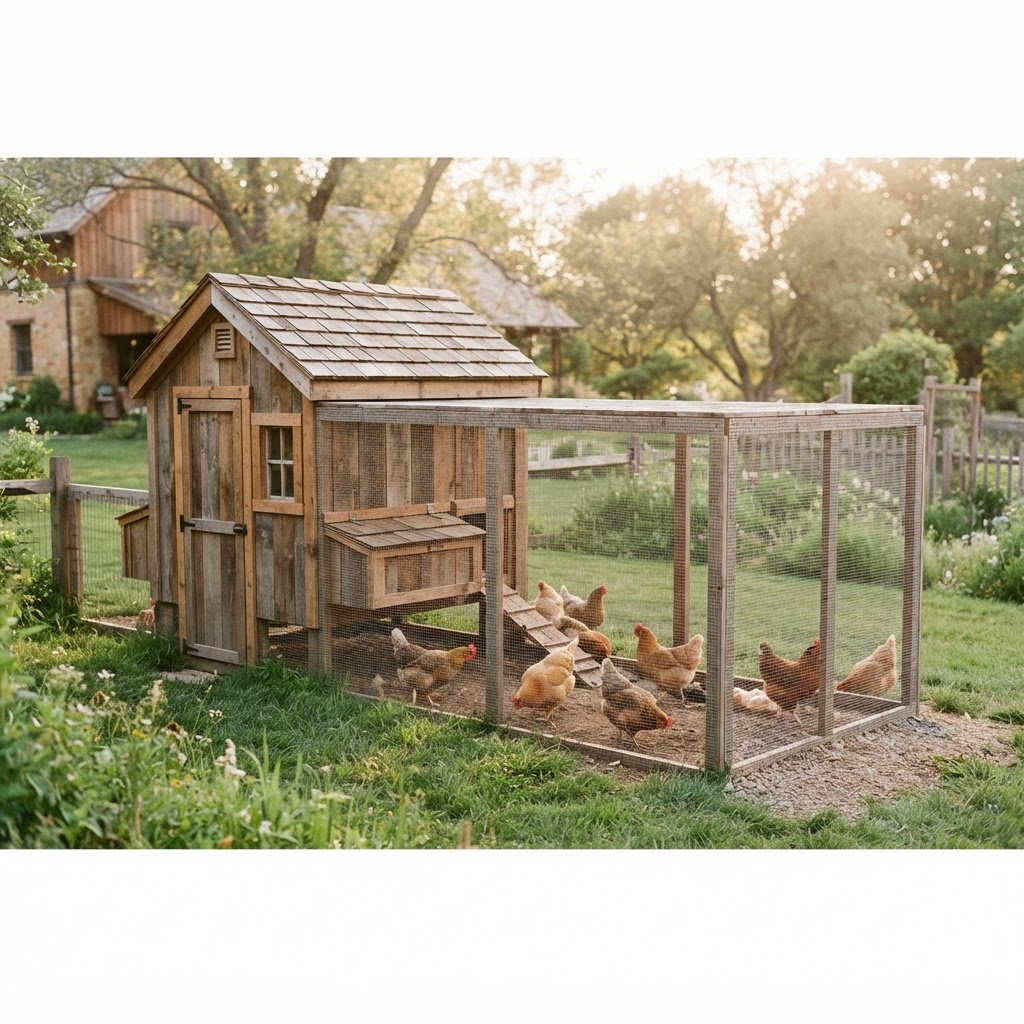
One of the easiest mistakes to make when starting a backyard flock is trusting the number printed on the side of a chicken coop.
"Fits 8 hens."
Sounds simple.
But eight chickens can feel very different inside a tiny prefab coop than they do in a properly sized coop with a roomy outdoor run.
And when chickens don't have enough usable space, the problem usually shows up somewhere else: wetter bedding, more manure concentrated in one area, harder cleaning, competition around resources, or birds that simply can't get away from one another.
So how much space do chickens actually need?
Chicken Space at a Glance
| Area | Roosted Planning Target |
|---|---|
| Indoor coop — standard hen | ~4 sq ft per chicken |
| Outdoor run — standard hen | ~10 sq ft per chicken |
| Birds with little/no outdoor access | Size the indoor area up substantially |
| Bantams | Can generally use somewhat less |
| Large/heavy breeds | Give more room |
| Nesting boxes | Separate calculation |
| Roosting bars | Separate calculation |
| Feeders, waterers & equipment | Don't count occupied floor area as usable space |
One important distinction: square footage is only part of the setup.
A 40-square-foot coop with terrible ventilation, no roost space, and a waterer leaking into the bedding isn't automatically better than a well-designed 32-square-foot coop.
Layout matters too.
How Much Coop Space Does One Chicken Need?
There isn't one universally agreed number.
That's worth saying clearly because chicken-space recommendations online are often presented as though someone discovered a biological law stating 4 square feet exactly.
They didn't.
Published Extension recommendations vary with:
- bird size
- housing style
- flooring
- outdoor access
- management system
Penn State's updated small-scale poultry housing guide lists minimum indoor space at approximately 1 square foot per bantam, 1.5 square feet per laying hen, and 2 square feet per large chicken when paired with outdoor runs.
UF/IFAS recommends at least 3 square feet per chicken indoors for backyard laying hens.
Texas A&M AgriLife poultry guidance gives a general backyard rule of thumb of approximately 2–4 square feet per bird indoors.
So why does Roosted use 4 square feet for a standard backyard hen?
Because we're designing for a backyard owner rather than trying to determine the maximum stocking density a building can technically accommodate.
You can build larger.
And depending on your climate and management style, larger may make a lot of sense.
How Much Run Space Does a Chicken Need?
The outdoor run is where I'd be especially reluctant to squeeze the numbers.
Penn State lists roughly 8 square feet of run per laying hen and 10 square feet per large chicken.
UF/IFAS recommends approximately 8–10 square feet of outdoor run per bird.
That's why our standard calculation uses 10 square feet per chicken in the run.
It's easy to remember.
And it gives your birds meaningful outdoor room for:
- scratching
- walking
- dust bathing
- moving away from flockmates
- exploring
- using feeders and waterers without everything happening in one tiny area
Chicken Coop & Run Size Chart
Using Roosted's simple 4 sq ft coop + 10 sq ft run per standard hen planning rule:
| Chickens | Coop Space | Run Space | Example Coop | Example Run |
|---|---|---|---|---|
| 2 | 8 sq ft | 20 sq ft | 2 × 4 ft | 4 × 5 ft |
| 4 | 16 sq ft | 40 sq ft | 4 × 4 ft | 5 × 8 ft |
| 6 | 24 sq ft | 60 sq ft | 4 × 6 ft | 6 × 10 ft |
| 8 | 32 sq ft | 80 sq ft | 4 × 8 ft | 8 × 10 ft |
| 10 | 40 sq ft | 100 sq ft | 5 × 8 ft | 10 × 10 ft |
| 12 | 48 sq ft | 120 sq ft | 6 × 8 ft | 10 × 12 ft |
| 15 | 60 sq ft | 150 sq ft | 6 × 10 ft | 10 × 15 ft |
| 20 | 80 sq ft | 200 sq ft | 8 × 10 ft | 10 × 20 ft |
These dimensions are examples.
A 60-square-foot run could be 6 × 10, 5 × 12, or another footprint totaling at least 60 usable square feet.
Your property and coop layout determine the shape.
Chicken Space Calculator
You don't actually need a complicated calculator for standard backyard hens. If you'd rather skip the mental math, use our interactive Chicken Coop Size Calculator to get coop and run targets for your exact flock in seconds.
Use two formulas:
Coop Size
Number of chickens × 4 = recommended coop square footage
Run Size
Number of chickens × 10 = recommended run square footage
Example: 6 Chickens
6 × 4 = 24 sq ft coop
6 × 10 = 60 sq ft run
So I'd start a six-hen flock around 24 sq ft indoors + 60 sq ft outdoors. A 4 × 6 coop and 6 × 10 run would hit those numbers almost perfectly.
Quick Chicken Space Calculator
| Your Flock | Multiply By | Space Needed |
|---|---|---|
| Indoor coop | Chickens × 4 | sq ft |
| Outdoor run | Chickens × 10 | sq ft |
Example
If you're planning for 9 hens: 9 × 4 = 36 sq ft coop and 9 × 10 = 90 sq ft run.
You could build something around a 6 × 6 coop and a 9 × 10 run and meet the basic target.
How Much Space Do 4 Chickens Need?
Using our backyard planning target:
Coop
4 × 4 = 16 square feet
Run
4 × 10 = 40 square feet
A simple setup could be a 4 × 4 coop + 5 × 8 run for four standard hens.
How Much Space Do 6 Chickens Need?
Coop
6 × 4 = 24 square feet
Run
6 × 10 = 60 square feet
A practical setup: 4 × 6 coop + 6 × 10 run.
Six hens is also a very common beginner flock size, and it's large enough to provide a meaningful number of eggs without immediately requiring a huge structure.
How Much Space Do 8 Chickens Need?
Coop
8 × 4 = 32 square feet
Run
8 × 10 = 80 square feet
Example: 4 × 8 coop + 8 × 10 run.
Once you're getting into eight or more hens, I particularly like walk-in runs.
The chickens appreciate the room.
You appreciate not crawling around on your knees trying to retrieve a feeder.
How Much Space Do 10 Chickens Need?
Coop
10 × 4 = 40 square feet
Run
10 × 10 = 100 square feet
Example: 5 × 8 coop + 10 × 10 run.
At this size, think about the entire layout rather than square footage alone. You'll also need enough:
- roost space
- nesting boxes
- feeder access
- water access
- ventilation
- doorway space
How Much Space Do 12 Chickens Need?
Coop
12 × 4 = 48 square feet
Run
12 × 10 = 120 square feet
Example: 6 × 8 coop + 10 × 12 run.
That's beginning to look like a real little chicken house rather than a decorative backyard box.
And that's a good thing.
What Counts as Coop Square Footage?
This part gets overlooked.
We're talking about usable floor area, not simply the outside dimensions of the building.
Suppose you have a 4 × 6 coop. That's 24 square feet. Great.
But if a giant built-in feeder, storage bin, and inaccessible nesting structure occupy six square feet of the floor? Your chickens don't really have 24 square feet available anymore.
University of Kentucky poultry guidance specifically notes that published space allowances can exclude equipment such as feeders, waterers, and dust baths.
That's a good principle for backyard planning too.
What About Nesting Boxes?
I generally wouldn't count wall-mounted or exterior nesting boxes against your floor calculation if the hens can still use the floor beneath them.
But don't forget that nesting-box capacity has its own requirements. For the full setup, see our guide to Chicken Nesting Boxes: Size, Dimensions, How Many You Need & Where to Put Them.
Do Bantam Chickens Need Less Space?
Generally, yes.
Bantams are physically smaller.
Penn State's minimum-space table lists approximately 1 sq ft indoors + 4 sq ft outdoors for bantam chickens.
Kentucky Extension's deep-litter table is somewhat more generous indoors, listing approximately 2 sq ft of deep-litter floor + 4 sq ft of run per bantam.
Again, this demonstrates why there isn't one magic number.
For a backyard flock, I still wouldn't try to pack the maximum number of bantams into the smallest technically acceptable footprint. Smaller chickens still:
- scratch
- forage
- chase one another
- dust bathe
- need room around resources
Their bodies may be smaller. Their personalities aren't necessarily.
Do Large Chicken Breeds Need More Space?
Yes.
A Brahma, Jersey Giant, or other heavy-bodied bird takes up more physical room than a small laying hen.
Penn State lists approximately 2 square feet indoors + 10 square feet outdoors as its minimum for large chickens.
Kentucky's deep-litter guidance uses approximately 4 square feet indoors + 10 square feet of run for large breeds.
For a backyard flock of genuinely large birds, I would size above the standard-hen calculation rather than below it.
The extra room also makes ramps, roosts, doorways, and traffic flow easier for less agile heavy breeds.
What If My Chickens Free-Range?
Daily free-ranging changes how the birds use their space.
A flock that leaves the coop every morning and spends the entire day across a large yard isn't using its enclosed run the same way as chickens that remain inside the run from sunrise to sunset.
But I wouldn't use free-ranging as an excuse to build an extremely undersized coop.
The birds still need indoor space when:
- sleeping
- laying
- weather keeps them inside
- predators prevent free-ranging
- you're away from home
- flock introductions require temporary confinement
Build for the days when things don't go perfectly.
What If Chickens Don't Have an Outdoor Run?
Then indoor space becomes considerably more important.
Oregon State Extension recommends at least 3 square feet per bird when chickens have access to an outdoor area, but 8–10 square feet per bird when they don't have outdoor access.
That's a major difference.
And it makes sense. If the coop is bedroom + living room + exercise area + dining room, it needs to be much larger than a building the hens mostly use for sleeping and laying eggs.
Can Chickens Have Too Much Space?
In a normal backyard setting? Running into too much outdoor run space isn't a problem I'd spend much time worrying about.
A very oversized enclosed building can be more expensive, harder to clean, harder to manage, and unnecessary for a tiny flock.
But outdoors? If you can safely give chickens more usable ground, shade, and enrichment space, there's little reason to intentionally shrink it down to the minimum.
The question usually isn't, "Can I give my chickens too much run?" It's, "How much securely enclosed run can I reasonably build?"
Why Does Chicken Space Matter?
Space affects much more than whether the chickens physically fit inside the building.
Penn State notes that adequate space helps keep humidity lower, while its poultry guidance also links increasing space as birds grow with limiting stress and behavioral problems.
More usable space can also make it easier to manage:
- manure concentration
- wet litter
- feeders
- waterers
- dust-bathing areas
- flock dynamics
- cleaning
That doesn't mean every behavioral problem is caused by crowding. But crowding gives you fewer options when something else goes wrong.
Space Doesn't Replace Enrichment
Here's another important distinction.
A giant empty dirt run isn't automatically an interesting environment.
Give chickens opportunities to:
- scratch
- forage
- perch
- dust bathe
- move between sun and shade
- investigate different areas
A 100-square-foot run containing structure and enrichment can function very differently from an empty rectangle.
The square footage gives you the canvas. You still have to design the space.
Don't Forget the Dust Bath
If your birds spend much of their day inside a run, make sure part of that space supports natural dust bathing.
The bath itself occupies room.
Which is another reason I don't like designing a run right at the absolute smallest footprint possible.
Our complete guide to the Chicken Dust Bath: What to Put In It, How to Make One & What to Avoid covers the substrate, placement, and setup.
How Much Roosting Space Do Chickens Need?
Floor area is only one dimension of a coop.
Birds also need somewhere to sleep.
Penn State recommends approximately 6 inches of perch space per standard chicken, with roosts spaced about one foot apart and approximately 18–24 inches above the floor.
Bantams need somewhat less. Large breeds may need different roost designs and lower heights because of their body structure and risk of injury.
So don't build a 40-square-foot coop for ten hens and then give them a three-foot roost.
The floor may be large enough. The bedroom isn't.
How Many Nesting Boxes Do Chickens Need?
This is also separate from floor space.
Penn State recommends two nests for the first four hens and then one additional nest for every four additional hens.
Other recommendations use roughly one nest for every four or five hens.
We break the whole question down in our Chicken Nesting Boxes: Size, Dimensions, How Many You Need & Where to Put Them guide.
And no: you do not need one box per hen. They'd probably all use the same one anyway.
Why Prefab Coop Capacity Can Be Misleading
Imagine a product listed as an "8-Chicken Coop."
Don't immediately assume it satisfies your requirements.
Look for the actual interior measurements. Then calculate length × width = indoor square footage.
Suppose the usable floor is 3 ft × 4 ft = 12 sq ft. At our 4-square-foot planning target: 12 ÷ 4 = 3 standard hens.
That's very different from eight.
Penn State recently highlighted an advertised 6–8-hen coop that provided only about half a square foot of indoor floor space per bird at the advertised capacity and described the space as inadequate.
Measure the coop. Don't trust the chicken icon on the packaging.
How to Check an Existing Coop
Already own the coop? Easy.
Step 1 — Measure the usable interior
Example: 5 ft × 6 ft = 30 sq ft.
Step 2 — Divide by 4
30 ÷ 4 = 7.5
I'd treat that as a coop for roughly 7 standard hens using our planning target.
Step 3 — Measure the run
Suppose it's 8 × 10 = 80 sq ft.
Step 4 — Divide by 10
80 ÷ 10 = 8 hens.
Your run supports eight by our formula. Your coop supports seven.
So for the complete setup, seven becomes the limiting number. The smallest part of the system usually determines capacity.
When Should You Build Bigger?
I would intentionally add more space if:
Your chickens are large breeds
More body needs more room.
Winters keep birds inside
The coop becomes living space instead of just sleeping space.
Your run is your birds' entire world
If they never free-range, outdoor run space matters considerably.
You're planning to grow the flock
Build for future chickens now.
You're introducing new birds
Extra space gives lower-ranking birds somewhere to move away.
Your property frequently gets wet
More area can reduce how intensely one small patch gets churned into mud.
You're deciding between two sizes
I'd usually take the larger one.
Common Chicken Coop Size Mistakes
1. Trusting the Manufacturer's Hen Count
Measure it yourself.
2. Calculating Coop Space but Ignoring the Run
Your hens spend a lot of waking time outside. The run isn't an afterthought.
3. Counting Equipment as Chicken Space
A feeder occupying floor area isn't usable floor area.
4. Forgetting Breed Size
A bantam and a Jersey Giant are both chickens. They're not the same size.
5. Planning for Perfect Weather
Some days the birds will spend more time inside. Build accordingly.
6. Building Exactly for Your Current Flock
Then buying four more chickens. You know who you are.
7. Ignoring Height and Layout
Floor square footage doesn't solve:
- inadequate roosts
- poor ventilation
- inaccessible nesting boxes
- low ceilings
- badly placed equipment
The whole coop has to function.
A Simple Roosted Space Formula
If you're starting with ordinary standard-size backyard hens and want one easy rule:
Indoor Coop
4 sq ft × number of chickens
Outdoor Run
10 sq ft × number of chickens
Then increase the space when birds are especially large, the flock spends substantial time confined indoors, you expect to add chickens, or you simply have room to build bigger.
That's the calculation I'd use to begin a backyard-coop plan.
The Bottom Line: How Much Space Do Chickens Need?
Published poultry recommendations vary. There isn't one exact square-foot number every chicken in every management system requires.
For backyard planning, though, you need somewhere to start. And for standard hens with daily outdoor access, ours is 4 square feet inside + 10 square feet outside per chicken.
So:
- 4 hens → 16 sq ft coop + 40 sq ft run
- 6 hens → 24 sq ft coop + 60 sq ft run
- 10 hens → 40 sq ft coop + 100 sq ft run
- 12 hens → 48 sq ft coop + 120 sq ft run
Treat those as planning targets — not an excuse to squeeze every possible bird into the footprint.
Then account for breed size, weather, time spent confined, equipment, roosts, nesting boxes, and future flock growth.
Your chickens don't need a palace. But they do need enough room for the coop and run to function like a chicken habitat rather than a storage box full of birds.
Chicken Space FAQ
How many square feet does a chicken need in a coop?
For standard backyard hens with outdoor access, Roosted recommends planning around 4 square feet of usable indoor floor per bird. Published Extension minimums vary from roughly 1.5–3+ square feet for typical layers depending on the housing system.
How much run space does one chicken need?
I'd plan around 10 square feet per standard hen. Extension recommendations commonly fall around 8–10 square feet per bird.
How much space do 6 chickens need?
Using our backyard rule: 24 sq ft coop + 60 sq ft run. A 4 × 6 coop and 6 × 10 run would meet those targets.
How much space do 10 chickens need?
Approximately 40 sq ft indoors + 100 sq ft outdoors using the 4 + 10 calculation.
Is a 4 × 8 coop big enough for 8 chickens?
A 4 × 8 coop contains 32 square feet. Using 4 square feet per standard hen: 32 ÷ 4 = 8 hens. I'd still verify run size, ventilation, roost space, nesting boxes, and how much floor area equipment occupies.
Is a 4 × 6 coop big enough for 6 chickens?
Yes, for six standard hens under our planning formula. A 4 × 6 coop equals 24 square feet, or four square feet per bird.
How much space do chickens need if they free-range?
Free-ranging gives chickens much more daytime space, but they still need properly sized secure housing for nighttime, weather, temporary confinement, and predator protection.
How much space do chickens need without a run?
Much more indoors. Oregon State recommends 8–10 square feet per bird when chickens don't have outdoor access.
Do bantams need less coop space?
Yes. Penn State lists smaller minimum space requirements for bantams than standard or large chickens.
Is more space better for chickens?
Generally, additional usable space gives you more flexibility for movement, resources, flock dynamics, and litter management. But good ventilation, predator protection, cleanliness, and proper layout still matter regardless of square footage.
Sizing vents for the coop you just planned? Use the Chicken Coop Ventilation Planner →
Know the area you need? Build your run and calculate materials with the Chicken Run Builder →
Keep Reading
Building the nesting area? Chicken Nesting Boxes: Size, Dimensions, How Many You Need & Where to Put Them
Budgeting the whole setup? How Much Do Chickens Cost? Chicks, Coop Setup & Monthly Costs
Choosing coop-floor material? Best Bedding for Chickens: Pine Shavings vs. Hemp, Straw & Sand
Adding a dust-bathing area? Chicken Dust Bath: What to Put In It, How to Make One & What to Avoid
Waiting for your first eggs? When Do Chickens Start Laying Eggs? Age, Signs & What to Expect
Enough roost space for everyone? Chickens Sleeping in Nesting Boxes? Why It Happens & How to Stop It
Making the run secure against cats? Do Cats Kill Chickens? How Much Risk Are Cats to Chicks & Adult Hens
Adding ducks to the run? Duck space needs differ from these chicken numbers — see Can Ducks and Chickens Live Together? Coop, Feed, Water & Mixed-Flock Safety
Keeping bantams like Silkies? Silkie Chickens: Eggs, Temperament, Lifespan & Complete Care Guide
Planning for a large breed? Buff Orpington Chickens: Egg Production, Temperament & Care
Housing giant breeds? Brahma Chickens: Size, Egg Production, Temperament & Care