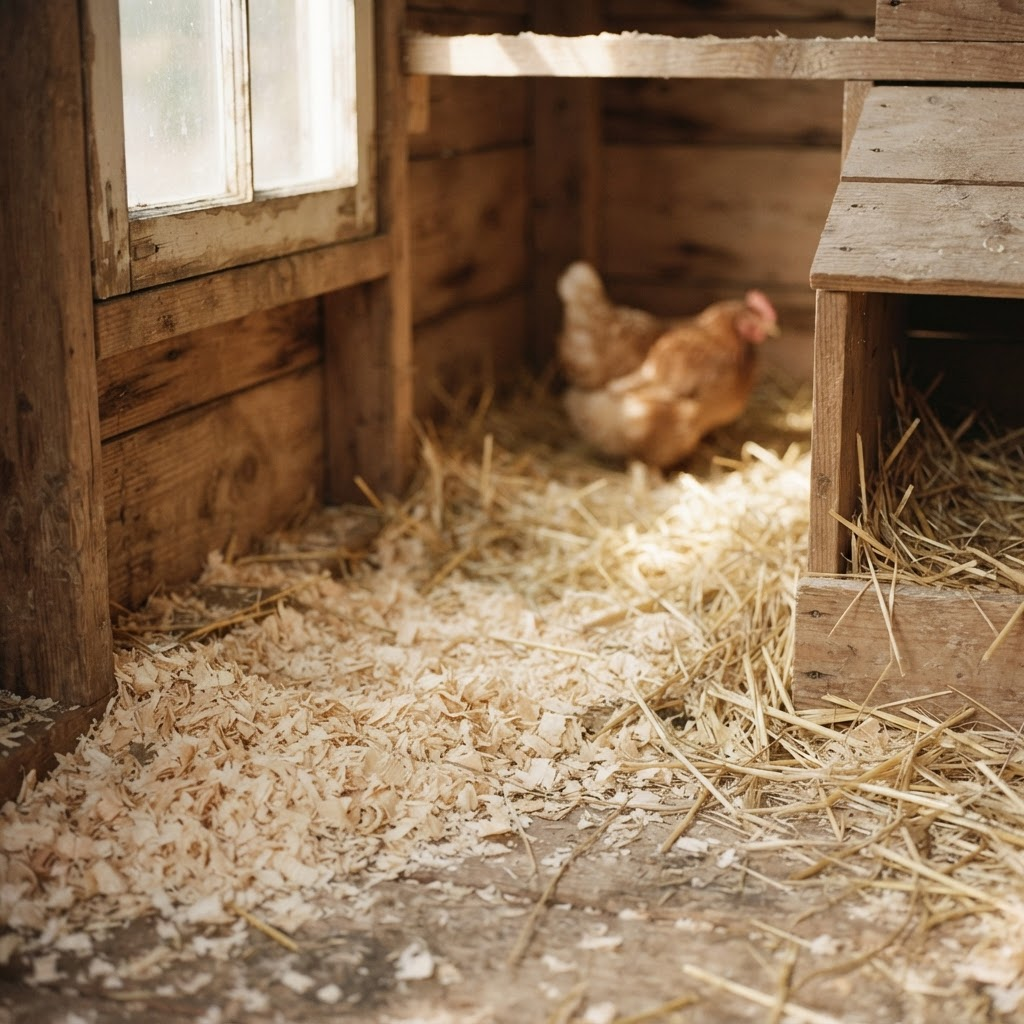
Choosing chicken bedding sounds simple until you actually start comparing options.
Pine shavings are everywhere.
Hemp gets marketed as the premium upgrade.
Straw is cheap and traditional.
Sand has chicken keepers who swear they'll never use anything else.
So which one is actually best?
The answer depends less on which material has the best marketing and more on what good poultry litter is supposed to accomplish:
keep the coop dry, manage manure, provide comfortable footing, stay reasonably low in dust, and be practical for you to maintain.
Chicken Bedding Compared at a Glance
| Bedding | Best For | Main Advantage | Main Drawback |
|---|---|---|---|
| Pine shavings | Most backyard coops | Proven, absorbent, inexpensive, easy to compost | Can become wet and compacted if poorly managed |
| Hemp | Keepers wanting a premium organic bedding | Good texture and organic litter properties | Higher cost and less poultry-specific comparative research |
| Straw | Budget-conscious keepers and some cold-weather setups | Cheap and widely available | More prone to matting/caking |
| Sand | Covered coops/runs with frequent spot cleaning | Dries quickly, easy to sift, chickens like it | Heavy, non-compostable, different maintenance style |
If you want one recommendation without reading another word:
Start with pine shavings.
Then switch only if your coop or cleaning style gives you a reason to.
What Is Chicken Bedding Actually For?
Technically, what covers a poultry-house floor is often called litter.
Once chickens begin using it, that litter becomes a mixture of:
- bedding material
- manure
- feathers
- spilled feed
- moisture
Good litter does more than make the coop look tidy.
Mississippi State Extension describes poultry litter as a loose, absorbent material that provides insulation, absorbs moisture, cushions birds from the floor, and lets them perform natural behaviors such as scratching and dust bathing.
University of Maryland Extension gives a similarly practical set of criteria: bedding should be absorbent, lightweight, inexpensive, nontoxic, and free of mold.
That gives us a better way to compare materials.
We're not asking, "Which one looks nicest?"
We're asking: Which one helps us maintain a dry, healthy, manageable coop?
Why Dry Bedding Matters So Much
Moisture is the enemy of good chicken litter.
As poultry litter gets wet, it begins to:
- compact
- form cake
- hold manure against the floor
- support more microbial activity
- contribute to ammonia problems
Mississippi State Extension emphasizes that keeping litter dry is a critical part of poultry management. When enough moisture accumulates, the bedding begins sticking together and forming a compacted layer known as cake.
That means the best bedding in the world won't fix a leaking roof, a dripping waterer, poor ventilation, or an overcrowded coop.
What Is the Best Bedding for Most Chickens?
For a typical backyard flock, I'd start with pine shavings.
That isn't because pine is trendy.
It's because pine shavings have a long track record in poultry housing, they're widely available, and multiple Extension programs recommend them directly.
Penn State says pine shavings provide the best litter for laying flocks, while noting that any sufficiently absorbent material with minimal dust may work.
Merck Veterinary Manual likewise lists pine shavings among useful clean, absorbent henhouse litter materials.
For most people, that makes pine the benchmark the other options need to beat.
Pine Shavings for Chicken Bedding
Why Pine Works
Pine shavings provide a useful combination of:
- moisture absorption
- cushioning
- insulation
- relatively low cost
- easy availability
- compostability
- easy handling
They're light enough to move with a rake or pitchfork and easy to replace when sections get wet.
Penn State recommends keeping laying-flock litter around 3–4 inches deep and removing wet material as necessary.
University of Minnesota gives a similar recommendation for young birds, suggesting roughly 2–4 inches of wood shavings, straw, or another suitable litter material.
Large Flakes vs. Fine Shavings
For the coop floor, I prefer larger wood shavings over sawdust-like material.
The goal is to have litter that remains loose and friable.
Very fine wood particles create more airborne dust and can cake more easily.
A major review of alternative poultry bedding notes that sawdust can be absorbent but identifies poor moisture release, caking, and fine particles that may contribute to respiratory concerns as disadvantages.
So when choosing wood bedding: shavings beat powder.
Pine Shavings: Pros
- Well-established poultry bedding
- Recommended by Extension sources
- Easy to find
- Easy to handle
- Absorbent
- Works for deep-litter-style systems
- Composts with manure
- Suitable for nesting boxes
Pine Shavings: Cons
- Wet areas still need to be removed
- Can become compacted if neglected
- Fine products can be dusty
- Requires periodic replacement
For most backyard chicken keepers, those are manageable tradeoffs.
Is Hemp Bedding Better Than Pine Shavings?
Maybe for some keepers.
But I wouldn't tell you it's scientifically proven to be universally superior.
Hemp bedding is made from processed parts of the hemp stalk, commonly the woody inner material known as hurd.
It's become popular because it offers an organic, fibrous bedding material similar in concept to wood-based litter.
Chicken-specific research on hemp exists, but there is considerably less long-term comparative poultry literature behind it than there is for pine shavings.
What Does the Research Say About Hemp Bedding?
One controlled study gave laying-hen chicks access to six litter materials:
- hemp shavings
- wood shavings
- sand
- peat
- straw
- crushed straw pellets
The chicks used different substrates for different behaviors.
They performed more foraging behavior in wood shavings, hemp shavings, and sand than in peat or pellets, while most dust-bathing occurred in sand and peat.
That's useful evidence that hemp functions as a usable behavioral substrate.
But it doesn't establish that hemp absorbs exactly some multiple more water than pine and is therefore definitively the best poultry litter.
A lot of exact absorbency claims online come from manufacturers or non-poultry testing rather than controlled backyard-chicken comparisons.
I'd be careful repeating them.
When I Would Choose Hemp
Hemp makes sense if:
- you don't mind paying more
- you prefer its texture
- you want an organic compostable bedding
- it's readily available near you
- you've found pine overly dusty in your particular setup
- you're willing to test whether it lasts longer in your coop
For a small flock, the higher price may not matter much.
For a large coop, cost becomes more noticeable very quickly.
Hemp Bedding: Pros
- Organic and compostable
- Suitable for scratching and foraging
- Generally easy to handle
- Can work as coop or nesting material
- Popular among keepers looking for alternatives to wood shavings
Hemp Bedding: Cons
- Usually more expensive
- Less widely available
- Smaller body of poultry-specific research
- Premium marketing claims sometimes exceed the actual evidence
My Take on Hemp
I like hemp.
I just wouldn't tell a chicken keeper with a clean, dry pine-shaving coop that they need to switch.
Is Straw Good Bedding for Chickens?
Straw can work.
Penn State explicitly lists pine shavings or straw as acceptable bedding for small laying flocks.
University of Minnesota also includes straw among appropriate litter materials for chicks and pullets.
So straw isn't inherently bad.
But it behaves differently from shavings.
The Problem With Straw: Matting and Moisture
A broad review of poultry litter materials notes that straw can be inexpensive, readily available, and useful for foraging — but also identifies lower water-holding performance and a risk of caking, particularly when the material isn't processed or chopped appropriately.
Long pieces can weave together.
Then manure and moisture accumulate inside that mat.
From the top, it may not look terrible.
Underneath? Different story.
Straw Bedding: Pros
- Inexpensive in many areas
- Widely available
- Comfortable
- Organic
- Compostable
- Works in nesting boxes
- Can add insulation and depth
Straw Bedding: Cons
- Can mat together
- Can hide wet areas
- Can cake if moisture accumulates
- Long strands are harder to rake than shavings
- Quality varies considerably
My Take on Straw
Straw is usable.
But for an everyday coop floor, I'd choose pine shavings first.
I like straw more as a situational material than my universal default.
What About Hay?
I wouldn't treat hay and straw as interchangeable.
Straw is primarily the dried stems left after grain harvest.
Hay is harvested forage containing grasses or legumes intended primarily as animal feed.
Hay can retain more nutritional plant matter and may be more attractive to animals as food.
For bedding, I'd rather use a material specifically intended to stay dry and function as litter.
And regardless of whether you're talking about straw or hay: never use moldy material.
Merck states that poultry litter should be dry and free of mold.
Can Sand Be Used as Chicken Bedding?
Yes.
And this is where the comparison gets interesting.
Sand doesn't behave like pine, hemp, or straw.
It's an inorganic floor substrate, so you aren't asking it to absorb manure into plant fibers and then compost.
Instead, appropriately managed sand allows moisture to move through or evaporate while droppings can be removed from the surface.
What Does the Research Say About Sand Bedding?
Sand has been studied extensively in poultry.
In one broiler experiment comparing sand and pine shavings over three successive flocks, researchers found no significant differences in litter moisture, ammonia production, mortality, feed conversion, or foot-pad lesions. The sand houses actually had lower measured coliform and aerobic bacterial counts in that experiment.
Another study gave broilers a choice between sand and wood shavings.
As the birds aged, they spent more of their behavioral time on the sand, including more dust bathing, sitting, and preening when both materials were available.
A larger meta-analysis also found that chickens generally preferred sand for dust bathing and spent more time on sand than on wood substrates when given choices.
So sand is absolutely a legitimate poultry substrate.
Sand Requires a Different Cleaning Philosophy
With pine or hemp, you remove wet organic litter and replace bedding.
With sand, you scoop droppings, rake or sift, and keep the substrate dry.
Think more like cleaning a giant litter box.
That's why people tend either to love sand or hate sand.
It fits a specific management style.
Sand Bedding: Pros
- Chickens like using it
- Excellent for dust-bathing behavior
- Doesn't mat like straw
- Can dry quickly in the right environment
- Can be sifted rather than continually replaced
- Doesn't break down
Sand Bedding: Cons
- Extremely heavy
- Requires regular scooping
- Doesn't compost with manure like organic bedding
- Can become a mess in wet, poorly drained areas
- Fine or dusty sand is undesirable
- Expensive and labor-intensive to install in large coops
My Take on Sand
Sand can be excellent in covered runs, droppings-board areas, or well-designed permanent coops for someone willing to scoop regularly.
But it's not necessarily what I'd hand a brand-new chicken keeper on Day 1.
If you're specifically choosing sand for a dust-bathing area rather than the whole coop floor, see Best Sand for a Chicken Dust Bath: Types, Grain Size & What to Avoid.
Pine vs. Hemp vs. Straw vs. Sand
Here's how I'd actually choose.
| If Your Priority Is... | I'd Start With... |
|---|---|
| Best all-around bedding | Pine shavings |
| Lowest complexity | Pine shavings |
| Premium organic alternative | Hemp |
| Cheap locally available material | Straw |
| Daily scoop-cleaning system | Sand |
| Composting used bedding | Pine / hemp / straw |
| Dust-bathing behavior | Sand |
| Nesting boxes | Pine shavings or other clean soft nesting material |
| Deep litter | Organic material such as pine |
| Covered run | Sand can work very well |
The important phrase is "I'd start with."
Your coop may teach you something different.
Which Chicken Bedding Absorbs the Most Moisture?
This question is trickier than it sounds.
Absorption isn't the only thing that matters.
A litter material can absorb a lot of water and then hold onto it, leaving the substrate wet.
Another material may absorb less but release moisture quickly.
That's why poultry scientists look at characteristics such as:
- absorption
- moisture retention
- drying
- caking
- friability
rather than only asking how many ounces of water a material can soak up.
Mississippi State describes good litter as material that absorbs moisture while also offering a reasonably quick drying time.
So don't buy bedding solely because the bag claims it "absorbs 400% of its weight."
The real question is: does your coop floor stay dry?
Which Bedding Is Best for Controlling Odor?
Start by correcting the question.
Healthy chicken litter shouldn't require perfume.
That sharp chicken-coop smell is often ammonia, and moisture management is central to controlling it.
Mississippi State emphasizes that dry litter helps control ammonia levels and maintain a healthier poultry-house environment.
If your coop smells strongly, check:
- wet areas
- leaking waterers
- ventilation
- manure buildup
- stocking density
- compacted bedding
before looking for a scented additive.
Which Chicken Bedding Creates the Least Dust?
This is difficult to rank universally because products differ dramatically.
One bag of pine shavings can contain big clean flakes.
Another may have a pile of sawdust at the bottom.
One sand product can be washed and coarse.
Another can produce a cloud when poured.
So rather than ranking materials by marketing category, I would physically evaluate the product.
Good signs
- larger particles
- minimal visible fines
- little clouding when poured
- no mold
- no strong chemical odor
Bad signs
- powder accumulating throughout the bag
- a visible dust cloud every time you move it
- musty smell
- unknown additives
The alternative-litter literature specifically identifies fine sawdust particles as a potential respiratory concern.
Bigger picture: choose the least dusty version of the material that works for your system.
Best Bedding for Chicken Nesting Boxes
This is one area where I'd make a distinction between coop floor bedding and nesting material.
Penn State's updated small-flock housing guidance recommends keeping about two inches of clean, dry nesting material inside nest boxes and specifically says pine shavings are preferred.
The job inside a nesting box is different.
You want material that:
- cushions the egg
- stays dry
- doesn't easily get kicked out
- remains clean
- is comfortable for the hen
For the full comparison, read What to Put in Chicken Nesting Boxes: Best Bedding, Herbs & What to Avoid.
Should You Use the Same Bedding in the Coop and Nesting Boxes?
You can. You don't have to.
For example:
- Coop floor: pine shavings
- Nesting boxes: pine shavings or nesting pads
- Covered run: sand
That's perfectly reasonable.
Your entire chicken setup doesn't need to use one material everywhere.
Think about the purpose of each area.
What About the Deep Litter Method?
The deep litter method relies on building and managing a deeper layer of organic litter over time.
Pine shavings are well suited to that type of system because they're carbon-rich, organic, and compostable.
Sand is fundamentally different.
It doesn't decompose into compost.
So if your goal is a deep-litter system, choose an organic bedding.
If your goal is a sift-and-scoop system, sand becomes more attractive.
These are two different management philosophies rather than two brands of the same thing.
Best Bedding for Chickens in Winter
I don't think you should choose winter bedding based entirely on the idea that bedding will "heat the coop."
Your bigger priorities remain dryness, ventilation, and protection from drafts.
Penn State emphasizes that poultry housing should remain dry and relatively draft-free while still providing ventilation.
Organic bedding such as pine shavings can provide cushioning and insulation from a cold floor.
Straw can also add depth.
But wet bedding in winter is worse than choosing the "wrong" dry bedding.
So winter rule number one remains: keep it dry.
What Bedding Should You Use for Baby Chicks?
Young chicks need traction, dry litter, safe footing, and clean surroundings.
University of Minnesota recommends 2–4 inches of wood shavings, straw, or another appropriate litter material after the brooder has been cleaned and disinfected.
Mississippi State specifically recommends pine shavings for brooder litter and describes bedding as important for insulation, cushioning, manure dilution, and drying fecal material.
For new chicks, I would prioritize predictable, clean bedding over experimentation.
Chicken Bedding I Would Avoid
Moldy Bedding
Automatic no.
Merck says henhouse litter should remain dry and free of mold.
Wet or Compacted Bedding
If a section stays wet, remove it.
Penn State specifically recommends cleaning out wet or compacted litter.
Sawdust-Like Material
Fine particles can become excessively dusty and may cake.
I would choose larger flakes instead.
Chemically Treated Wood
Merck cautions against treated wood in poultry housing because chemicals can be harmful to birds.
That same conservative principle makes sense for bedding.
Know what the material is.
Cedar for Young Chicks
Penn State's brooder guidance specifically says not to use cedar shavings with chicks.
With pine readily available, there's little reason for me to recommend cedar as your first choice anyway.
How Deep Should Chicken Bedding Be?
For a standard laying flock, around 3–4 inches is a good starting point.
Penn State recommends maintaining approximately 3–4 inches of litter and removing wet sections as necessary.
The actual depth can vary with:
- your cleaning system
- bedding material
- climate
- coop floor
- flock density
- whether you're using deep litter
Don't obsess over one inch.
Watch the condition of the litter.
How Often Should You Change Chicken Bedding?
There isn't one calendar that works for every coop.
Your bedding tells you when something needs attention.
Look for:
- wet patches
- compacted litter
- strong ammonia smell
- excessive manure
- mold
- material that no longer stays loose
Spot cleaning and moisture control may allow bedding to stay useful much longer than a rigid weekly full cleanout.
For our full system, see How Often Should You Clean a Chicken Coop? Daily, Weekly & Deep-Clean Schedule.
My Recommendation for a New Chicken Keeper
If you asked me, "I'm getting my first six hens this weekend — what bedding should I buy?" I'd tell you:
Buy a bale of clean pine shavings.
Put roughly 3–4 inches on the coop floor.
Keep the waterer from leaking into it.
Remove anything wet.
Fluff or stir compacted areas when necessary.
Pay attention to smell.
Learn how your coop handles moisture.
Then, after you've lived with your setup for a while, decide whether hemp, straw, or sand would solve an actual problem.
Don't complicate chicken keeping before the chickens even arrive.
The Bottom Line: What Is the Best Bedding for Chickens?
For most backyard chicken coops, pine shavings are my best overall choice.
They're established, widely available, absorbent, compostable, and specifically recommended by poultry Extension programs.
But that doesn't make every other option bad.
Choose hemp if you like a premium organic alternative and the higher cost works for you.
Choose straw if it's inexpensive and locally available and you're willing to watch carefully for matting and wet areas.
Choose sand if you want a reusable sift-and-scoop substrate and your coop or run is designed to keep it relatively dry.
The more important rule applies to all four: good bedding is clean, dry, loose, and properly managed.
A premium bag of bedding sitting underneath a leaking waterer is worse than inexpensive pine shavings in a dry, well-ventilated coop.
The material matters.
Management matters more.
Chicken Bedding FAQ
What is the best bedding for chicken coops?
For most backyard coops, I'd start with pine shavings. Penn State Extension specifically recommends pine shavings as preferred litter for laying flocks.
Is hemp bedding better than pine shavings?
Not universally. Hemp can be an excellent organic alternative, but there is less poultry-specific comparative research behind it than pine shavings. If pine is working well in your coop, you don't need to switch simply because hemp is marketed as premium.
Are pine shavings safe for chickens?
Pine shavings are widely used and specifically recommended by poultry Extension and veterinary sources. Use clean material and avoid excessively fine, dusty products.
Is straw good chicken bedding?
Yes, straw can be used. Penn State and University of Minnesota both recognize it as an acceptable poultry litter material. Watch for wetness, matting, and caking.
Is sand good for chicken coops?
It can be. Controlled poultry studies have shown sand can perform well as litter, and chickens often prefer sand for behaviors such as dust bathing. Sand works best as part of a regular scoop-and-sift routine.
Is sand better than pine shavings?
They're different systems. Pine absorbs moisture into an organic litter bed, while sand functions more like a reusable mineral substrate. Which is "better" depends heavily on how you want to clean the coop.
Can I compost chicken bedding?
Organic bedding such as pine shavings, straw, and hemp can be composted with chicken manure. Sand does not break down in the same way and isn't suited to an organic deep-litter composting system.
How much bedding does a chicken coop need?
Around 3–4 inches is a practical starting depth for conventional poultry litter.
What bedding should I use in nesting boxes?
Clean, dry pine shavings are an excellent choice. Penn State specifically recommends pine shavings and keeping around two inches of clean nesting material in the boxes.
What bedding should I use for chicks?
Clean pine shavings are a straightforward choice once chicks are on normal litter. University of Minnesota recommends wood shavings, straw, or another appropriate material at roughly 2–4 inches deep.
Bedding staying damp or smelling of ammonia? Moisture and ammonia are often ventilation problems too. Check your coop with the Chicken Coop Ventilation Planner →
Keep Reading
Cleaning the coop? How Often Should You Clean a Chicken Coop? Daily, Weekly & Deep-Clean Schedule
Setting up the nesting boxes? Chicken Nesting Boxes: Size, Dimensions, How Many You Need & Where to Put Them
Choosing nesting material? What to Put in Chicken Nesting Boxes: Best Bedding, Herbs & What to Avoid
Building a dust bath? Chicken Dust Bath: What to Put In It, How to Make One & What to Avoid
Choosing dust-bath sand specifically? Best Sand for a Chicken Dust Bath: Types, Grain Size & What to Avoid
Budgeting the whole setup? How Much Do Chickens Cost? Chicks, Coop Setup & Monthly Costs
Sharing the coop with ducks? Duck-heavy litter needs more frequent changes — see Can Ducks and Chickens Live Together? Coop, Feed, Water & Mixed-Flock Safety