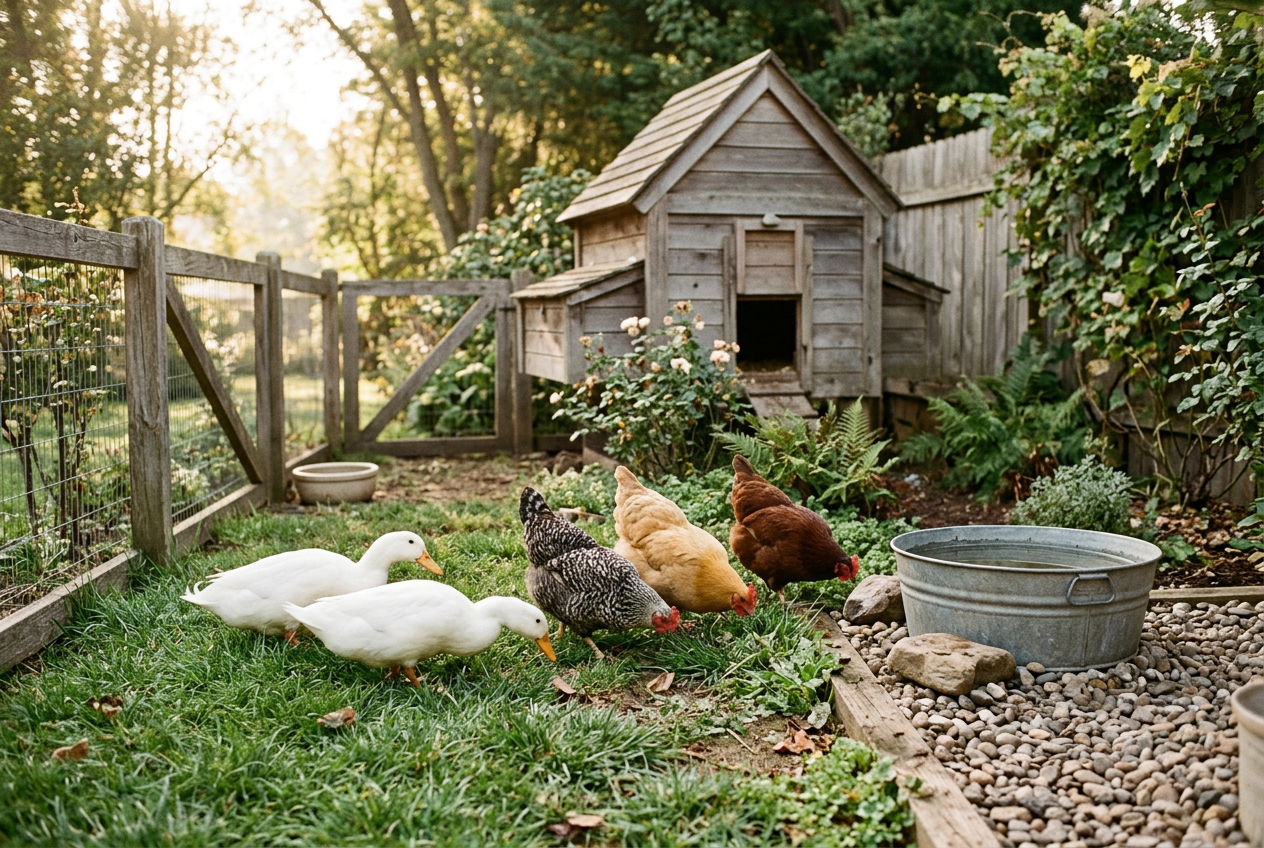
Ducks and chickens seem like they should fit together pretty easily. They're both backyard poultry, they both eat feed, they both need a secure place to sleep — and plenty of people keep them on the same property.
But once you actually combine the two, the differences become obvious. Chickens like dry bedding and elevated roosts. Ducks sleep mostly on the ground, drink a remarkable amount of water, splash that water everywhere, and produce much wetter manure.
Then there are feed differences, social dynamics, drakes — and an important biosecurity question that deserves more attention than it usually gets.
So can ducks and chickens actually live together?
Ducks & Chickens Together at a Glance
| Question | Roosted Take |
|---|---|
| Can adult ducks and chickens coexist? | Yes, with careful management |
| Is mixing them best for biosecurity? | No — separate species are safer |
| Can they share a run? | They can, but moisture, space and behavior need managing |
| Can they share a coop? | Possible, but separate sleeping zones or shelters are better |
| Can they eat the same feed? | Adults can use an all-flock feed labeled for both species |
| What about ducklings? | Nutrition and brooding needs differ; rear them separately |
| Do ducks need a pond? | No |
| Do ducks need deeper water? | Enough depth for normal head and bill grooming |
| Will ducks make the coop wetter? | Very likely |
| Can chickens use duck water? | Yes, but ducks turn shared water areas into wet zones |
| Will ducks sleep on chicken roosts? | Most won't; Muscovies are an exception |
| Are drakes a concern? | Yes — monitor and separate if they target hens |
| Should a duck live only with chickens? | Other ducks are preferable companions |
Can Ducks and Chickens Really Live Together?
From a purely behavioral and practical standpoint: sometimes, yes.
University of Vermont Extension notes that many people keep ducks and chickens in the same coop, while also pointing out the problems this creates — especially water mess, bedding moisture and differences between the species.
That's consistent with what many backyard keepers experience. The birds may forage in the same yard, eat beside one another, and share the same property for years without a serious behavioral issue. But that does not mean they have identical needs — and that's where the problems begin.
The Bigger Question: Should Ducks and Chickens Live Together?
This is different from asking whether they can. If your goal is the easiest management, the driest chicken coop, the simplest feeding, and the lowest biosecurity risk, I would keep them separate.
That matters because some Extension biosecurity guidance is much stronger than the casual advice you'll find online. Mississippi State University Extension specifically recommends not mixing multiple poultry species — particularly ducks and chickens — and recommends quarantining newly purchased birds for 30 days. USDA's current biosecurity guidance warns that wild ducks and other waterfowl may carry and spread avian influenza without showing signs of illness.
So two statements need to be kept apart. "People successfully keep ducks and chickens together" is true. "Mixing ducks and chickens is ideal poultry biosecurity" is not.
Why Are Ducks a Biosecurity Concern?
This isn't because domestic ducks are inherently unhealthy. The larger issue is waterfowl biology and exposure.
USDA identifies wild waterfowl as an important source of highly pathogenic avian influenza transmission and recommends limiting poultry exposure to wildlife and contaminated water. That's particularly relevant if your domestic ducks have access to:
- farm or natural ponds
- drainage areas
- standing water
- locations visited by wild ducks or geese
A backyard pool that only your domestic ducks use is different from an open pond attracting migrating waterfowl. If you keep chickens and ducks together, be especially careful about letting wild waterfowl mingle with the flock or share its water.
Can Ducks and Chickens Share a Coop?
They can. But I would rather give them separate nighttime spaces.
The problem isn't simply that they're different species — it's that their housing behavior is different. Chickens and ducks essentially want different bedrooms.
Chickens Roost — Most Ducks Don't
Chickens have a strong natural drive to perch at night. Most waterfowl do not. Small and Backyard Poultry, authored by University of Kentucky poultry specialist Dr. Jacquie Jacob, notes that chickens readily use perches while most waterfowl do not. One interesting exception: Muscovy ducks may roost.
For most domestic ducks, nighttime housing needs comfortable, dry floor space. So a mixed shelter needs elevated chicken roosts plus dry ground-level duck sleeping space — and you don't want the ducks sleeping directly beneath the chickens, for reasons the ducks will discover around midnight.
Chicken Roosts Should Stay Chicken Roosts
Design the chicken half normally: appropriately sized roosts, enough perch length, good ventilation, clean nesting boxes, and protection from direct drafts. Then create a separate dry ground-level area for the ducks.
You don't have to build a literal wall down the center, but the layout should acknowledge that these birds use sleeping space differently.
The Biggest Mixed-Flock Problem: Water
If you've only kept chickens, ducks will introduce you to an entirely new interpretation of "I spilled a little water."
Ducks don't just drink. They dip, splash, dabble, rinse, shake, and carry water around on their bills — and their manure contains considerably more moisture. Small and Backyard Poultry notes that ducks consume substantial water, produce watery manure and need housing designed around moisture management. University of Vermont Extension similarly warns that mixed duck/chicken housing generally requires more frequent bedding changes.
This is probably the biggest everyday reason I prefer separate sleeping areas.
Chickens Want Dry Bedding
Dry litter helps control moisture, caking, odor, ammonia and overall coop cleanliness. Put a duck water station directly beside the chicken roost and you've found a pretty efficient way to undo all of it. Our bedding guide goes deeper: Best Bedding for Chickens: Pine Shavings vs. Hemp, Straw & Sand.
Where Should Duck Water Go?
If ducks and chickens share an enclosure, keep the primary duck water station outside the sleeping coop whenever practical — or at minimum, well away from the dry sleeping and nesting zones.
Put it somewhere designed to handle water: well-drained soil, sand, gravel drainage underneath, a removable catch tray, a washable platform, or an area you can hose down easily. The goal isn't to stop ducks from being ducks. It's to contain the consequences.
What About the Run?
A duck water station over pine shavings in a poorly drained run can turn into wet organic material remarkably quickly. Around a high-use duck water area, favor a surface designed around drainage — for example, a gravel base topped with sand or another manageable surface, depending on the site. Our full comparison: Best Ground Cover for a Chicken Run: Sand vs. Wood Chips vs. Gravel.
Do Ducks Need Water Deep Enough to Dunk Their Heads?
Ducks need water access that supports normal drinking and grooming. Extension guidance recommends water deep enough for a duck to immerse its head for normal grooming.
That doesn't mean they need a swimming pool inside the coop — please don't put one there. Small and Backyard Poultry notes that ducks do not require swimming water, although they do require plentiful fresh drinking water.
Do Ducks Need a Pond?
No. Domestic ducks can be kept successfully without a pond; Small and Backyard Poultry specifically states that ducks do not need water to swim in. A pool or bathing area can provide enrichment, but drinking water is required and a pond is not.
From a biosecurity standpoint, an open natural pond that attracts wild waterfowl can create additional disease exposure. USDA recommends managing poultry access to areas frequented by wild waterfowl.
Can Ducks and Chickens Eat the Same Feed?
Adult mixed flocks can sometimes be managed with one appropriate feed — but read the actual feed label.
A 2026 Extension response addressing a mixed chicken-and-duck flock recommended an all-flock/flock-raiser feed labeled for both ducks and chickens, with free-choice oyster shell available for laying birds. It also emphasized that ducks require more niacin than chickens. That's probably the simplest mixed-adult-flock system.
A Practical Adult Mixed-Flock Feeding Setup
| Component | What to Provide |
|---|---|
| Main feed | A complete all-flock feed specifically labeled for chickens and ducks |
| Calcium | Oyster shell offered separately, free choice, for laying birds |
| Grit | Appropriate grit as needed, based on diet and natural grit access |
| Water | Fresh water near feeders — ducks shouldn't eat dry feed without it |
Why Not Just Feed Everyone Chicken Layer Feed?
Because you're managing more than chickens now. Feed formulated exclusively for laying hens isn't automatically designed to meet duck nutritional requirements. The biggest difference that repeatedly appears in Extension guidance is niacin: ducks require more of it than chickens, especially during growth.
So don't improvise on the idea that "poultry feed is poultry feed." It isn't necessarily.
Ducklings and Chicks Are a Different Story
I'd be considerably more reluctant to raise ducklings and chicks together than adult birds, because their nutrition, moisture production, heat requirements, size and growth rates don't line up.
Ducklings Need More Niacin
Small and Backyard Poultry notes that chick starter is formulated for chickens, which have a lower niacin requirement than ducks. If chick starter is used for ducklings, additional niacin may be needed; a dedicated waterfowl ration is the simpler option. For that reason, waterfowl starter is my preference for ducklings.
What About Medicated Chick Feed?
Don't assume it's safe simply because both animals are poultry. Small and Backyard Poultry advises against feeding young waterfowl medicated chicken feed or other feeds not formulated for them, because some poultry medications can cause adverse reactions in waterfowl. Read the species listed on the label — if it doesn't say it's appropriate for ducks, I wouldn't guess.
Different Brooding Temperatures Matter Too
Extension poultry guidance notes that ducklings require lower brooding temperatures and feather out differently, and University of Vermont Extension points out that size differences can create problems under shared heat plates. Then add the water: ducklings are exceptionally good at turning a dry brooder into something resembling a roadside ditch, while chicks benefit from a much drier environment.
My recommendation: brood chicks and ducklings separately. It simplifies heat, feed, niacin, water management, bedding and sanitation. Once they're fully grown, you can decide whether controlled shared space makes sense.
Can Ducks and Chickens Share a Run?
From a husbandry standpoint, yes, they can — and I'd rather share a large outdoor run than force both species into one small sleeping enclosure. But there are requirements.
Give Them Plenty of Space
University of Minnesota Extension warns that adding ducks to an established chicken flock may result in fighting and notes that ducks can injure chickens. More space provides escape distance, separate feeding and water areas, fewer bottlenecks, and more ability for each species to choose where it spends time. Don't build a mixed flock at the absolute minimum stocking density.
Don't Use a Chicken Space Calculator for Ducks
Our How Much Space Do Chickens Need? Coop & Run Size Chart + Calculator was written specifically for chickens. Waterfowl have different floor-space and moisture-management needs — Small and Backyard Poultry notes their manure contains substantially more moisture and calls for additional management of both housing and runs.
So if you're adding ducks, expand the setup. Don't simply insert three ducks into a run already built right at its intended chicken capacity.
Ducks Need Duck Companions Too
This gets lost when people build mixed flocks. A chicken is company, but it isn't a complete replacement for another duck. The Association of Avian Veterinarians describes ducks as very social and recommends housing them with other ducks when possible.
So I would not intentionally create a flock of eight chickens and one duck. If you're adding ducks, add a small duck group. Let the ducks have ducks, let the chickens have chickens — they can still share portions of the environment.
What About Drakes?
Male ducks change the calculation. Drakes can be much more intense during breeding behavior; the MSD Veterinary Manual notes that drakes frequently engage in forced copulation with females, and University of Minnesota Extension separately warns that ducks in mixed flocks may injure chickens.
So if you're mixing species and keeping a drake, watch him closely. If he chases chicken hens, grabs them repeatedly, attempts to mount them, corners them, or causes feather loss or injury — separate him immediately. I would not experiment to see whether the behavior gets worse.
The Easiest Mixed Flock
If someone told me they definitely wanted both chickens and ducks and asked for the simplest combination, I'd choose hens plus female ducks before adding roosters, drakes or breeding groups. That eliminates a significant source of conflict. It doesn't remove moisture, feeding, biosecurity or housing differences — but it simplifies behavior considerably.
Can a Rooster Live With Ducks?
He may. But watch the actual flock: you're mixing different body sizes, communication, mating behavior and social hierarchies. A bird doesn't need to understand our idea of a "mixed flock" — it only needs to decide another bird is competition or a target. If males create repeated aggression, separate them.
Should Ducks and Chickens Share Nesting Boxes?
Usually this isn't necessary. Chicken hens typically prefer elevated, enclosed nesting spots, while many domestic ducks lay closer to ground level. Create species-appropriate laying areas, don't force ducks to navigate elevated chicken boxes, and keep chicken nests protected from the ducks' wetter floor zone.
Our chicken-specific setup: Chicken Nesting Boxes: Size, Dimensions, How Many You Need & Where to Put Them.
How Do You Introduce Ducks to Chickens?
Don't buy ducks at noon and put them inside the chicken coop at sunset. Treat them like new flock members.
Step 1 — Quarantine new birds. USDA and Extension biosecurity guidance recommends keeping newly acquired poultry separate from an existing flock for at least 30 days. This is bigger than chicken-vs.-duck behavior; it's about disease.
Step 2 — Let them see each other. After quarantine, start with visual contact without direct access. A divided run works well, letting both groups get used to each other's movement, sounds and presence without competing for resources.
Step 3 — Use plenty of space. Make first direct introductions somewhere large enough that a bird can walk away — not inside a tiny enclosed coop.
Step 4 — Duplicate resources. Initially provide more than one feeder, waterer, shade area and resting spot. Don't force unfamiliar animals to compete over one bowl.
Step 5 — Watch them. Look for repeated chasing, cornering, pecking, mounting, blocked access to food or water, or one bird isolating itself. A few disagreements don't mean failure; persistent targeting is different.
Step 6 — Don't rush overnight housing. Shared daytime space going well doesn't require shared nighttime housing. A shared, supervised daytime run plus separate secure nighttime shelters is my preferred compromise.
A Better Mixed-Flock Layout
If I were designing a backyard for both chickens and ducks, I'd divide it functionally.
| Zone | What It Should Look Like |
|---|---|
| Chicken house | Dry, ventilated, elevated roosts, chicken nesting boxes, no duck bathing water |
| Duck house | Ground-level sleeping area, easy-clean bedding, enough floor space, built around moisture |
| Shared secure run | Large enough for both species, with multiple feeding locations |
| Duck water zone | Outside the shelters, drainage underneath, easy to clean, away from nests and dry litter |
| Optional duck bath | Separate from the coop, easy to dump and refill, runoff directed away from the poultry house |
| Dust bath | A protected dry area primarily for the chickens |
Ducks being nearby doesn't change the basic chicken dust-bath requirements. See Chicken Dust Bath: What to Put In It, How to Make One & What to Avoid.
The Best Compromise: Same Property, Different Bedrooms
This is probably my favorite arrangement. The birds can interact outside while you keep species-specific housing, which solves several problems at once:
- Dry chicken bedding — ducks aren't splashing drinking water beside the roost.
- Easier feeding — you can separate birds when specific diets are needed.
- Better sleeping — chickens roost, ducks sleep at ground level, and nobody compromises.
- Easier observation — if one species develops illness, aggression or feed problems, separation is already available.
- Better biosecurity control — it's still a mixed-species property, so it isn't equivalent to fully separated flocks, but separate housing gives you far more control than one shared enclosure.
Keep Duck Water Away From Wild Ducks
It may sound charming to have domestic ducks and wild mallards enjoying the same pond. From a biosecurity standpoint, it isn't.
USDA warns that wild waterfowl can carry and spread avian influenza without looking sick and recommends reducing opportunities for wild birds to access poultry areas and water sources. If your domestic birds share a pond with wild ducks, you're managing far more disease interfaces.
What About Avian Influenza?
This isn't a reason to panic about owning ducks. It is a reason to take mixed-flock biosecurity seriously.
USDA continues to identify HPAI as an ongoing threat to U.S. poultry and describes wild birds — particularly through droppings and contaminated water ��� as an important source of transmission. Basic practices include:
- prevent contact with wild birds
- isolate new birds
- clean equipment and avoid sharing contaminated tools
- maintain clean footwear and clothing practices
- monitor for illness
- contact a veterinarian or animal-health authority when unexplained significant illness or deaths occur
Biosecurity isn't just for commercial chicken farms.
How to Keep a Mixed Flock Cleaner
If you decide the benefits outweigh the added management, focus heavily on moisture.
Keep swimming water outside — not in the coop.
Put water over a drainable surface so splashing doesn't soak organic bedding every day.
Remove wet bedding quickly rather than piling dry material over saturated litter.
Ventilate the shelter. More moisture means more reason to pay attention to airflow — see Chicken Coop Ventilation: How Much Does Your Coop Need?.
Give the run somewhere to drain. If your mixed run becomes a swamp after rain, you have a drainage problem, not merely a bedding problem.
Clean water frequently. Duck water gets dirty — design the setup so cleaning it isn't an enormous project. If dumping it means dragging a 100-pound container across the yard every morning, you're going to hate the system.
Common Mistakes When Keeping Ducks and Chickens Together
- Treating ducks like waterproof chickens. Their needs overlap; they aren't identical.
- Underestimating the water mess. Probably the most common husbandry surprise.
- Putting duck water inside the sleeping coop. It makes dry chicken-litter management unnecessarily difficult.
- Feeding one species' diet without checking the label. Use a ration labeled for the animals eating it.
- Raising chicks and ducklings identically. Feed, niacin, water management and heat requirements differ.
- Providing roosts but no duck floor area. Most waterfowl won't sleep on chicken roosts.
- Keeping a lone duck with chickens. Ducks are highly social and should have duck companions when possible.
- Ignoring drakes. Male behavior can change an otherwise peaceful mixed flock quickly.
- Ignoring disease risk because the birds look healthy. Some waterfowl carry avian influenza without obvious illness.
- Assuming "they get along" means the setup works. Behavior is only one piece — you also have to manage nutrition, water, litter, disease, space and housing.
- Putting a duck pool under the chicken roost. No.
- Assuming more bedding fixes water problems. Fix the water location and drainage first, then deal with bedding.
A Simple Roosted Mixed-Flock Checklist
Before adding ducks to chickens, ask:
Housing: Can the chickens keep a dry sleeping area with proper roosts? Do ducks have sufficient ground-level sleeping space? Can you separate the species if necessary?
Water: Do ducks have appropriate fresh water? Is it outside the primary sleeping area, over a surface that drains, and easy to clean?
Feed: Is the adult ration labeled for both ducks and chickens? Do laying birds have free-choice calcium? Are ducklings getting adequate niacin, and are you avoiding feeds not labeled for ducks?
Social: Do ducks have other ducks? Is there enough space to escape aggression? Are males behaving appropriately, and can problem birds be separated?
Biosecurity: Were new birds quarantined? Is wild-waterfowl contact minimized? Are feeders and water protected from wild birds? Are you watching for signs of illness?
If several of those answers are no, fix the setup before buying ducks.
What I Would Do
Suppose I already had six backyard hens and wanted to add three female ducks. I wouldn't put three ducklings directly into the chicken coop. Instead I'd:
- Raise the ducks separately, using duck-appropriate feed, water and brooding.
- Maintain quarantine and biosecurity, especially if the birds came from another flock.
- Introduce the groups gradually, visual contact first.
- Let them share a roomy, secure outdoor area with multiple resources.
- Create a dedicated duck water station away from the chicken house.
- Give ducks separate nighttime housing, or at minimum a clearly separated dry floor zone.
- Keep the chicken roost and nest area dry — the part I'm least willing to compromise.
That gives me most of the fun of a mixed backyard flock without forcing both species into one management system.
The Bottom Line: Can Ducks and Chickens Live Together?
Yes — but that answer needs an asterisk.
Adult chickens and ducks can coexist behaviorally, and many keepers successfully maintain mixed flocks. But ducks create more moisture, need different water access, usually sleep on the ground, have different nutritional needs (particularly when young), and add another layer of disease-management complexity.
Current biosecurity guidance also gives an important reason not to treat mixed-species housing as best practice: Mississippi State specifically recommends not mixing ducks and chickens, and USDA emphasizes reducing poultry exposure to waterfowl and contaminated environments because of avian influenza risk.
So my preferred setup is same backyard if you want — different bedrooms. Give chickens a dry, ventilated, roost-focused shelter and ducks a ground-level, moisture-tolerant one. Use feed appropriate for both species, give ducks duck companions, keep duck water out of the chicken sleeping area, watch males closely, and keep wild waterfowl away.
And don't assume "they're both poultry" means "they should be managed exactly the same." That distinction is what makes a mixed flock much easier to manage.
Can Ducks and Chickens Live Together? FAQ
Can ducks and chickens live together?
Yes, adult ducks and chickens can coexist, but mixed housing creates additional challenges involving water, feed, bedding, behavior and biosecurity. For the lowest biosecurity risk and easiest management, separate species housing is preferable.
Can ducks and chickens sleep in the same coop?
They can, but separate sleeping areas are better. Chickens normally roost off the ground, while most waterfowl do not use perches.
Can ducks and chickens eat the same food?
Adult birds can use a nutritionally complete all-flock feed specifically labeled for both ducks and chickens, with calcium offered separately for laying birds. Ducks have higher niacin requirements than chickens.
Can ducklings eat chick starter?
Waterfowl starter is preferable. Chicken starter may not provide enough niacin for ducklings, so feed formulations must be evaluated carefully.
Can ducklings eat medicated chick starter?
Don't assume they can. Extension poultry guidance advises against feeding young waterfowl medicated chicken feeds not formulated for them.
Do ducks need a pond?
No. Ducks require fresh drinking water, but Extension poultry guidance states they do not require swimming water.
Do ducks need water deep enough to put their head in?
Their water should allow normal drinking and grooming. Extension guidance recommends water deep enough for normal head immersion.
Do ducks make chicken coops wet?
They certainly can. Ducks splash water and produce much wetter manure than chickens, which substantially increases litter-management demands.
Do ducks sleep on chicken roosts?
Most domestic waterfowl don't normally use perches. Muscovy ducks are a notable exception and may roost.
Can one duck live with chickens?
Chickens provide some social contact, but ducks are highly social and should be housed with other ducks when possible.
Can drakes live with chicken hens?
Use significant caution. Drakes can display forceful breeding behavior, and ducks may injure chickens. If a drake begins chasing, mounting or repeatedly targeting hens, separate him.
Can chickens and ducks share a run?
They can, provided there's sufficient space, separate feeding and watering areas, good drainage and careful observation. From a strict biosecurity standpoint, keeping species separate is safer.
Should I keep ducks and chickens separate during bird-flu outbreaks?
Follow current USDA, state animal-health and veterinary guidance. USDA emphasizes protecting poultry from wild waterfowl and strengthening biosecurity because waterfowl may spread avian influenza without showing illness.
Keep Reading
Planning your flock size? How Many Chickens Should I Get? A Practical Flock Size Guide for Beginners
Checking your chicken housing? How Much Space Do Chickens Need? Coop & Run Size Chart + Calculator
Dealing with a wet run? Best Ground Cover for a Chicken Run: Sand vs. Wood Chips vs. Gravel
Managing moisture inside the coop? Chicken Coop Ventilation: How Much Does Your Coop Need?
Choosing coop-floor bedding? Best Bedding for Chickens: Pine Shavings vs. Hemp, Straw & Sand
Sources & Further Reading
- USDA APHIS — Defend the Flock: Protect Poultry From Wildlife
- Mississippi State University Extension — Biosecurity Measures to Combat Avian Influenza Threat
- Small and Backyard Poultry — Feeding Ducks
- Small and Backyard Poultry — Raising Meat Ducks in Small and Backyard Flocks
- Small and Backyard Poultry — Perches in Housing for Small and Backyard Poultry Flocks
- University of Vermont Extension / Ask Extension — Chicks & Ducklings
- Association of Avian Veterinarians — Ducks and Socialization