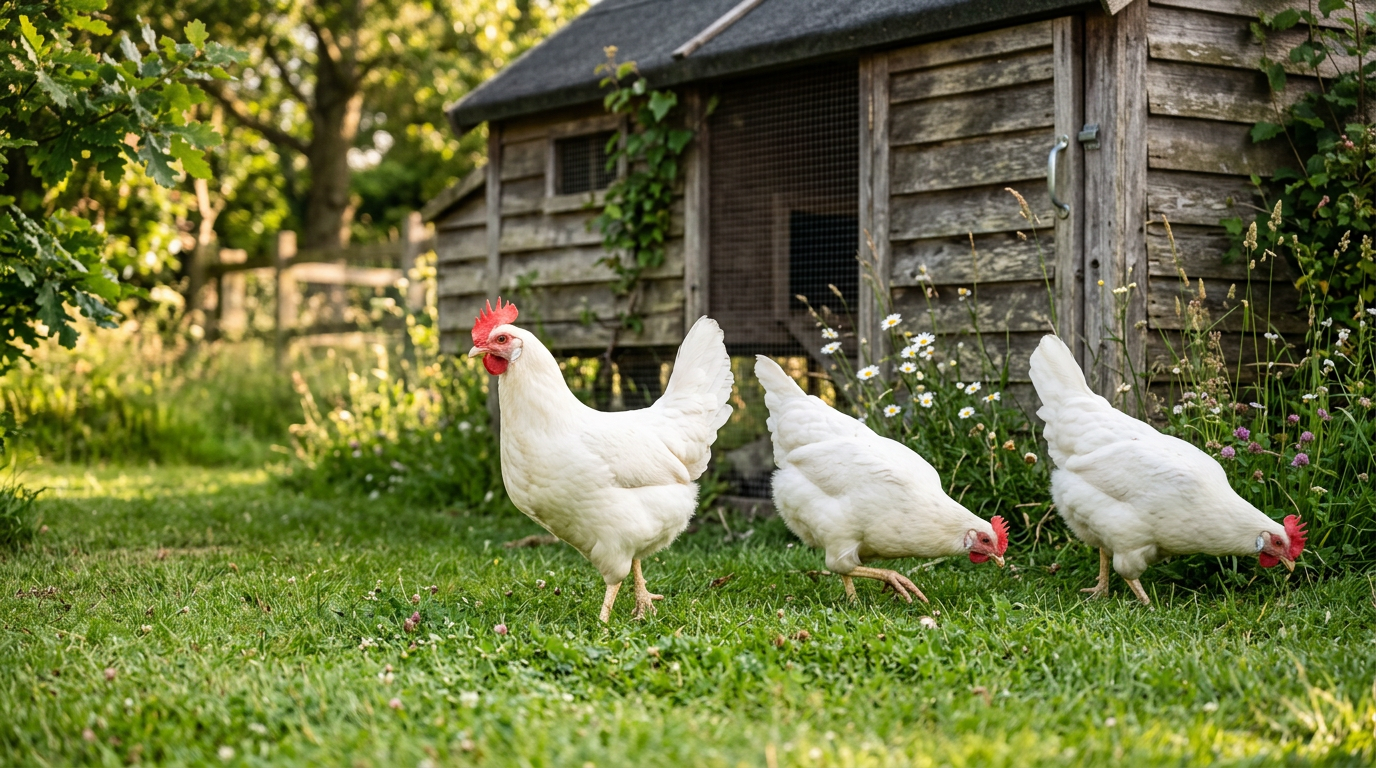
If your main reason for raising chickens is to collect fresh eggs, Leghorns deserve a place near the top of your list.
These lightweight, energetic chickens have been associated with egg production for generations. Their ability to produce large white eggs while consuming relatively little feed helped make them one of the most influential breeds in the modern egg industry.
A productive White Leghorn can lay five or more eggs a week during its prime. That's impressive for a hen weighing only about 4.5 pounds.
But there's a tradeoff.
Leghorns aren't typically the slow-moving, cuddly chickens that follow you around hoping to be picked up. They're active, curious, independent birds that would often rather be scratching through the yard than sitting in someone's lap.
For some chicken keepers, that's exactly the appeal.
For others, a calmer breed might be a better fit.
Here's what to know about Leghorn egg production, temperament, white eggs, heat tolerance, and everyday backyard care before adding them to your flock.
Leghorn Chicken Quick Facts
| Trait | Leghorn Chicken |
|---|---|
| Origin | Italy, particularly the Tuscany region |
| Breed type | Traditional standardized egg-laying breed |
| APA class | Mediterranean |
| Primary use | Egg production |
| Standard hen weight | Approximately 4.5 lb |
| Standard rooster weight | Approximately 6 lb |
| Egg color | White |
| Egg size | Generally large; varies by line |
| Annual egg production | Around 250–300 for many productive White Leghorn lines; some estimates reach 320 |
| First egg | Often around 17–22 weeks in early-maturing production lines |
| Temperament | Active, alert, independent |
| Broodiness | Low; rarely broody |
| Heat tolerance | Generally very good |
| Cold tolerance | Adaptable, but large single combs are vulnerable to frostbite |
| Comb type | Single or rose, depending on variety |
| Foraging ability | Excellent |
| Flight ability | Good |
| Noise level | Often relatively vocal |
| Beginner-friendly | Yes for egg-focused keepers; less ideal for those wanting calm pets |
| Main consideration | High activity, flightiness, and containment |
The important distinction is that a Leghorn's productivity doesn't tell you everything about its suitability for your backyard.
You also need to consider how the bird behaves.
Why Are Leghorn Chickens Such Good Egg Layers?
Leghorns were developed and refined with egg production as a major priority.
Their history begins in Italy, where relatively small chickens were valued for producing a large number of eggs without needing the same amount of feed as heavier farm birds.
As the breed spread internationally, poultry breeders continued selecting birds for productive laying characteristics.
According to the University of Wisconsin Extension, Leghorns and their descendants played an important role in developing many modern egg-producing chicken strains.
The University of Maryland Extension also identifies Leghorns as excellent layers with good foraging ability.
The Leghorn Advantage: Eggs Without a Large Body
One reason Leghorns became so successful is their body type.
A Leghorn hen weighs considerably less than many traditional dual-purpose breeds.
She's built around a relatively light frame rather than a broad, heavy body intended for meat production.
That lighter body can contribute to good feed efficiency.
In simple terms, a productive Leghorn can produce a substantial number of eggs without needing to maintain the larger body weight of a heavy chicken.
This doesn't mean every Leghorn eats exactly the same amount of feed.
Feed intake still changes with age, weather, activity, diet, and production.
But the combination of a relatively small body and strong laying potential is one of the breed's defining characteristics.
Are All Leghorns Equally Productive?
No.
This is one of the most important things to understand when researching Leghorns.
There are differences between traditional non-industrial breeding lines, exhibition-oriented birds, high-producing hatchery lines, and commercial egg-laying strains.
A carefully selected production White Leghorn may lay considerably more eggs than a traditional bird kept primarily for breed preservation or exhibition.
The name Leghorn tells you the bird's breed.
It doesn't guarantee one exact production number.
Roosted Note
When you're comparing hatcheries, look beyond the description "excellent egg layer."
Ask whether the birds come from a production-focused line or an exhibition-focused line.
If the hatchery lists an annual egg estimate, treat it as an estimate for its own breeding program, not a guarantee for every Leghorn chicken.
How Many Eggs Do Leghorn Chickens Lay?
A productive White Leghorn can lay approximately 250–300 white eggs annually, with some high-output strains estimated at 280–320 under favorable conditions.
But there's more variation within the breed than that single number suggests.
Published estimates include:
| Source | Estimated Annual Production | Context |
|---|---|---|
| Utah State University Extension | 280–320 eggs | High-producing White Leghorns |
| University of Alberta Heritage Chickens | 250–300 eggs | Its documented White Leghorn population |
| Oklahoma State University | 200 or more eggs | Broad breed description |
| The Livestock Conservancy | 150–320 eggs | Wider range across non-industrial Leghorns |
These estimates are not necessarily contradictory.
They describe different populations and levels of selection for egg production.
For a backyard keeper purchasing a production-oriented White Leghorn, approximately 250–300 eggs annually can be a reasonable planning estimate.
If you're purchasing birds from a traditional breeder, the expected range may be considerably different.
How Many Eggs Do Leghorns Lay Per Week?
A highly productive Leghorn may produce approximately five to six eggs per week during a strong laying period.
Some hens can come close to laying every day for stretches.
However, that doesn't mean a healthy Leghorn must deliver six or seven eggs every week.
A hen's reproductive cycle requires roughly 24–26 hours to produce an egg, and laying patterns naturally include pauses.
Production can also slow because of:
- Age
- Shorter daylight hours
- Molting
- Extreme weather
- Illness
- Nutritional problems
- Stress
- Individual genetics
A Leghorn that regularly lays six eggs per week during spring might produce fewer during fall or winter.
That's not automatically a problem.
How Many Eggs Can Four Leghorn Hens Produce?
If four productive Leghorn hens each average 250–300 eggs in a year, their combined annual production would be approximately:
1,000–1,200 eggs per year.
That's roughly 19–23 eggs per week when averaged across the year.
It's a planning example, not a promise.
Actual production will fluctuate throughout the year, and individual hens may perform differently.
Still, it demonstrates why Leghorns are worth considering if household egg production is your primary goal.
You can estimate your flock's output using the Roosted Chicken Egg Production Calculator.
For a broader explanation of normal laying frequency, read How Often Do Chickens Lay Eggs?.
What Color Eggs Do Leghorn Chickens Lay?
Leghorn chickens lay white eggs.

This is one of the breed's most consistent characteristics.
White Leghorns, Brown Leghorns, and other recognized color varieties are white-egg layers.
The color of a chicken's feathers does not determine the color of its eggs.
A Brown Leghorn still lays white eggs.
How Big Are Leghorn Eggs?
Leghorn eggs are generally considered large, with productive laying lines often producing large to extra-large eggs.
Egg size varies by strain and individual hen.
Young pullets commonly begin by producing smaller eggs.
As they mature, egg size often increases.
Are White Eggs Less Nutritious Than Brown Eggs?
No.
Eggshell color doesn't determine whether an egg is healthier.
Mississippi State University Extension specifically explains that brown eggs are not inherently more natural or nutritious than white eggs.
Egg nutritional characteristics depend on factors such as the hen's diet and management, not simply the shell color.
A white egg from a healthy, properly fed Leghorn can be just as nutritious as a brown egg from another breed.
So if you've been avoiding white-egg breeds because you thought brown eggs were healthier, there's no nutritional reason to make that distinction based on shell color alone.
When Do Leghorn Chickens Start Laying Eggs?
Leghorns are relatively early-maturing chickens.
Production-oriented White Leghorn pullets may begin laying around 17–22 weeks of age.
Meyer Hatchery reports that its White Leghorns commonly begin around 17–20 weeks.
Individual birds may start earlier or later depending on their breeding line, development, and environment.
That's generally earlier than some large, slower-maturing heritage breeds.
Signs Your Leghorn Is Getting Ready to Lay
Look for:
- A larger, redder comb and wattles
- Increased interest in nesting boxes
- Squatting when approached
- Changes in vocalization
- More frequent exploration of nesting areas
A Leghorn pullet may look physically mature before her reproductive system is fully ready.
Don't judge readiness by appearance alone.
Does Season Affect First Laying?
Yes.
A pullet approaching maturity during spring or summer may have a different laying timeline from one maturing as autumn daylight decreases.
Shorter days can delay or reduce egg production.
If your pullet hasn't started laying at the exact age advertised by a hatchery, that doesn't automatically indicate a problem.
Use our First Egg Calculator to estimate her first-egg window based on hatch date and breed.
For more detail, read When Do Chickens Start Laying Eggs?.
How Long Do Leghorn Chickens Lay Eggs?
Leghorns can continue laying for several years, but their highest production generally occurs when they're younger.
University of Florida Extension explains that egg production commonly declines significantly after a hen's first two or three years.
That's true of laying hens more broadly, not exclusively Leghorns.
A useful way to think about it is:
| Laying Stage | What to Expect |
|---|---|
| First eggs | Small or irregular eggs as the pullet matures |
| First productive season | Strong production in a well-managed high-output line |
| Second laying year | Often still productive, but seasonal and age-related changes become more noticeable |
| Third year and beyond | Gradual or sometimes substantial production declines |
| Older hens | May continue producing eggs, usually less frequently |
These are general tendencies, not fixed deadlines.
Some hens remain productive for longer than others.
Do Leghorns Stop Laying After Two Years?
No.
A decline in production does not mean a hen stops laying entirely.
A Leghorn that once produced five or six eggs a week may continue laying for years, but at a lower rate.
The distinction matters if you're raising chickens as long-term backyard companions rather than replacing laying birds based strictly on productivity.
How Long Do Leghorn Chickens Live?
The Livestock Conservancy reports an approximate four- to six-year average for non-industrial Leghorn laying hens.
However, this should not be treated as a guaranteed lifespan for every Leghorn.
Actual longevity varies with genetics, health, environment, reproductive issues, predator protection, and ongoing care.
A chicken's lifespan and productive laying lifespan are two different measures.
A hen can continue living long after her highest-producing years.
Are Leghorn Chickens Friendly?
Leghorns are often described as active, alert, independent, and sometimes flighty.
That doesn't automatically mean they're unfriendly.
It means they're usually more interested in exploring their surroundings than spending long periods being handled.
The Livestock Conservancy notes that Leghorns are not naturally aggressive, but some strains can be easily startled.
Oklahoma State University similarly describes the breed as active and lively.
Do Leghorns Like Being Held?
Generally, they aren't known for being especially cuddly chickens.
Some Leghorns become comfortable with people, particularly when they're raised with patient, gentle handling.
Others prefer to maintain a little distance.
A Leghorn may come running when you arrive with feed and then immediately return to scratching through the yard.
That's normal.
A bird doesn't have to enjoy being held to be comfortable around its keeper.
Are Leghorn Chickens Aggressive?
Leghorns are not generally considered naturally aggressive.
Their quick movements and nervous reactions are sometimes mistaken for aggression.
However, individual chickens can behave differently.
Roosters, in particular, should always be evaluated individually.
Never assume that a rooster will be safe around children or visitors simply because of his breed.
Are Leghorns Good With Kids?
They aren't usually the first breed I'd recommend for children who want chickens they can frequently pick up and cuddle.
The Livestock Conservancy makes a similar distinction, noting that Leghorns are less suited to people looking for relaxed companion birds.
If your family mainly enjoys collecting eggs and watching chickens forage, Leghorns may be a good fit.
If your children want calm birds that are comfortable with frequent handling, consider breeds known for more relaxed temperaments.
Roosted Note
There's a difference between a chicken that is aggressive and one that simply doesn't want to be held.
A Leghorn running away when you reach toward her isn't necessarily showing poor temperament.
She may just prefer to keep moving.
Choose chickens based on the kind of interaction you want, rather than expecting every breed to behave like a Buff Orpington.
Are Leghorn Chickens Flighty?
Yes. Leghorns are generally more flighty and active than many heavier backyard chicken breeds.
Their lightweight bodies contribute to their agility.
Oklahoma State University notes that Leghorns can fly well enough to roost in trees if given the opportunity.
That makes them different from larger, heavier breeds that tend to stay closer to the ground.
What Does Flighty Mean?
In chicken keeping, flighty usually describes birds that:
- React quickly to movement
- Startle relatively easily
- Prefer more personal space
- Move rapidly around the run
- Are more capable of jumping or flying over obstacles
- Can be harder to catch and handle
Flighty doesn't necessarily mean unhealthy, aggressive, or constantly frightened.
It can simply describe a more reactive, energetic temperament.
Can Leghorn Chickens Fly Over Fences?
Yes.
Leghorns are capable of meaningful flight, particularly compared with heavy dual-purpose chickens.
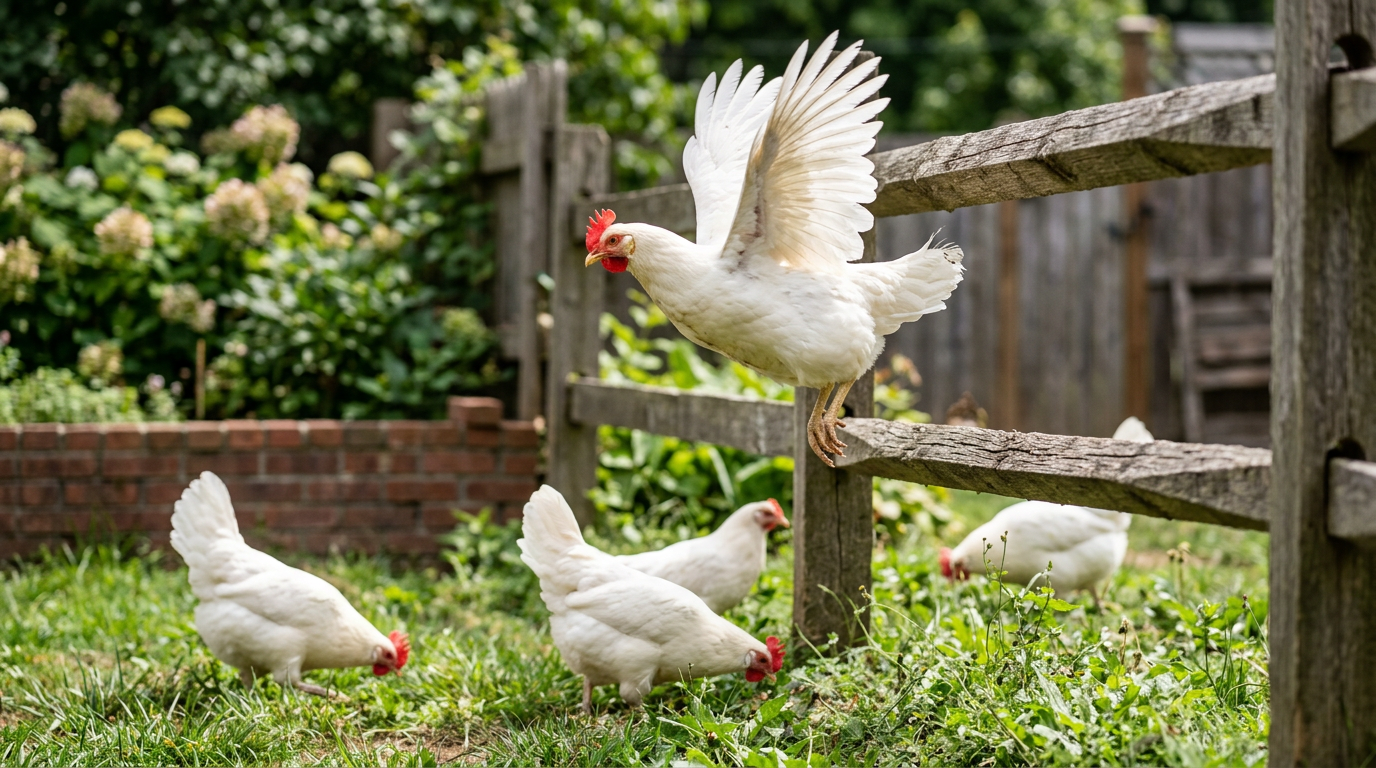
A low fence that contains a large Orpington may not contain an active Leghorn.
For backyard management, consider:
- Taller fencing where practical
- A secure covered run
- Overhead predator protection
- A reliable nighttime coop
- Removing attractive access points that lead birds outside the run
A covered run is often the simplest solution.
It helps prevent escape while also offering protection against aerial predators.
Do Leghorns Roost in Trees?
They can.
Their good flight ability means some may choose elevated outdoor perches when given unrestricted access.
However, allowing chickens to spend the night in trees creates unnecessary predator risks.
Leghorns should have secure nighttime housing just like any other backyard chicken.
Are Leghorn Chickens Noisy?
Leghorns are often described as relatively vocal birds.
University of Wisconsin Extension and Oklahoma State University both characterize them as lively or noisy.
That doesn't mean every Leghorn hen makes constant noise.
But it's reasonable to expect an active, communicative flock.
Normal sounds include:
- Contact calls
- Egg announcements
- Excited calls around feeding time
- Alarm vocalizations
- General flock communication
Are Leghorn Hens Loud?
Some can be.
The breed doesn't have a scientifically established decibel rating that allows us to say every Leghorn is louder than every Barred Rock or Australorp.
Individual behavior and environment matter.
But Leghorns aren't usually among the breeds specifically selected for quiet companion temperament.
Are Leghorn Roosters Loud?
Roosters crow, and Leghorn roosters are no exception.
If you're keeping chickens in a neighborhood with noise restrictions, carefully consider whether roosters are permitted and whether the breed's active temperament suits your property.
For an egg-focused backyard flock, you don't need a rooster at all.
Hens will lay unfertilized eggs without one.
Are Leghorns Good Free-Range Chickens?
Yes. Leghorns are excellent foragers and are particularly well suited to environments where they have room to explore.
This is one of their strongest traits beyond egg production.
The Livestock Conservancy describes Leghorns as active chickens that spend considerable time scratching and hunting for food.
University of Maryland Extension also rates their foraging ability favorably.
What Makes Leghorns Good Foragers?
Leghorns tend to spend a lot of time moving.
They enjoy investigating:
- Grass and vegetation
- Loose soil
- Fallen leaves
- Compost areas
- Insects
- Seeds
- Other natural food sources
Their relatively light bodies and active nature make them comfortable moving across larger areas.
However, free-ranging doesn't eliminate the need for complete poultry feed.
Natural forage changes with season, available vegetation, weather, and the number of chickens using the area.
A backyard flock should still receive an appropriate complete diet.
Will Leghorns Damage a Garden?
They certainly can.
A chicken that enthusiastically scratches for insects won't necessarily distinguish between a designated foraging area and freshly planted vegetables.
If you maintain flower beds or a vegetable garden, you may need fencing to keep the chickens out.
That same energetic scratching behavior can be beneficial in an appropriate chicken run, where the birds have materials to investigate.
Can Leghorns Live in a Run Instead of Free-Ranging?
Yes.
Leghorns can be kept in confinement, but they generally benefit from sufficient space and opportunities for activity.
The Livestock Conservancy warns that they can become bored when kept in areas that are too small.
Consider offering:
- Plenty of usable run space
- Dry areas for dust bathing
- Perches at different appropriate heights
- Loose litter or bedding to scratch through
- Areas with shade and cover
- Foraging opportunities and safe enrichment
A well-designed run can give Leghorns opportunities to express their natural behaviors without exposing them to unrestricted predator risks.
Are Leghorn Chickens Good for Hot Climates?
Yes. Leghorns are generally considered a good choice for warmer climates, although they still need careful summer management.
Utah State University Extension identifies Leghorns among breeds suited to hot weather.
University of Maryland Extension also explains that Mediterranean-type chickens generally perform well in hot conditions.
Their relatively light body size is one practical consideration.
Leghorns also commonly have large combs, which play a role in exchanging heat with their environment.
Why Do Leghorns Handle Heat Well?
Several breed characteristics contribute to their warm-weather suitability:
- Relatively lightweight bodies
- Mediterranean ancestry
- Active, adaptable behavior
- Comb structures that can assist heat exchange
However, heat tolerance does not mean immunity to heat stress.
An active Leghorn can still become dangerously overheated if exposed to extreme temperatures without adequate shade, ventilation, or water.
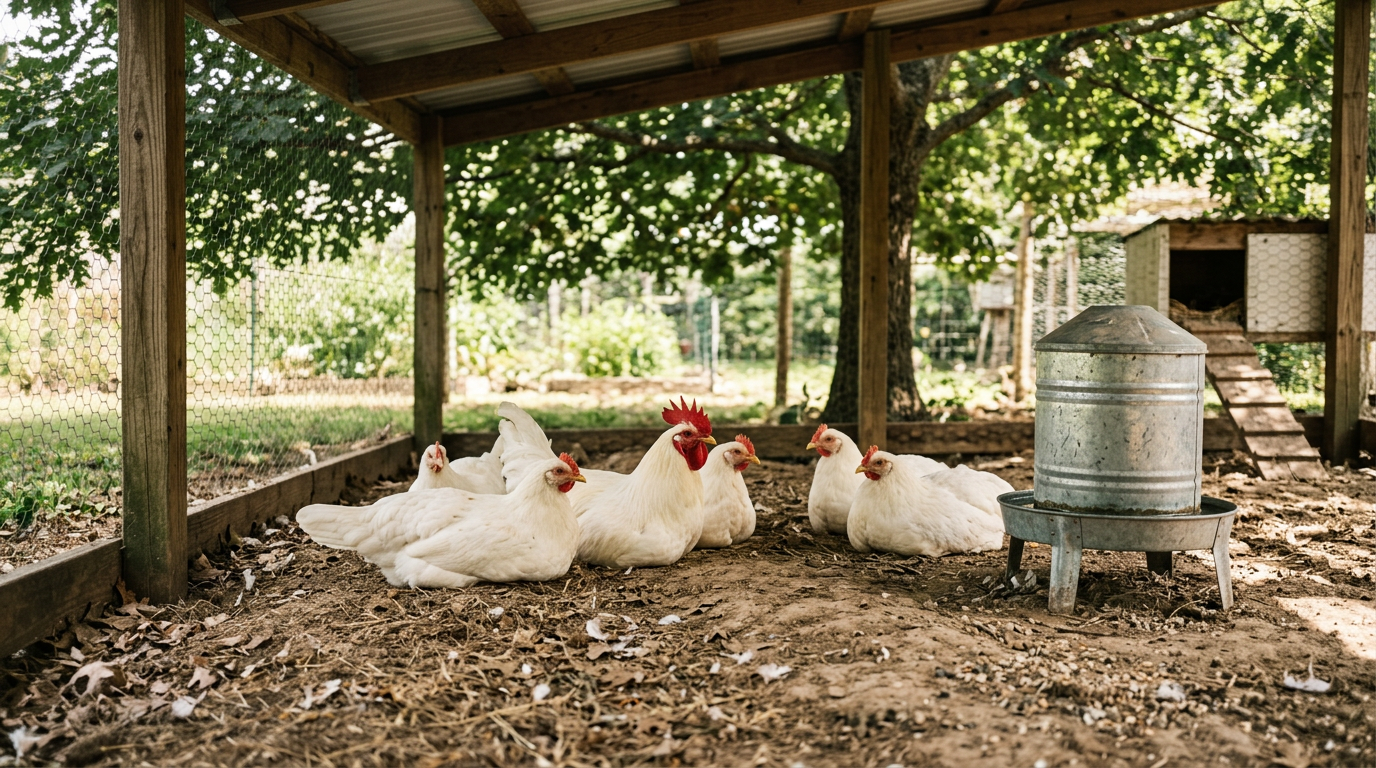
Summer Care for Leghorns
Provide:
- Shaded areas throughout the day
- Cool, clean water that is easy to reach
- Good airflow through the coop and run
- Enough space to avoid crowding
- Areas where birds can rest away from direct sunlight
- Additional water capacity during hot weather
Watch for signs of heat stress such as persistent open-mouth panting, wings held away from the body, unusual weakness, or lack of responsiveness.
If a bird shows severe signs of overheating, begin appropriate cooling measures and seek veterinary advice promptly.
Use the Roosted Chicken Water Calculator to help plan warm-weather water capacity.
Our guide to Keeping Chickens Cool in Summer explains practical ways to manage a flock through high temperatures.
Are Leghorn Chickens Cold Hardy?
Leghorns can live successfully in colder environments, but the breed's comb type matters.
Many Leghorns have large single combs.
Those combs provide considerable exposed tissue, which increases vulnerability to frostbite in freezing conditions.
The Livestock Conservancy notes that rose-comb Leghorns are particularly useful in colder climates because their lower combs are less prone to frostbite.
Single-Comb vs. Rose-Comb Leghorns
| Feature | Single-Comb Leghorn | Rose-Comb Leghorn |
|---|---|---|
| Comb appearance | Tall, upright, pointed | Low and relatively flat |
| Common association | Familiar White Leghorn appearance | Less commonly seen |
| Frostbite vulnerability | Greater exposed comb area | Reduced exposed comb area |
| Egg color | White | White |
| Basic breed type | Leghorn | Leghorn |
| Cold-climate consideration | Greater attention to comb protection | Potential comb advantage |
A rose-comb Leghorn is still a Leghorn.
It's a recognized comb variation within the breed, not a separate hybrid.
Winter Care for Leghorns
Focus on:
- Dry bedding
- Proper ventilation
- Protection from precipitation
- Avoiding direct drafts across roosting birds
- Unfrozen drinking water
- Adequate nutrition
- Monitoring exposed comb and wattle tissue
Don't confuse sealing a coop tightly with keeping chickens safe in winter.
Trapped moisture can increase frostbite risk.
For more guidance, read Chicken Coop Ventilation: How Much Does Your Coop Need?.
What Do Leghorn Chickens Look Like?
The classic White Leghorn is easy to recognize.
It has a streamlined body, white feathers, yellow legs, and a prominent red comb.
But not every Leghorn is white.
Typical breed characteristics include:
- A relatively light, slender body
- Upright, active posture
- White earlobes
- Red comb and wattles
- Yellow legs and skin
- Clean, unfeathered legs
- Four toes
- A well-developed tail
- Single or rose comb, depending on variety
University of Wisconsin Extension describes the breed as a small, lively chicken with good flight ability.
Its physical appearance reflects its egg-laying background.
Unlike the broad, rounded body of a Wyandotte or the heavy frame of a Brahma, a Leghorn is comparatively lean.
How Big Do Leghorn Chickens Get?
According to the University of Wisconsin Extension, standard Leghorn weights are:
| Bird | Standard Weight |
|---|---|
| Adult rooster | 6 lb |
| Adult hen | 4.5 lb |
| Young cockerel | 5 lb |
| Young pullet | 4 lb |
These are standardized breed weights, not exact weights for every chicken.
Commercially selected strains may vary from traditional exhibition standards.
Leghorns are small compared with many familiar dual-purpose breeds, but they are not necessarily bantams.
Standard large-fowl and bantam Leghorns both exist.
White Leghorn vs. Brown Leghorn Chickens
White Leghorns are the most familiar variety because of their association with high-volume white egg production.
But Brown Leghorns also have a long history.
Both are varieties of the same standardized breed.
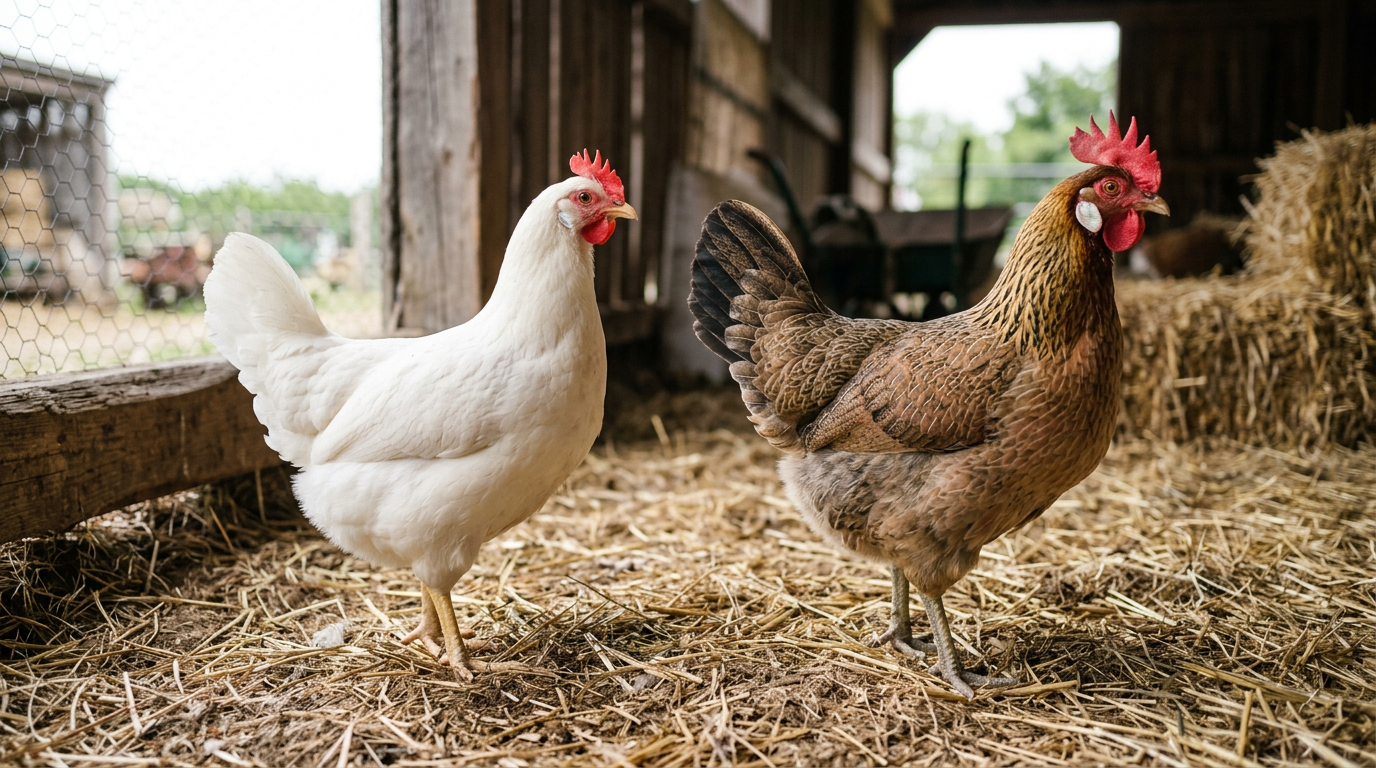
White Leghorn Chickens
White Leghorns have predominantly white plumage and are strongly associated with modern egg-focused breeding programs.
Their main appeal is high white-egg production from a lightweight bird.
Brown Leghorn Chickens
Brown Leghorns have more intricate feather coloring, with patterns that differ between males and females.
Roosters may display striking combinations of red, black, and darker feathering.
Hens generally have more subdued brown patterning that provides a very different appearance from the familiar white variety.
Brown Leghorns remain active, lightweight, white-egg-laying chickens.
White vs. Brown Leghorn Comparison
| Trait | White Leghorn | Brown Leghorn |
|---|---|---|
| Main plumage | White | Brown and patterned |
| Egg color | White | White |
| Standard body type | Lightweight | Lightweight |
| Temperament | Active and alert | Active and alert |
| Foraging ability | Good | Good |
| Egg production | Especially high in many production lines | Depends on breeding line |
| Comb varieties | Single and rose | Single and rose |
| Best reason to choose | High-output white eggs | Traditional appearance and white eggs |
The most important distinction isn't simply feather color.
It's the breeding line.
A production-focused White Leghorn and an exhibition-oriented Brown Leghorn may have noticeably different egg-production expectations.
Are Leghorns Heritage Chickens or Commercial Hybrids?
This is an important distinction.
Leghorn is a traditional standardized chicken breed, not automatically a commercial hybrid.
However, Leghorn genetics have been heavily used in developing commercial white-egg-laying populations.
The Livestock Conservancy distinguishes non-industrial Leghorns from the industrial lines that dominate much of modern egg production.
University of Wisconsin Extension similarly explains how commercial poultry breeding shifted toward specialized strains and crosses.
That means there are several different concepts to understand:
| Term | Meaning |
|---|---|
| Leghorn breed | A recognized standardized chicken breed |
| Non-industrial Leghorn | Traditional breeding populations maintained outside intensive commercial production |
| Production Leghorn | A line selected heavily for egg-laying performance |
| Commercial laying strain | A specialized breeding population selected for production; may be Leghorn-derived and is not necessarily equivalent to a standardized purebred Leghorn |
This matters for both egg expectations and breed preservation.
Not every chicken described as a White Leghorn comes from the same breeding program.
And not every commercial white-egg layer should automatically be treated as an ordinary traditional Leghorn.
If preserving recognized breed characteristics matters to you, ask the breeder about the birds' lineage and breeding goals.
If eggs are the main priority, production records may be more important than exhibition characteristics.
Do Leghorn Chickens Go Broody?
Leghorn hens rarely go broody.
The University of Maryland Extension identifies Leghorns as generally non-broody, and The Livestock Conservancy describes them as poor setters.
This is consistent with their history as egg-focused chickens.
A broody hen stops laying normally while she attempts to incubate eggs.
For a production-oriented breed, frequent broodiness interrupts egg output.
Can Leghorns Hatch Their Own Eggs?
They can produce fertile eggs when kept with a fertile rooster.
However, because they seldom develop a strong broody instinct, they aren't generally reliable choices for natural incubation.
If you want to hatch Leghorn eggs, you may need an incubator or an appropriately broody hen of another breed.
Some individual Leghorns may still become broody.
Rare doesn't mean impossible.
Housing and Space Requirements for Leghorns
Leghorns don't require unusual housing, but their activity level should influence how you design the coop and run.
For standard backyard hens, Roosted uses a general planning target of:
- 4 square feet of usable indoor coop space per bird
- 10 square feet of outdoor run space per bird
Those numbers are comfortable starting points, not universal biological minimums.
For active Leghorns, I'd favor providing more outdoor space whenever practical.
Space Planning for a Leghorn Flock
| Number of Hens | Indoor Coop Space | Baseline Outdoor Run Space |
|---|---|---|
| 3 | 12 sq ft | 30 sq ft |
| 4 | 16 sq ft | 40 sq ft |
| 6 | 24 sq ft | 60 sq ft |
| 8 | 32 sq ft | 80 sq ft |
| 10 | 40 sq ft | 100 sq ft |
For six Leghorns, approximately 24 square feet indoors and 60 square feet outdoors is the Roosted baseline.
But if your property allows a larger run, give these active birds additional room.
A Leghorn that spends its day scratching, exploring, and moving around will appreciate the space.
Use our Chicken Coop Size Calculator to plan your setup.
Roosting Bars
Leghorns are capable flyers and generally comfortable using elevated roosts.
Provide sturdy perches that are appropriately sized and positioned.
Avoid creating unsafe landing areas or arrangements that make it easy for chickens to escape outside the run.
Nesting Boxes
Standard nesting boxes work well.
One box for every three to four laying hens is a common backyard planning approach.
Keep boxes relatively quiet, clean, and easy to access.
Leghorns that have unrestricted outdoor access may occasionally choose hidden nesting locations, so encourage consistent use of designated boxes.
Predator Protection
Although Leghorns are alert and mobile, their flight ability shouldn't be mistaken for reliable predator protection.
They remain vulnerable to dogs, hawks, raccoons, and other predators.
Provide a secure run and lock the coop at night.
The Roosted Chicken Run Builder can help estimate run dimensions and materials.
Feeding Leghorn Chickens
Leghorns are efficient layers, but strong egg production still depends on proper nutrition.
A complete poultry ration appropriate for the bird's age and life stage should make up the foundation of the diet.
Feeding by Life Stage
| Stage | Feeding Approach |
|---|---|
| Chicks | Complete chick starter |
| Growing pullets | Appropriate grower ration |
| Approaching laying age | Follow the feed program's recommended transition |
| Laying hens | Complete layer feed or properly managed flock feed with adequate calcium |
| All stages | Continuous access to clean water and suitable grit when required |
Egg-laying hens need adequate energy, protein, calcium, phosphorus, vitamins, and minerals.
University of Florida Extension emphasizes that nutritional imbalances can reduce egg production.
Do Leghorns Eat Less Than Other Chickens?
Their relatively small body size can contribute to lower feed consumption compared with heavier chickens.
But avoid assuming every Leghorn has one fixed daily feed requirement.
An active Leghorn may consume different amounts depending on:
- Weather
- Body size
- Laying activity
- Foraging opportunities
- Feed formulation
- Health and age
Use the Roosted Chicken Feed Calculator to estimate flock-level feed needs.
Can Foraging Replace Commercial Feed?
No.
Leghorns are excellent foragers, but the insects, vegetation, and seeds available in a backyard do not automatically supply a complete, balanced laying diet.
Treat forage as a beneficial addition to an appropriate feeding program.
For a productive egg-laying flock, balanced nutrition matters more than trying to make chickens obtain all their food from the yard.
Are Leghorn Chickens Good for Beginners?
Leghorns can be good beginner chickens, but the answer depends on what you expect from your flock.
If you're primarily interested in producing white eggs, learning everyday chicken care, and watching active birds explore, Leghorns can be an excellent choice.
If you want especially calm chickens that are easy to catch and handle, there are often better options.
Leghorns Are a Good Fit for Beginners Who Want:
- High egg production
- White eggs
- Lightweight chickens
- Active foragers
- A relatively low tendency toward broodiness
- Birds that do well in warmer weather
They May Be Less Suitable for Beginners Who Want:
- Chickens that enjoy frequent handling
- Especially calm companion birds
- Minimal fencing or containment considerations
- A particularly quiet flock
- Hens that regularly hatch their own chicks
The care itself isn't especially complicated.
The difference is the bird's personality and activity level.
Leghorn vs. Rhode Island Red vs. Australorp
If you're choosing a breed primarily for eggs, these are useful comparisons.
All three can be productive backyard layers.
But their temperaments and physical characteristics are different.
| Characteristic | Leghorn | Rhode Island Red | Australorp |
|---|---|---|---|
| Egg color | White | Brown | Brown |
| Egg production | Very high in productive lines | High in productive lines | High in productive lines |
| Standard hen size | Light, approximately 4.5 lb | Medium-heavy, approximately 6.5 lb | Heavy, approximately 6.5 lb |
| Temperament | Active, independent | Confident, sometimes assertive | Generally calmer |
| Foraging | Excellent | Good | Variable |
| Heat suitability | Very good | Adaptable | Adaptable with shade |
| Broodiness | Low | Variable | Variable |
| Main appeal | Efficient white-egg production | Strong brown-egg production | Eggs with calmer temperament |
| Main consideration | Flightiness and activity | More assertive individuals | Larger body and summer management |
Leghorn vs. Rhode Island Red
Both have strong laying reputations.
Leghorns are smaller, typically more active, and lay white eggs.
Rhode Island Reds are heavier dual-purpose chickens that lay brown eggs.
If you want a high-producing flock and prefer active birds, Leghorns make sense.
If you want a larger, more traditional farm chicken with good brown-egg production, consider Rhode Island Reds.
Read our Rhode Island Red Chicken Guide.
Leghorn vs. Australorp
Australorps are productive brown-egg layers with a reputation for calmer behavior.
They're also heavier than Leghorns.
For a family wanting an approachable backyard flock, an Australorp may be the more comfortable choice.
For someone prioritizing efficient white-egg production, Leghorns remain particularly attractive.
Read our Australorp Chicken Guide.
Leghorn vs. Barred Rock
Barred Rocks are another practical American backyard breed.
They're heavier, generally calmer, and lay brown eggs.
Leghorns are lighter, more active, and associated with higher white-egg production in productive strains.
If you want a straightforward, all-around backyard flock, Barred Rocks are worth considering.
If you want a flock built primarily around white eggs, Leghorns may be a better match.
Read our Barred Rock Chicken Guide.
Leghorn Chicken Pros and Cons
| Pros | Cons |
|---|---|
| Excellent egg production in productive lines | More active and flighty than many backyard breeds |
| Large white eggs | Not usually the most cuddly breed |
| Lightweight body | Can fly over inadequate fencing |
| Good feed efficiency | May be relatively noisy |
| Excellent foraging ability | Large single combs can develop frostbite |
| Very good warm-weather suitability | Can become restless in cramped housing |
| Rarely goes broody | Not a dependable natural broody hen |
| Often starts laying relatively early | Egg production declines with age |
| Useful for egg-focused beginners | Less suited to people wanting calm companion chickens |
Who Should Choose Leghorn Chickens?
Leghorns are especially appealing for chicken keepers who want a productive, active backyard flock.
I'd consider them if:
- Fresh eggs are your primary reason for keeping chickens.
- You prefer white eggs.
- You want relatively lightweight birds.
- You have a secure run with room for activity.
- You enjoy watching chickens forage.
- You live in a warm climate.
- You're comfortable with chickens that may not enjoy frequent handling.
Who Might Prefer Another Breed?
You may prefer another chicken if you:
- Want particularly calm birds for children to handle
- Have limited space for an active flock
- Want chickens that are unlikely to escape low fencing
- Prefer brown, blue, or green eggs
- Want hens with strong broody instincts
- Live in a severe winter climate and don't want to manage large single combs
There's no single perfect backyard chicken.
A Leghorn's greatest strength is egg production.
Whether that makes it the best chicken for your backyard depends on everything else you want from your flock.
The Bottom Line: Are Leghorn Chickens Worth Raising?
Leghorns have earned their reputation as exceptional egg layers.
Their lightweight bodies, strong foraging instincts, early maturity, and impressive white-egg production make them valuable birds for backyard keepers who care about having a productive egg basket.
But they're not necessarily the breed for everyone.
Leghorns are active, alert, independent chickens. They can be flighty, relatively vocal, and more interested in exploring their surroundings than being handled.
For some people, that energy is exactly what makes them enjoyable.
For others, a calmer breed such as an Australorp or Buff Orpington may be a better fit.
If your priority is producing plenty of white eggs from an efficient, energetic backyard chicken, Leghorns are one of the strongest breeds to consider.
Just make sure you're choosing the whole chicken, not only the egg count.
Leghorn Chicken FAQ
How many eggs do Leghorn chickens lay?
Productive White Leghorn strains can lay approximately 250–300 eggs annually, with some Extension estimates reaching 280–320. Traditional non-industrial lines may vary considerably, so actual production depends on genetics, age, and management.
What color eggs do Leghorn chickens lay?
Leghorn chickens lay white eggs. This includes White Leghorns, Brown Leghorns, and other recognized feather-color varieties.
Are Leghorn chickens friendly?
Leghorns can become comfortable around people, but they're generally more active and independent than many other backyard breeds. They usually aren't known for enjoying frequent handling or being cuddly pets.
Are Leghorn chickens noisy?
Leghorns have a reputation for being relatively vocal, although individual noise levels vary. Hens make normal chicken calls, and roosters crow. They may be less suited to backyards with particularly strict noise concerns.
Are Leghorn chickens flighty?
Yes. Leghorns are lightweight, alert chickens that can startle easily and fly better than many heavier breeds. A secure, covered run is useful for containment and predator protection.
Are Leghorns good for hot climates?
Yes. Leghorns are considered well suited to warm climates, according to poultry Extension guidance. They still require adequate shade, ventilation, space, and fresh drinking water during hot weather.
Are Leghorns good backyard chickens?
Yes, especially for people who want productive white-egg layers and enjoy active chickens. They're less ideal for someone primarily seeking calm, frequently handled pets.
How long do Leghorns lay eggs?
Leghorns can lay for several years, but their highest production generally occurs in their early laying years. Egg output commonly declines after the first two or three years, although individual birds vary.
When do Leghorn chickens start laying eggs?
Many production-oriented White Leghorns begin laying around 17–22 weeks of age. Hatchery line, season, nutrition, and individual development can affect the timing.
Do Leghorn chickens go broody?
Rarely. Leghorns are generally considered non-broody chickens and aren't usually reliable choices for naturally incubating and raising chicks.
Do Leghorns fly?
Yes. Leghorns are capable flyers and may jump or fly over fencing that would contain heavier breeds. Some may even roost in trees when given the opportunity.
Are Brown Leghorns as productive as White Leghorns?
Both belong to the same breed and lay white eggs, but annual production depends heavily on breeding line. White Leghorns are especially associated with production-focused strains, so don't assume that every Brown Leghorn will match the egg output of a selected commercial White Leghorn.
Want to estimate what your flock could produce? Try the Chicken Egg Production Calculator →
Raising Leghorn pullets? Estimate when they may lay their first egg →
Not sure whether this breed is right for you? Try the Chicken Breed Finder →
Keep Reading
If you're planning a productive backyard flock, these Roosted resources can help:
- Chicken Breed Finder — Compare breeds by egg production, temperament, climate, and backyard suitability.
- Chicken Egg Production Calculator — Estimate how many eggs your flock might produce.
- First Egg Calculator — Estimate when your pullets could begin laying.
- Chicken Feed Calculator — Plan daily and monthly feed requirements.
- Chicken Coop Size Calculator — Work out how much indoor and outdoor space your chickens need.
- How to Keep Chickens Cool in Summer — Practical summer flock management.
- How Often Do Chickens Lay Eggs? — Understand laying frequency and normal variation.
- Why Are My Chickens Not Laying Eggs? — Troubleshoot changes in production.
Sources & Further Reading
- Utah State University Extension — Managing Chickens From Chicks to Peak Egg Production — White Leghorn egg-production estimates, breed selection, temperament, and warm-weather suitability.
- The Livestock Conservancy — Leghorn, Non-Industrial Chicken — Breed history, egg-production variation, temperament, foraging, broodiness, lifespan, and comb characteristics.
- Oklahoma State University — Leghorn Chickens — Standard body weights, breed characteristics, egg color, activity, flight ability, and varieties.
- University of Wisconsin Extension — Chicken Breeds & Varieties — Leghorn classification, comb types, standard weights, and the history of egg-laying strains.
- University of Maryland Extension — Choosing the Best Poultry Breed for Your Small Farm — Breed comparisons, egg production, foraging, climate considerations, and broodiness.
- University of Alberta — White Leghorn Heritage Chickens — Documented White Leghorn population and production estimates.
- Mississippi State University Extension — Choosing the Right Breed for Your Backyard Flock — Egg-breed selection, Leghorn characteristics, and eggshell color nutrition misconceptions.
- Meyer Hatchery — Breed Spotlight: The White Leghorn — Hatchery-specific laying maturity, productive characteristics, and backyard temperament.
- University of Florida IFAS Extension — Factors Affecting Egg Production in Backyard Chicken Flocks — Age-related laying declines, nutrition, molting, and causes of production changes.