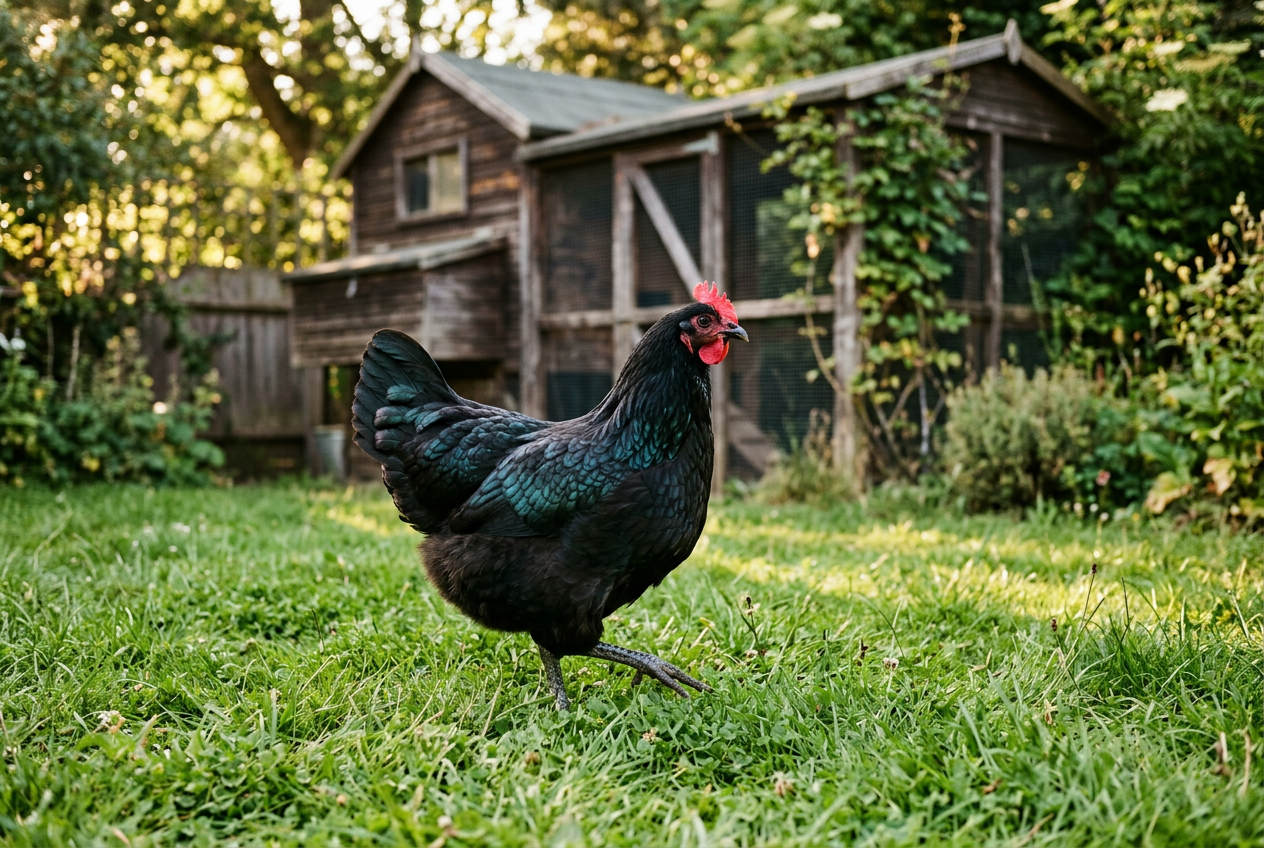
Australorps have one of the most interesting origin stories in the chicken world.
They began with English Orpington stock, but Australian poultry breeders took those birds in a very different direction. Instead of emphasizing the large, heavily feathered table-bird qualities that became associated with Orpingtons, Australian breeders pushed hard for egg production, efficiency, and practical farm utility. The result eventually became its own breed: the Australorp.
That history still defines the bird today. Australorps are medium-heavy chickens that combine excellent laying potential with enough body size to remain genuinely dual-purpose. They're also known for being active without being excessively flighty, generally gentle around people, and capable of fitting into a wide range of backyard flock setups.
And unlike some breeds whose famous production claims are mostly marketing, the Australorp has actual historic laying records behind its reputation.
Australorp Quick Facts
| Trait | Australorp |
|---|---|
| Primary use | Eggs and dual-purpose utility |
| Origin | Australia |
| Ancestry | Developed primarily from Black Orpington stock |
| APA class | English |
| Hen weight | About 6.5 lb |
| Rooster weight | About 8.5 lb |
| Egg color | Tinted to light brown |
| Egg size | Medium to large |
| Egg production | Excellent; 250+ annually reported for productive backyard birds |
| Temperament | Active yet gentle |
| Broodiness | Variable; historically selected downward but some hens still brood |
| Foraging | Good |
| Confinement | Handles it well, but benefits from exercise and foraging |
| Heat management | Provide plenty of shade, especially for black birds |
| Best for | Eggs, beginners, homesteads, families, mixed utility flocks |
| Main care consideration | Prevent inactivity/overconditioning and provide summer shade |
The combination of production + temperament + practical size is what separates the Australorp from both its Orpington ancestors and lightweight specialist layers.
What Makes Australorp Chickens Unique?
The easiest way to understand an Australorp is to compare it with the breed it came from. English breeders were developing the Orpington into a large, heavily feathered bird with strong meat qualities. Australian breeders looked at similar Black Orpington stock and asked a different question: how productive can we make this chicken?
That difference in breeding goals eventually created a noticeably different bird. The Livestock Conservancy explains that Australians imported Black Orpingtons from England between roughly 1890 and 1900 and then selected them heavily for laying ability. Breeders also used other genetics, including Minorca, White Leghorn, and Langshan influences, while continuing to select for practical production.
Over time, the Australian birds became trimmer than English Orpingtons, more production-oriented, more active, less heavily feathered, and better known for egg output. Eventually they stopped being thought of merely as Australian Orpingtons and became Australorps.
That's what makes this breed particularly interesting: it represents an early version of purposeful production breeding without abandoning the traditional dual-purpose chicken altogether.
Australorp History, Size & Appearance
Where Did Australorps Come From?
The foundation came from Black Orpington chickens imported into Australia. Australian breeders valued egg production more heavily than the meat-focused direction Orpington breeders were taking in England, and by the early 1900s Australian-bred Orpingtons were already performing strongly in egg-laying competitions.
During their development the birds went by several names, including Australian Utility Black Orpington, Australian Laying Orpington, and Australs. By the early 1920s, Australorp became the accepted name, and the breed was recognized by the American Poultry Association in 1929.
What Does an Australorp Look Like?
The classic American Australorp is black. A good Black Australorp has:
- glossy black plumage
- a greenish or beetle-green sheen in sunlight
- dark eyes
- a moderately deep body
- a red single comb and red earlobes
- dark/slate shanks
- white or pinkish-white skin underneath
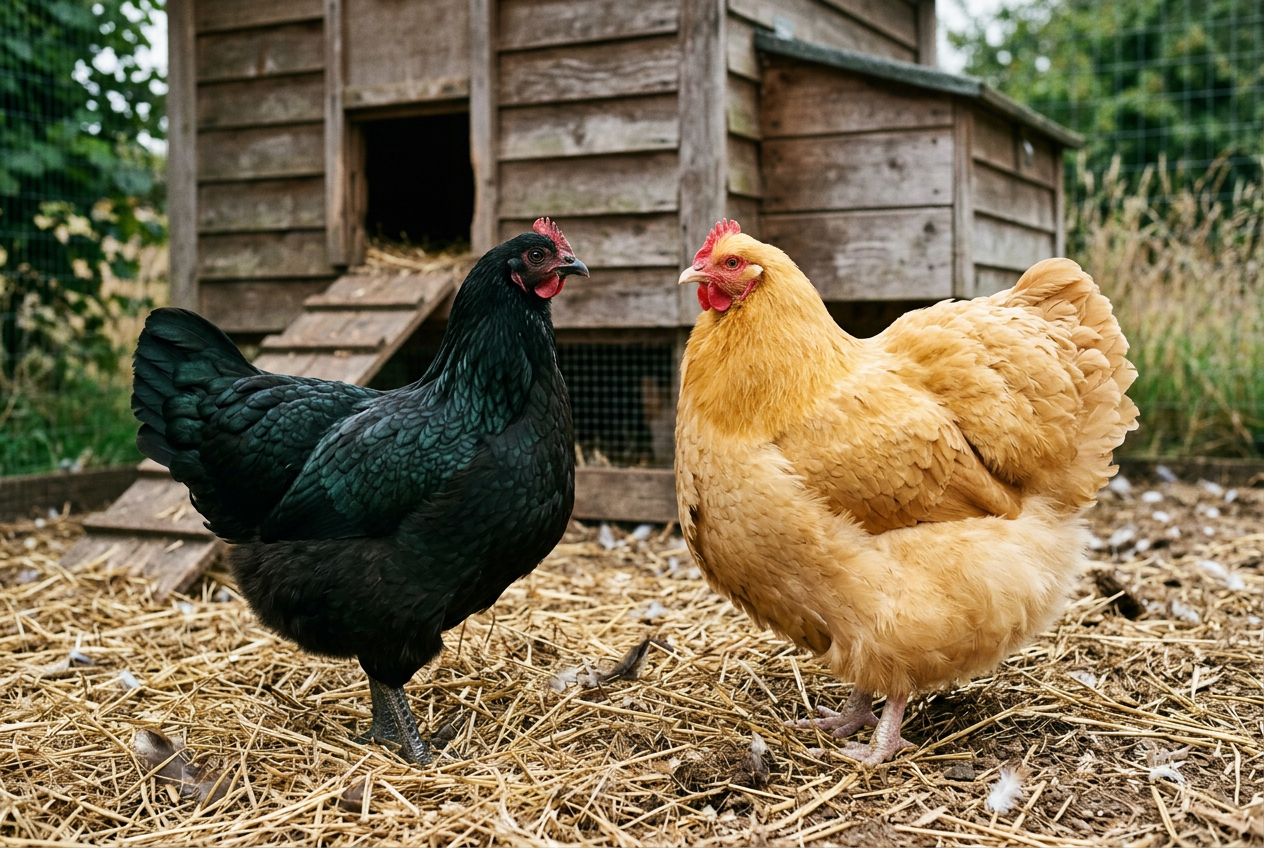
Oklahoma State describes the breed as smaller and trimmer than the Orpington from which it was developed, and that distinction matters visually. A Buff Orpington looks broad, fluffy, and almost excessively round. An Australorp still looks substantial, but generally appears cleaner, tighter, and more athletic.
How Big Do Australorps Get?
Standard large-fowl weights are approximately:
| Bird | Standard Weight |
|---|---|
| Rooster | 8.5 lb |
| Hen | 6.5 lb |
| Cockerel | 7.5 lb |
| Pullet | 5.5 lb |
Those weights are reported consistently by both Oklahoma State and The Livestock Conservancy. This puts the Australorp in an especially useful middle ground — substantial enough to retain dual-purpose value without reaching the bulk of breeds such as Buff Orpingtons, Brahmas, or Jersey Giants.
What Colors Do Australorps Come In?
This is one area where country and poultry-standard differences matter. The current American Poultry Association accepted-breed list recognizes the Black Australorp in large fowl and bantam form in the United States. Other Australorp colors exist internationally and in breeding populations, including blue and white varieties.
So if you're buying a bird specifically for exhibition in the United States, don't assume that every Australorp color recognized elsewhere is currently an APA-recognized large-fowl variety.
The Australorp Egg-Laying Records
We don't usually give historic production records their own section in Roosted breed guides. The Australorp deserves one, because its entire identity was shaped by competitive egg laying.
In 1922–23, six Australorp hens at Geelong, Victoria laid 1,857 eggs in 365 days — an average of 309.5 eggs per hen. Then individual hens began pushing the record even higher: one recorded 347 eggs in 365 days, another 354 eggs in twelve months, and eventually one Australorp hen produced 364 eggs in 365 days.
These figures are documented in the breed history maintained by The Livestock Conservancy, and Oklahoma State also notes the 364-egg world record from official Australian trap-nest testing. That's remarkable. But it needs context.
The 364-Egg Record Is Not a Backyard Production Promise
You should not buy four Australorps and calculate 4 × 364 = 1,456 eggs every year. Those historic birds were exceptional individuals from highly selected laying lines under controlled testing.
The records prove the breed's production potential. They do not define what every modern Australorp hen will do. The impressive number is real; using it as a guaranteed modern production figure would not be.
Australorp Egg Production
Australorps still deserve their reputation as strong layers. The Livestock Conservancy currently describes a backyard Australorp as capable of laying 250+ eggs per year, with medium-to-large tinted or light-brown eggs.
For practical planning, that puts a productive hen at roughly 4–5 eggs per week averaged across good production periods. Individual birds will vary.
What Affects Australorp Egg Production?
Just like every laying breed, output depends on bloodline, age, season, daylight, nutrition, molt, health, broodiness, and the individual hen. A utility Australorp from a hatchery selected strongly for eggs may perform differently from an exhibition line selected primarily for body shape and feather quality.
For the bigger picture on laying rhythms, see How Often Do Chickens Lay Eggs?
Are Australorps Good Egg Layers?
Yes. This is one of the breeds where I'd comfortably call egg production excellent. The Livestock Conservancy describes the breed as productive, and its historical breed-comparison materials classify Australorps as excellent layers.
That doesn't mean they outperform every modern hybrid — commercial laying hybrids are optimized far more aggressively for egg production. But among traditional breeds, Australorps are very competitive.
What Color Eggs Do Australorps Lay?
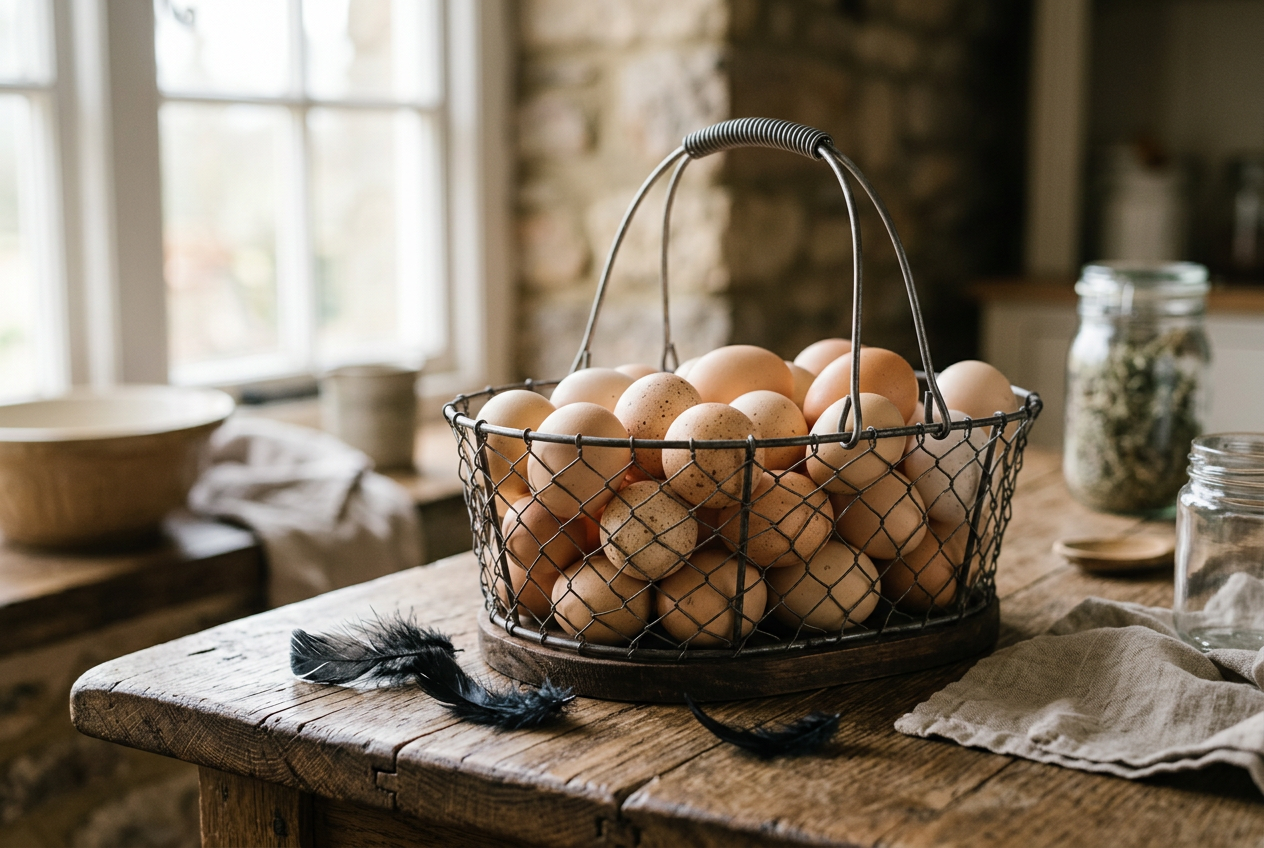
Australorps produce tinted to light-brown eggs. Oklahoma State simply categorizes them as brown-shell layers, while The Livestock Conservancy describes the eggs more specifically as tinted to light brown. Don't expect chocolate brown, blue, green, or olive — this is a traditional neutral-to-brown egg layer.
How Big Are Australorp Eggs?
The Livestock Conservancy lists medium-to-large eggs, averaging approximately 26–27 ounces per dozen in its breed description. Modern hatchery descriptions frequently market them as large brown-egg layers, so individual lines can vary somewhat.
When Do Australorps Start Laying?
Australorps are relatively early-maturing compared with many heavier heritage breeds. Murray McMurray Hatchery reports that its Black Australorp pullets generally begin laying at around 5–6 months.
I'd treat that as a practical hatchery estimate rather than a universal biological deadline. A particular pullet can start earlier or later depending on strain, season, daylight, diet, and development. For the broader laying timeline, see When Do Chickens Start Laying Eggs? Age, Signs & What to Expect.
Australorp Temperament & Flock Compatibility
One reason Australorps are so useful as backyard chickens is that their production ability doesn't come attached to an excessively nervous temperament. The Livestock Conservancy describes them as active, yet gentle — and that's a good description.
I wouldn't expect the average Australorp to behave exactly like a heavy, very laid-back Buff Orpington. But they're also not typically described like an extremely flighty Mediterranean layer. They occupy a useful middle ground: curious enough to forage, calm enough to manage easily.
Are Australorps Friendly?
Generally, yes. The Livestock Conservancy specifically describes Australorps as friendly, notes that even the roosters have a good reputation, and recommends the breed for youth poultry projects. That makes them appealing for family flocks, beginners, 4-H and youth projects, and people who want birds comfortable around humans.
Individual personality still matters. A breed description can tell you what's typical; it cannot guarantee the personality of every chicken.
Are Australorps Good With Children?
They can be an excellent choice. Their manageable size, generally gentle temperament, lower flightiness, and sturdy body make them easier for many families to work with than very nervous breeds.
Children should still be taught to approach slowly, avoid chasing, support the bird properly, respect individual behavior, and wash hands after poultry contact.
What Are Australorp Roosters Like?
The breed has a comparatively favorable reputation for male temperament. That is not the same as saying every Australorp rooster is safe. An adult rooster should always be evaluated individually — watch for charging, biting, spur use, excessive territorial behavior, aggression toward children, and excessive mating pressure.
Breed tendency gives you a starting expectation. The individual bird determines what you actually have.
Can Australorps Live With Other Breeds?
Usually, yes. The Livestock Conservancy specifically notes that they do well with breeds of similar temperament, and they're large enough to fit comfortably into many standard mixed flocks without being enormous. Good companions include Buff Orpingtons, Plymouth Rocks, Rhode Island Reds, Easter Eggers, and Sussex. As always, actual flock dynamics matter more than the breed list.
Broodiness & Mothering Ability
Australorp broodiness has an interesting history. During the development of the breed, Australian breeders deliberately selected against broodiness because a hen sitting on eggs isn't laying eggs for a production contest. The Livestock Conservancy notes that the major early Australorp lines were bred to reduce broodiness, contributing to the breed's commercial success.
And yet modern Australorps have not completely lost the trait. The same breed profile describes them as generally good sitters and mothers. That may sound contradictory, but it really isn't.
Do Australorps Go Broody?
Some do. The better interpretation is that Australorps aren't as relentlessly broody as breeds selected strongly for mothering, but broodiness still occurs, and different bloodlines may behave differently.
If you need a hen almost guaranteed to brood, I'd choose something like a Silkie. If you want a productive laying breed that still occasionally produces capable broody hens, the Australorp can fit that balance nicely.
Are Australorps Good Mothers?
When an Australorp does commit to broodiness, the breed has a solid reputation for maternal ability. That's useful for natural hatching, small homestead breeding, and keepers who don't want to incubate every clutch artificially. But don't buy an Australorp because you're counting on every hen going broody.
Australorp Lifespan & Long-Term Production
There isn't a strong reason to assign Australorps one precise breed-specific lifespan. For planning purposes, roughly 6–8+ years is reasonable for a well-managed chicken, with some individuals living considerably longer and others shorter. Genetics, disease, predators, housing, nutrition, accidents, and veterinary care matter much more than a breed-name lifespan promise.
Their Best Laying Years Come Earlier
The famous laying record doesn't mean an Australorp produces at peak level forever. Egg production generally declines with age, and a hen can remain a healthy flock member long after her strongest production years have passed. For anyone building a flock around eggs, that's worth planning for before the birds arrive.
Housing, Roosts & Space Requirements
Australorps are straightforward standard-size chickens. You do not need a specialized Australorp coop — you need a good chicken coop.
Coop Space
Roosted's general backyard target remains about 4 square feet of usable indoor space per standard hen. For four Australorps, I'd start around 16 square feet indoors and happily build larger if the property allows. That gives you more flexibility around bad weather, litter management, feeders, social dynamics, and future flock growth.
Use the complete calculator: How Much Space Do Chickens Need? Coop & Run Size Chart + Calculator
Run Space
Our usual planning target is about 10 square feet per chicken outdoors, and Australorps can make good use of more. They're active enough to enjoy scratching, foraging, exploring, and dust bathing rather than spending their entire day parked beside the feeder.
Roosts
Normal sturdy wooden roosts work well. Provide enough perch length, stable attachment, comfortable width, sensible height, and easy access. Australorps are reasonably capable birds and don't need the unusually low roost systems we'd recommend for giant Brahmas or poor-flying Silkies.
Nesting Boxes
Normal standard-sized nesting boxes accommodate Australorp hens comfortably, and you don't need one box per bird. For dimensions and ratios, see Chicken Nesting Boxes: Size, Dimensions, How Many You Need & Where to Put Them.
Feeding & Weight Management
Australorps became famous as efficient production birds. That doesn't mean nutrition should be complicated — feed according to age, growth stage, and laying status.
Feed by Life Stage
Chicks: complete chick starter.
Growing pullets: an appropriate grower ration.
Laying hens: complete layer feed or a properly managed flock ration.
All birds: constant clean, fresh water.
That's the foundation.
Don't Feed for the World Record
The famous 364-egg hen is not a reason to start adding random supplements to your flock. A nutritionally complete poultry ration should do most of the work, and treats should remain supplemental.
Australorps Can Become Overconditioned
This is a particularly useful breed-specific point. The Livestock Conservancy notes that Australorps tolerate confinement but may get fat if kept only in confinement, which is one reason allowing them to forage and exercise is useful.
A productive hen needs adequate nutrition. She does not need unlimited treats plus limited movement. Look at body condition, activity level, treat intake, and available run space rather than using the bird's appearance as your only indicator.
Cold Weather & Summer Heat
Australorps are fairly adaptable birds, and The Livestock Conservancy's breed-comparison material describes them as doing well in both cold and heat. But one feature deserves extra attention in warm climates: their color.
Summer Heat & Black Plumage
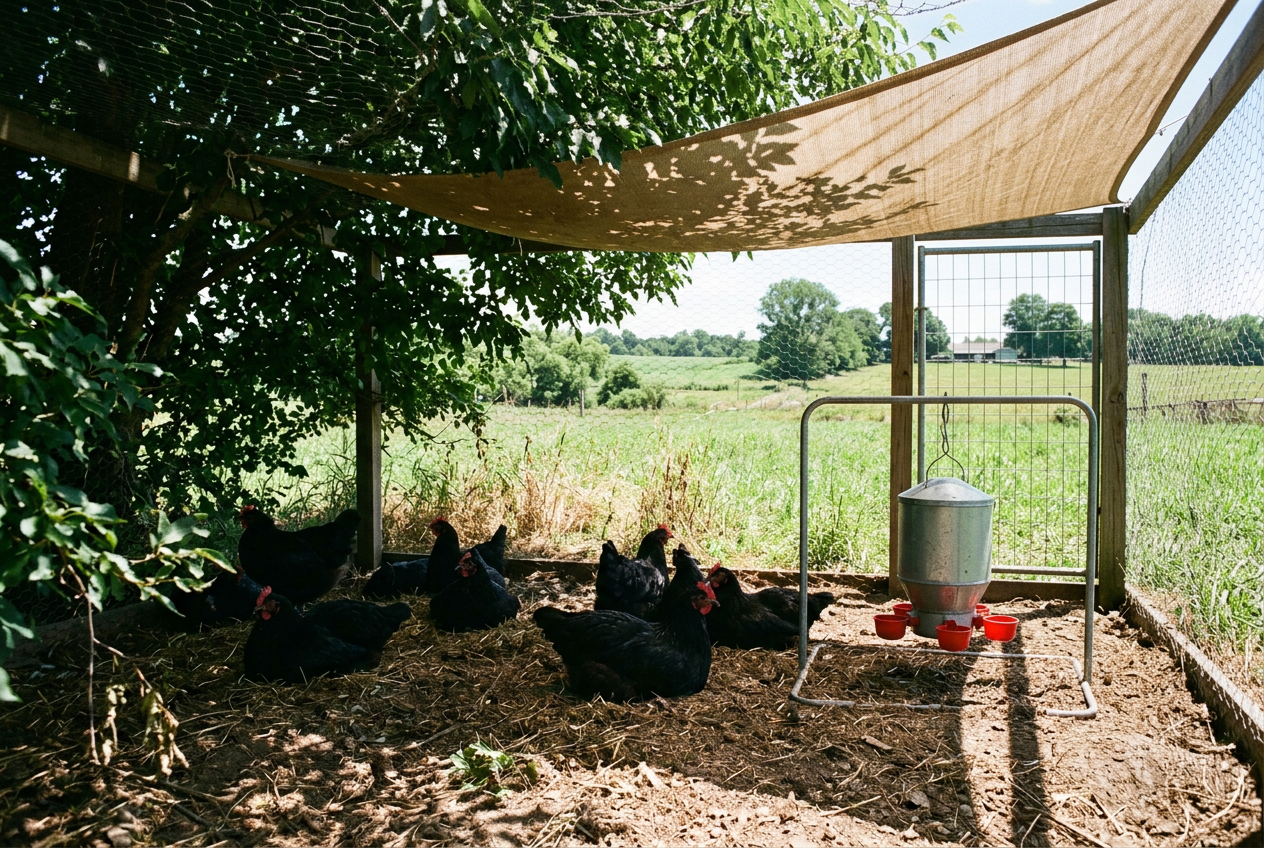
The Livestock Conservancy specifically recommends ample shade in warm weather because black plumage can contribute to overheating in direct sun. In hot regions, provide substantial shade, clean cool water, good coop ventilation, air movement, and adequate space.
Don't build a black-chicken run with full afternoon sun, a metal roof, and no shade and assume breed hardiness will solve the problem. For more, see How to Keep Chickens Cool in Summer.
Cold Weather
Australorps also handle cooler conditions well under normal backyard management. Provide dry bedding, adequate ventilation, unfrozen water, protection from precipitation, and no concentrated drafts over the roost.
Their single comb is more exposed than the pea comb of a Brahma or the rose comb of some cold-climate breeds, so exposed comb tissue still deserves normal attention during severe cold. For winter airflow, see Chicken Coop Ventilation: How Much Does Your Coop Need?
Free-Ranging & Foraging
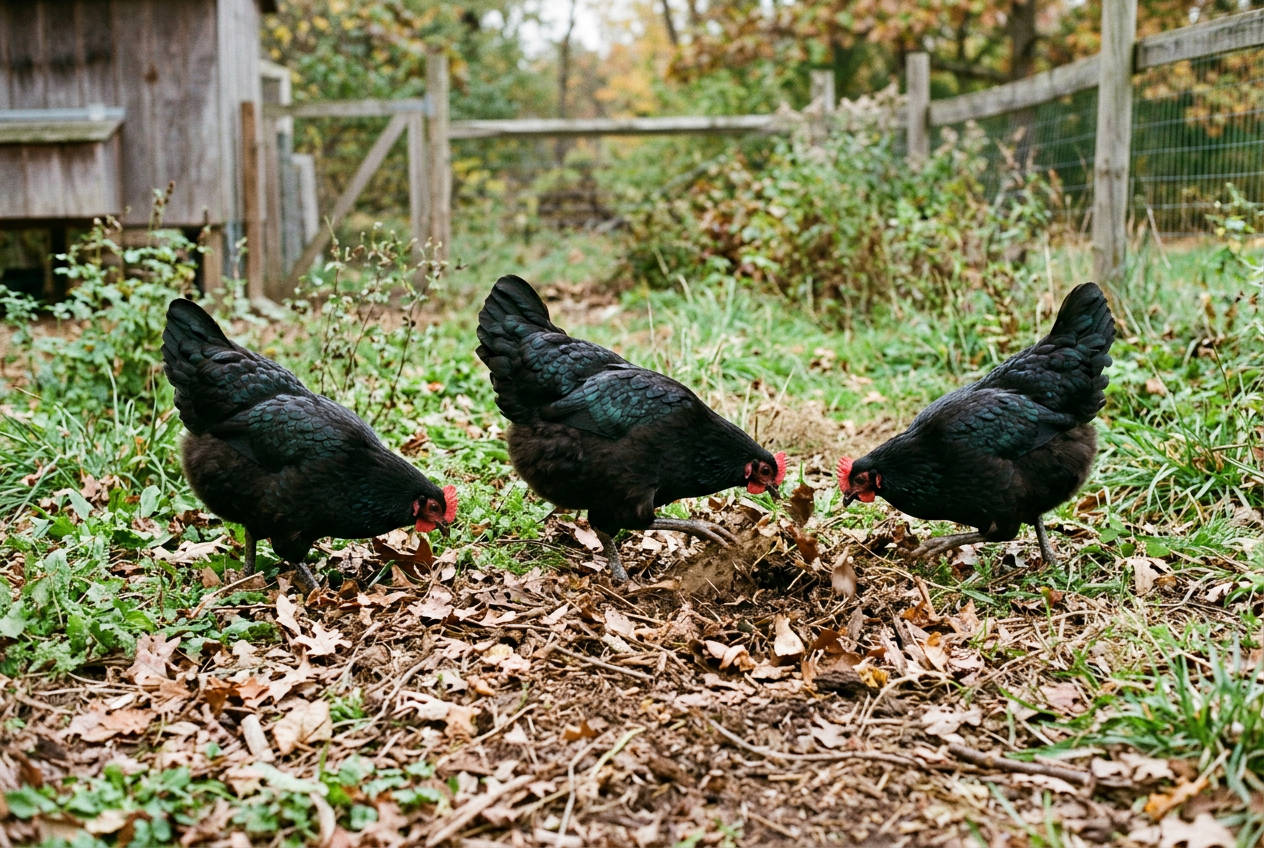
Australorps are a good example of a breed that can function well in confinement without being a bird I'd want permanently inactive. The Livestock Conservancy says they handle confinement but should also have opportunities to forage, something the breed enjoys. That makes them a good fit for roomy permanent runs, supervised free-ranging, homestead systems, and pasture-oriented flocks.
Are Australorps Good Foragers?
Yes. They're active birds and retain useful foraging behavior — part of what made them practical farm chickens rather than birds developed only for exhibition. If you want a flock that actually makes use of a larger run, Australorps fit better than extremely sedentary breeds.
Will Australorps Stay Inside a Fence?
They're not usually thought of as extreme flyers, but they're lighter and more active than breeds such as Brahmas or heavy Orpingtons. Don't treat a decorative garden border as secure poultry fencing — containment and predator protection remain separate design questions.
Australorp vs. Similar Chicken Breeds
Australorps are particularly useful to compare because they sit right between heavy dual-purpose birds and more production-focused layers.
| Characteristic | Australorp | Buff Orpington | Rhode Island Red | White Leghorn |
|---|---|---|---|---|
| Main appeal | Excellent eggs + gentle dual-purpose utility | Calm family dual-purpose bird | Hardy practical brown-egg layer | Maximum egg efficiency |
| Hen weight | ~6.5 lb | ~8 lb | ~6.5 lb | ~4.5 lb |
| Egg color | Tinted/light brown | Brown | Brown | White |
| Egg size | Medium–large | Large–extra large | Large | Large |
| Egg production | Excellent | Moderate–good | Good–excellent by line | Excellent |
| Temperament | Active yet gentle | Very calm | Confident/active | Active, often more flighty |
| Broodiness | Variable | Fairly common | Variable | Low |
| Foraging | Good | Moderate | Good | Very good |
| Main consideration | Can overcondition in confinement; needs shade in heat | Larger body, heat management | Strain variation | More active/flighty temperament |
Australorp vs. Buff Orpington
This is the most historically important comparison. The Australorp grew out of Orpington stock, but Australian breeders pushed toward egg production while Orpington breeders increasingly emphasized a large body, table qualities, and exhibition type. The result is visible today.
Choose the Australorp if you want stronger egg production, a trimmer body, more active foraging, and less extreme feather volume. Choose the Buff Orpington if you want larger body size, an especially calm temperament, stronger broodiness, and a more traditional heavy dual-purpose feel.
Read: Buff Orpington Chickens: Egg Production, Temperament & Care
Australorp vs. Rhode Island Red
These two make a very practical comparison. Both are medium-heavy, strong brown-egg producers, useful foragers, and dual-purpose breeds. The Australorp generally carries a particularly gentle reputation, while Rhode Island Reds often come across as somewhat more confident or assertive, depending on strain.
Production can be excellent in either. If eggs are your main goal, pay close attention to the specific breeder line rather than choosing between them entirely by breed name.
Read: Rhode Island Red Chickens: Eggs, Temperament & Complete Care Guide
Australorp vs. White Leghorn
This is essentially balanced utility vs. specialized production. The Australorp gives you more body size, a calmer temperament, brown eggs, and dual-purpose value. The Leghorn gives you lower body weight, exceptional feed-to-egg efficiency, high white-egg production, and much more active behavior.
If the only scoreboard is eggs produced per pound of chicken, the Leghorn is difficult to beat. If you want a calmer, more substantial backyard bird while still getting excellent production, the Australorp becomes very appealing.
Are Australorps Good for Beginners?
Yes — this may be one of the easiest breed recommendations in the Roosted library. The Livestock Conservancy specifically highlights Australorps as good birds for youth projects, and its heritage breed material classifies them as appropriate for novice keepers.
They combine strong egg production, manageable body size, a generally gentle temperament, useful foraging, tolerance of confinement, straightforward housing requirements, and broad climate adaptability. Their care isn't specialized. You mostly need to understand: don't overfeed them, give them room to move, and provide shade in hot weather.
Australorp Pros & Cons
| Pros | Cons |
|---|---|
| Excellent egg-production heritage | Not as efficient as modern commercial hybrids |
| Generally gentle temperament | Can gain excess weight with too little activity |
| Useful dual-purpose body | Black plumage benefits from summer shade |
| Good foragers | Single comb needs normal cold-weather attention |
| Handles confinement reasonably well | Broodiness is inconsistent |
| Good family/youth breed | Exact production varies by line |
| Medium-heavy, manageable size | U.S. exhibition color options are limited |
| Attractive black-green sheen | Not a novelty egg-color breed |
Australorps Are a Good Fit If You Want
- plenty of eggs
- calm backyard chickens
- brown/tinted eggs
- good foraging ability
- dual-purpose utility
- family-friendly birds
- a productive heritage breed
- a flock that can use both a run and free-range time
Consider Another Breed If You Want
- blue or green eggs (look at Easter Eggers)
- extremely small birds
- maximum modern hybrid efficiency
- very strong, predictable broodiness
- giant chickens
- a large selection of APA-recognized color varieties in the U.S.
Recommended Setup for Four Australorps
Four hens make a very practical small household flock. Not sure four is right? See How Many Chickens Should I Get?
| Area | What I'd Provide |
|---|---|
| Coop | Dry, secure, well ventilated |
| Indoor space | Around 16 sq ft or more |
| Run | Around 40 sq ft minimum; more is useful |
| Roosts | Normal sturdy wooden perches |
| Nest boxes | 1–2 standard boxes |
| Feeder | Enough access to reduce crowding and waste |
| Water | Constant fresh water |
| Shade | Significant summer shade |
| Ground | Dry, well-drained scratchable surface |
| Dust bath | Dry loose soil/sand area |
| Foraging | Regular room to move and explore |
| Predator protection | Secure run and nighttime housing |
The biggest difference between this and our Brahma setup is that I wouldn't automatically enlarge everything to accommodate giant body size. The Australorp is a much more conventional standard backyard chicken.
Australorp Care Checklist
Daily: provide complete age-appropriate feed, keep fresh water available, collect eggs, observe flock behavior, and check predator security.
Regularly: check bedding moisture, clean feeders and waterers, monitor body condition, watch treat intake, provide opportunities for movement and foraging, keep nesting boxes clean, and inspect coop and run condition.
During summer: provide deep shade, maintain abundant cool water, maximize ventilation, limit prolonged direct afternoon sun, and watch for panting and lethargy.
During winter: keep bedding dry, maintain ventilation, prevent drinking water from freezing, keep direct drafts off the roost, and monitor exposed comb tissue in severe cold.
During peak laying: maintain balanced complete nutrition, provide appropriate calcium access, keep water continuously available, monitor unexplained production drops, and watch body condition rather than pushing extra feed.
The Bottom Line: Are Australorp Chickens Right for You?
The Australorp is what happens when breeders take a traditional dual-purpose chicken and ask: what if we made egg production a much bigger priority?
Australian breeders started with Orpington stock and spent decades selecting toward practical laying performance. The results were extraordinary — six hens once averaged more than 300 eggs each over a year, and one reached 364 eggs in 365 days. More than a century later, the Australorp still has a reputation as one of the strongest laying breeds among traditional dual-purpose chickens.
But that's not the only reason I'd recommend them. They also offer a manageable 6½-pound hen size, a gentle temperament, good foraging ability, medium-to-large tinted/light-brown eggs, dual-purpose utility, beginner-friendly management, and enough activity to make good use of outdoor space.
Their biggest weaknesses are relatively minor for many backyard keepers. Give them shade during hot weather. Don't let a confined flock become overweight. Don't expect every modern hen to recreate a world record. And don't choose them because you want novelty-colored eggs.
If someone told me, "I want one traditional breed that is friendly, practical, and really good at laying eggs," the Australorp would be very high on my list. Its famous production history isn't the whole story — but it tells you exactly what generations of Australian poultry breeders were trying to build: a chicken that earns its place in the flock.
Australorp Chicken FAQ
How many eggs do Australorps lay?
The Livestock Conservancy reports that a backyard Australorp can produce 250+ eggs per year. Actual output varies by bloodline, age, season, nutrition, and individual hen.
Did an Australorp really lay 364 eggs in one year?
Yes. Historical Australian testing recorded one Australorp hen laying 364 eggs in 365 days, and earlier Australorp pens and individual hens also set major laying records. That record should not be treated as normal backyard production.
What color eggs do Australorps lay?
Australorps lay tinted to light-brown eggs, generally medium to large in size.
Are Australorps friendly?
They're generally described as active yet gentle, and The Livestock Conservancy specifically notes their friendly temperament and suitability for youth projects.
Are Australorps good for beginners?
Yes. Their strong production, manageable temperament, useful size, and straightforward care make them one of the breeds I'd confidently consider for a beginner flock.
How big do Australorps get?
Standard large-fowl hens weigh approximately 6½ pounds, while roosters weigh around 8½ pounds.
When do Australorps start laying?
A practical estimate is around 5–6 months for many modern hatchery birds, although individuals can mature earlier or later.
Are Australorps broody?
Broodiness varies. Early Australorp breeders deliberately selected against broodiness to improve production, but modern birds can still go broody and are described as capable sitters and mothers.
Are Australorps heat tolerant?
They can handle warm climates with proper management, but black plumage makes ample shade especially important during hot weather.
Can Australorps free-range?
Yes. They enjoy foraging and can be excellent active backyard or pasture birds.
Can Australorps live with other chicken breeds?
Yes. They're generally good mixed-flock chickens when paired with birds of compatible temperament.
Are Black Australorps the only Australorps?
Other colors exist internationally and in breeding populations, but the current American Poultry Association accepted list recognizes Black as the large-fowl Australorp variety in the U.S.
Want to estimate what your flock could produce? Try the Chicken Egg Production Calculator →
Raising an Australorp pullet? Estimate her first-lay window →
Not sure whether this breed is right for you? Try the Chicken Breed Finder →
Keep Reading
Want their heavier English cousin? Buff Orpington Chickens: Egg Production, Temperament & Care
Comparing another practical brown-egg layer? Rhode Island Red Chickens: Eggs, Temperament & Complete Care Guide
Interested in colorful eggs instead? Easter Egger Chickens: Egg Colors, Temperament & Care Guide
Deciding how many hens to keep? How Many Chickens Should I Get? A Practical Flock Size Guide for Beginners
Planning the coop and run? How Much Space Do Chickens Need? Coop & Run Size Chart + Calculator
Sources & Further Reading
- The Livestock Conservancy — Australorp Chicken
- Oklahoma State University — Australorp Chickens
- American Poultry Association — Accepted Breeds & Varieties
- The Livestock Conservancy — Chicken Breed Comparison
- Murray McMurray Hatchery — Black Australorp
Want a more balanced farm-utility alternative? Barred Rock Chickens: Egg Production, Temperament & Care