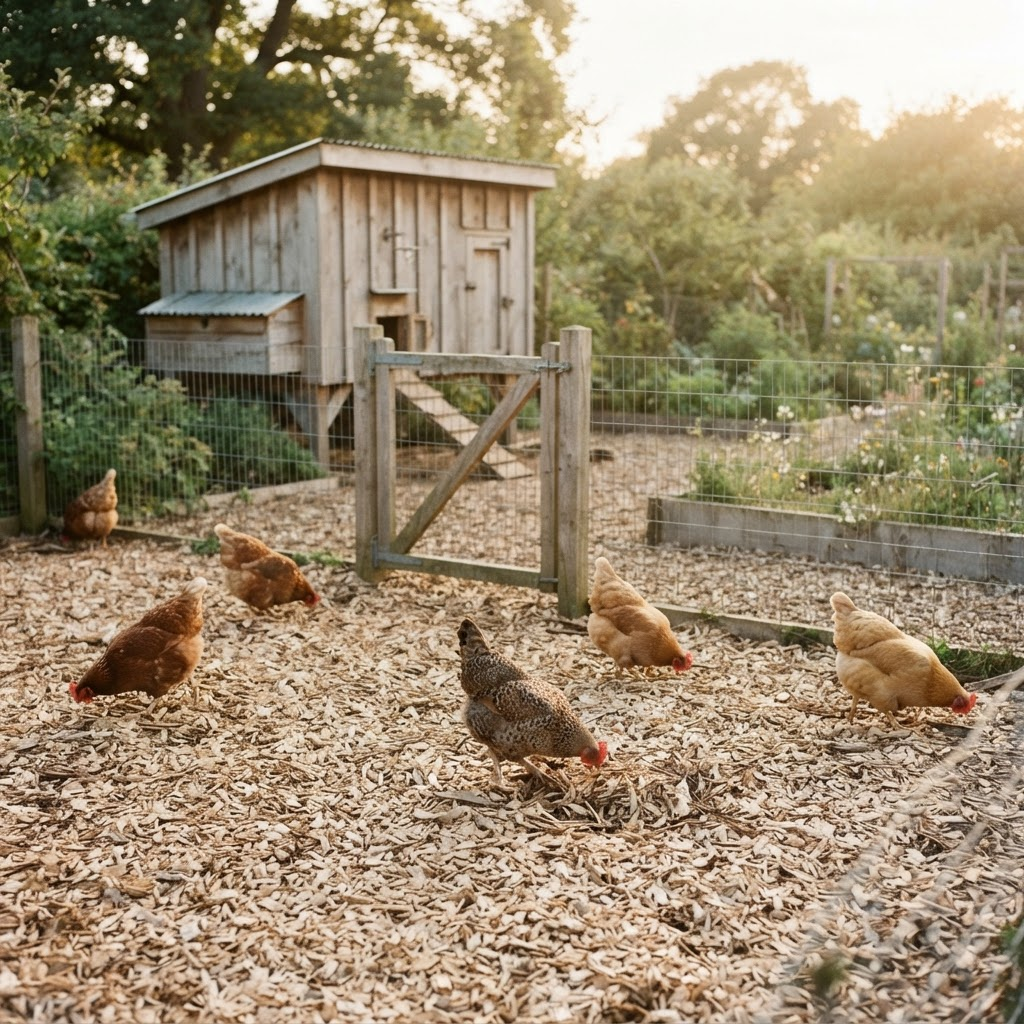
Chicken-run flooring sounds like one of those decisions that shouldn't require much thought.
Until the grass disappears.
Then the dirt turns to mud.
Then the chickens scratch everything into the waterer.
And suddenly you're standing in the landscaping aisle wondering whether your chicken run needs sand, mulch, gravel — or all three.
The answer depends heavily on whether the run is covered, how well the ground drains, and how you want to clean it.
Sand, wood chips, and gravel can all have a place in a chicken run.
But I wouldn't use them all the same way.
Chicken Run Ground Cover at a Glance
| Material | Best For | Biggest Advantage | Biggest Drawback |
|---|---|---|---|
| Sand | Covered, well-drained runs | Easy to rake/scoop and stays loose when dry | Heavy and won't fix bad drainage |
| Wood chips | Natural or uncovered runs | Scratchable, organic and replaceable | Break down and require replenishing |
| Gravel | Drainage base / wet sites | Moves water and creates a durable base | Not my favorite exposed surface for the whole run |
| Bare dirt | Very dry or rotated areas | Free and natural | Often becomes compacted or muddy |
| Straw | Temporary use | Cheap and available | Can mat and stay wet |
| Grass | Rotational/free-range areas | Excellent while it lasts | Chickens frequently destroy it in permanent runs |
The biggest takeaway is this: don't choose the surface before understanding the water.
If your chicken run collects standing water every time it rains, spreading a new material over the top may hide the problem temporarily.
It doesn't necessarily solve it.
What Makes a Good Chicken Run Ground Cover?
Before comparing materials, it helps to define what we're trying to accomplish.
A useful run surface should help provide:
- reasonably dry footing
- drainage
- a surface chickens can move across comfortably
- opportunities to scratch and forage
- manageable manure cleanup
- minimal mud
- minimal mold
- reasonable dust levels
- a practical maintenance routine
Chickens are going to interact with the ground constantly. They scratch it, peck it, dig through it, dust bathe in it, drop manure on it — and occasionally rearrange the entire thing five minutes after you finish making it look nice.
So this isn't landscaping in the normal sense. The surface needs to work with chicken behavior, not against it.
Research reviewing poultry enrichment supports the importance of manipulable litter substrates for normal behaviors such as foraging and dust bathing, with materials including sand and wood-based substrates commonly used by birds.
Is Sand Good for a Chicken Run?
Yes. In the right setup, sand can be excellent.
Cornell Cooperative Extension describes dry sand as an ideal ground cover for an outside chicken area, while NC State Extension similarly calls dry sand a suitable ground cover for an outdoor run.
And poultry research confirms that sand itself is a legitimate substrate. Controlled broiler research has found sand capable of functioning as poultry litter without significant disadvantages in several measures compared with pine shavings.
But there's an important word in the Extension recommendation: dry.
Sand works very differently in a covered, properly drained run than it does when poured into a low spot that collects water.
Why People Like Sand
Sand creates a completely different cleaning system from wood chips.
With an organic ground cover, you're often adding, turning, and eventually replacing material. With sand, you're more likely scooping, raking, and sifting.
Think of it somewhat like a large litter-box system. Droppings stay relatively visible on the surface and can be removed. That can be extremely convenient in a smaller covered run.
Sand Also Fits Normal Chicken Behavior
Chickens naturally scratch and dust bathe in loose particulate material. A review of enrichment research found that poultry commonly use substrates such as sand and wood-based material for behaviors including dust bathing and foraging.
That doesn't mean your entire run has to become one giant dust bath. But a loose sand surface certainly isn't foreign to chicken behavior.
Sand: Pros
- Easy to rake
- Droppings can be scooped
- Doesn't decompose like organic bedding
- Chickens can scratch through it
- Useful for dust-bathing behavior
- Can remain relatively clean when dry
- Works particularly well in covered runs
Sand: Cons
- Very heavy
- Can be expensive to install deeply
- Doesn't compost
- Can migrate into surrounding soil
- Doesn't fix standing water underneath it
- Requires regular scooping for a tidy system
- Fine, dusty products are undesirable
- Can become unpleasant when drainage is poor
My take: I like sand a lot for covered, permanent, well-drained runs — especially when the owner wants to clean frequently rather than maintain an organic litter layer.
What Kind of Sand Should You Use in a Chicken Run?
This is where I'd apply the same logic we've used in our dedicated dust-bath guide.
I want sand that is clean, dry, reasonably washed, loose, not excessively powdery, free of chemical additives, and able to drain.
I would generally look at a clean washed construction/all-purpose-type sand with a natural range of particles, rather than intentionally seeking an ultra-fine powder.
And importantly: "play sand" isn't automatically bad. Some poultry guidance and research has used washed play sand in poultry applications.
The better question is: what is actually in the bag? If it's clean, washed, loose and not excessively dusty, the product may work perfectly well. If pouring it creates a cloud of powder, I'd look for something else.
For a much deeper breakdown of sand specifically, see Best Sand for a Chicken Dust Bath: Types, Grain Size & What to Avoid.
Are Wood Chips Good for Chicken Runs?
They can be. And for a lot of backyard runs, I actually prefer them over creating a permanent sand floor.
Wood chips provide a natural, scratchable, organic, renewable surface.
Wood-based materials have a long history as poultry litter. A scientific review describes wood bedding as widely used in poultry production and notes its suitability as a manipulable, absorbent substrate.
The advantage in a run isn't merely absorption. It's the entire management style. Chickens can dig through the chips, turn them over, and scratch for insects while manure and organic material gradually mix through the layer.
Eventually, the material can be removed and replaced rather than permanently remaining part of the ground.
Wood Chips vs. Wood Shavings
They're related. But they're not exactly the same thing.
Wood shavings are usually smaller, lighter, more absorbent, and commonly used inside chicken coops.
Wood chips are usually chunkier, heavier, slower to break down, and better suited to an outdoor surface.
For an outdoor run, I'd generally prefer a coarser chip over a thick layer of extremely fine sawdust. The goal isn't to create a giant pile of powder. It's to create a loose organic surface chickens can work through.
Are Wood Chips Safe for Chickens?
This needs more nuance than "wood chips are safe" or "wood chips are toxic."
Extension poultry guidance on this question isn't completely uniform. One Extension poultry specialist recommends kiln-dried pine chips or shavings and cautions that some other wood-chip material can introduce molds or fungi. Another Extension poultry specialist has noted that many typical wood chips can be used but emphasizes that research does not exist for every tree species and that certain plants may present specific concerns.
That tells me not to panic about wood chips. But it also tells me not to treat every mystery pile from a tree service as identical.
What I Would Look for in Chicken-Run Wood Chips
- Clean — no trash, nails, plastic or construction debris.
- Untreated — skip painted, stained, chemically treated or recycled construction lumber.
- Free of obvious mold — don't put moldy organic material into the run.
- From known or reasonably safe wood — pine and commonly used poultry wood products are straightforward choices.
- Coarse enough to remain loose — not primarily sawdust.
- Not contaminated with toxic landscape plants — particularly relevant if you're accepting mixed fresh chips from pruning operations.
What About Free Arborist Wood Chips?
They can be incredibly useful. But I'd want to know what I'm receiving.
A load may contain wood, bark, leaves, twigs, multiple tree species, and fresh green material. That's not automatically a problem. But it's also not identical to buying a bag of processed pine poultry bedding.
If you don't know what was chipped, I wouldn't blindly assume every plant in the load belongs in a chicken enclosure.
Wood Chips: Pros
- Natural appearance
- Chickens can scratch through them
- Organic
- Can eventually become compost material
- Usually fairly affordable
- Free sources may be available locally
- Easy to add more
- Good option for larger runs
- Doesn't require scoop-cleaning every dropping
Wood Chips: Cons
- Break down over time
- Need replenishing
- Quality varies
- Unknown wood sources deserve caution
- Can become wet if drainage is poor
- Moldy material should not be used
- More difficult to spot-clean than sand
My take: For a large backyard run where I want a more natural surface, wood chips are probably my first choice — especially if the run isn't being managed like a litter box.
Is Gravel Good for a Chicken Run?
Yes — but I think gravel is often used incorrectly.
If you ask me, "What should my chickens walk around on all day?" gravel probably isn't my first answer.
If you ask, "How do I stop this chicken run from becoming a swamp?" now I'm much more interested.
An Extension poultry specialist specifically recommended considering a gravel base to improve conditions in a muddy run where water accumulation was causing problems.
That's how I tend to think about gravel: infrastructure first, surface second.
Gravel as a Drainage Layer
Imagine a run sitting on dense clay. Every heavy rain creates standing water → mud → manure slurry → more material dumped on top.
That isn't really a bedding problem. It's a drainage problem.
Depending on your property, the solution may involve grading, redirecting roof runoff, adding gutters, raising the run, drainage trenches, gravel, drain pipe, or covering part of the run.
Then you decide what surface goes on top.
Would I Use Gravel as the Entire Top Surface?
Usually not.
Chickens naturally spend a lot of time interacting with loose substrates. I'd rather give them significant areas where they can scratch, forage, dig, and dust bathe than build their entire enclosure like a gravel driveway.
That doesn't mean gravel is dangerous or forbidden. It means I see its strongest role as pathways, high-traffic areas, drainage zones, or a drainage base underneath a more chicken-friendly surface.
What About Pea Gravel?
Pea gravel can create a durable surface and may work around gates, feeders, waterers, and drainage areas where traffic is especially heavy.
But again, I wouldn't necessarily make it the only material available in a permanent run. Give the chickens some loose, manipulable substrate somewhere.
Gravel: Pros
- Excellent drainage potential
- Durable
- Doesn't decompose
- Useful in muddy areas
- Good underneath other materials
- Useful around high-traffic zones
Gravel: Cons
- Doesn't compost
- Difficult to remove once mixed into soil
- Manure can settle between stones
- Not as scratchable as loose organic material
- Can become part of the property permanently
- Doesn't solve drainage if water has nowhere to go
My take: Use gravel to build the run correctly — not necessarily to be the entire run. That's a meaningful difference.
Sand vs. Wood Chips vs. Gravel
Here's how I would actually choose.
| If You Want... | I'd Consider... |
|---|---|
| Easy daily scooping | Sand |
| A natural scratchable run | Wood chips |
| A compostable surface | Wood chips |
| A permanent mineral floor | Sand |
| Help with drainage underneath | Gravel |
| A covered small run | Sand |
| A large natural run | Wood chips |
| A muddy low-lying run | Drainage first + possibly gravel base |
| Dust-bathing opportunity | Sand |
| An organic deep-litter-style surface | Wood chips |
| High-traffic gate area | Gravel can work well |
This is why I don't really like articles that crown one material "the best chicken run floor" without knowing anything about the property. The run determines the answer.
What's Best for a Covered Chicken Run?
If the run stays substantially dry, I'd strongly consider sand.
A roof changes everything. You're no longer trying to manage rainfall + runoff + manure + mud all at once. You're mostly managing manure + normal moisture.
Sand becomes easier to rake and keep loose.
You can also create a hybrid system: sand in the covered run, wood chips in an adjoining outdoor area. That's perfectly reasonable. Chicken keeping doesn't require committing your entire property to one substrate.
What's Best for an Uncovered Chicken Run?
If the run has good natural drainage and gets rain, I start leaning toward coarse wood chips.
They're easy to refresh. They're organic. Chickens can scratch through them. And you aren't trying to maintain a pristine litter-box-style sand surface through every rainstorm.
That said, an uncovered run sitting in a low spot is going to challenge any material. Fix the water. Then choose the surface.
What's Best for a Muddy Chicken Run?
Not another bag of bedding. At least not first.
Ask: where is the water coming from?
- Rain falling directly into the run? Consider a roof or partial cover.
- Water coming off the coop roof? Add gutters or redirect runoff.
- Yard draining toward the chickens? You may need grading or drainage work.
- Low spot? The run may need to be raised or drained.
- Waterer leaking? Fix the waterer.
Once the water problem is controlled, then choose the surface. An Extension response to this exact problem suggested considering a gravel base to help address the water contributing to mud, followed by suitable poultry surface material.
Can I Put Wood Chips Over Mud?
You can. But if you have a serious drainage problem, you're probably just feeding wood chips to the mud. They disappear. You add more. Those disappear. Eventually you're wondering how 10 cubic yards of wood ended up underground.
The better order is: 1) fix runoff, 2) improve drainage, 3) stabilize the base if necessary, 4) add your ground cover.
Can I Put Sand Over Mud?
Same answer. Sand is not a magical water-removal system.
If the ground underneath stays saturated, your sand can mix into the soil rather than creating the dry surface you imagined. A good sand run begins with a good site.
Should You Put Gravel Under Sand?
Sometimes. If you're intentionally building a permanent run in an area that requires better subsurface drainage, a properly designed aggregate base may make sense.
But don't automatically assume every chicken run needs excavation + landscape fabric + gravel + sand before buying your first hen.
If you already have high ground, permeable soil, good grading, and roof protection, your site may drain perfectly well without turning the project into road construction. Build to the problem you actually have.
What About Bare Dirt?
Dirt is what many chicken runs start with. And chickens love scratching it.
The problem is that a permanent flock can eventually transform grass or loose soil into compacted bare earth. Then rain arrives. Now it's mud.
Bare dirt can work especially well in dry climates, large low-density enclosures, rotational systems, and areas with excellent drainage. But a tiny permanent run containing several chickens is likely to look very different after six months than it did on Day 1.
Can Grass Survive in a Chicken Run?
Sometimes. But I wouldn't build my entire plan around it.
Chickens are remarkably efficient landscape-removal equipment. They scratch roots, eat shoots, dig holes, create dust baths, and repeatedly walk the same areas.
In a large enclosure with relatively few birds, vegetation may survive. In a small permanent run? Don't get emotionally attached to the grass.
If maintaining live vegetation matters, rotational runs or movable chicken tractors make much more sense.
What About Straw?
Straw can provide temporary ground cover. But it's not my favorite long-term answer for an outdoor wet run.
Poultry-litter research has identified caking and moisture-management issues with some straw-based materials compared with better-performing wood substrates. Once long strands become wet and mix with manure, they can create a dense mat.
So I'd rather use coarse wood chips for a longer-term organic outdoor surface.
What About Pine Shavings?
Pine shavings are one of my preferred materials inside the coop. Outside, they can still work. But they're smaller and break down faster than coarse chips.
For a large outdoor run, I'd rather reserve my bagged pine shavings for the coop and use chunkier material outside. For our full indoor-bedding comparison, see Best Bedding for Chickens: Pine Shavings vs. Hemp, Straw & Sand.
What About Mulch?
Be careful with the word mulch. Landscape mulch can mean a lot of things.
It may contain dyed wood, unknown recycled wood, treated wood, proprietary additives, decorative bark, or unknown plant material.
I would not automatically buy a decorative landscape mulch simply because "it's wood." Know what you're putting into an enclosure where animals will scratch, peck and forage. Simple is better.
How Deep Should Chicken Run Ground Cover Be?
This is another place where I'd avoid pretending there is one scientifically established backyard formula.
Depth depends on material, soil, drainage, flock density, run coverage, and how often you refresh it.
Your goal is enough material to create a functional surface, not a decorative dusting. If you can still see chickens immediately mixing the material into saturated mud underneath, the problem probably isn't whether you need another half-inch. It's the base.
How Often Should You Replace Wood Chips?
There's no universal calendar. Instead, watch the material. Refresh or remove it when it becomes excessively decomposed, heavily manure-loaded, wet, compacted, moldy, or difficult to keep functional.
In a large run with good conditions, chips may be managed by periodically adding fresh material. In a small heavily stocked run, they may require more frequent replacement.
The chickens will help turn them. Whether you consider that assistance is between you and the chickens.
How Often Should You Clean Sand?
Sand lends itself to more frequent spot cleaning. That's one of its biggest advantages.
I would scoop obvious manure regularly, rake the surface, remove wet or contaminated sections, and replenish lost sand when necessary.
Don't assume sand means never clean again. It just changes what cleaning looks like.
What About the Chicken Dust Bath?
Even if you use wood chips across the majority of the run, I'd still give chickens access to an intentional loose dust-bathing area. That could contain dry soil + suitable sand rather than expecting the coarse chips to perform every function.
Our full setup guide is here: Chicken Dust Bath: What to Put In It, How to Make One & What to Avoid. And if you're choosing the sand itself: Best Sand for a Chicken Dust Bath: Types, Grain Size & What to Avoid.
Your Run Size Matters Too
Ground-cover problems become harder when too many chickens occupy too little ground. More chickens mean more manure, scratching, traffic, and soil disturbance per square foot.
If you're trying to keep eight chickens inside a tiny run, changing from wood chips to sand isn't necessarily going to fix the underlying management problem.
Our backyard planning target is approximately 10 square feet of run per standard hen, with adjustments for flock size, confinement and layout. Use the full chart here: How Much Space Do Chickens Need? Coop & Run Size Chart + Calculator.
A Simple Chicken Run Ground-Cover Decision
Ask yourself four questions.
1. Is the run covered?
If yes, sand becomes very attractive. If no, keep going.
2. Does the ground drain well?
If yes, wood chips or sand can both work. If no, fix drainage first.
3. How do you want to clean?
If you'll scoop manure frequently, choose sand. If you'll add, turn and periodically replace organic material, choose wood chips.
4. Is mud already the problem?
Think drainage, grading, runoff, and a gravel base if appropriate — before thinking about surface material.
That's the entire decision tree.
What I Would Use in a Chicken Run
If I were building a normal backyard setup from scratch, here's how I'd approach it.
Covered run: I'd seriously consider clean sand, especially in a smaller permanent run I plan to spot-clean frequently.
Large natural run: I'd lean toward coarse clean wood chips. They're scratchable, renewable and easy to refresh.
Muddy run: I'd stop before adding either and address drainage — that might mean gutters, grading, roof cover, trenching, a raised base, or a gravel drainage layer. Once dry enough, I'd finish the surface with sand or an organic material depending on the management system.
High-traffic areas: Around a gate, water station, or path, I wouldn't be afraid to use gravel where durability makes sense.
Dust bath: Regardless of the run floor, dry soil + suitable sand in a dedicated area.
Different parts of a chicken run can serve different purposes. They don't all have to match.
Common Chicken Run Ground-Cover Mistakes
1. Trying to Cover Up a Drainage Problem
This is the big one. Mud isn't asking for prettier mulch. It's asking where the water is going.
2. Using Extremely Dusty Sand
Chickens live close to the ground. Choose clean material with minimal airborne fines.
3. Using Mystery Landscape Mulch
Know what's in it.
4. Using Treated Wood
Skip painted, stained, preserved or chemically treated wood products.
5. Letting Organic Material Stay Constantly Wet
Wet organic material can become compacted and moldy. Replace problem areas.
6. Assuming Gravel Automatically Fixes Drainage
Water still needs somewhere to go. A bucket of gravel inside a hole filled with water just creates wet gravel. Drainage is a system.
7. Forgetting Chicken Behavior
Chickens aren't decorative garden birds. Give them material they can interact with.
8. Expecting Grass to Survive a Tiny Permanent Run
Good luck.
9. Never Cleaning Because You Use Sand
Sand changes the cleaning method. It does not eliminate manure.
10. Never Refreshing Wood Chips
Organic material eventually breaks down. That's partly the point.
The Bottom Line: What's the Best Ground Cover for a Chicken Run?
There isn't one material I'd recommend for every backyard. Instead:
Choose sand if you have a covered, well-drained run and want a surface you can rake and scoop. Cornell and NC State Extension both specifically identify dry sand as suitable outdoor chicken-run ground cover.
Choose wood chips if you want a natural, organic, scratchable surface that can gradually break down and be refreshed. Wood-based substrates are well-established in poultry systems, although the exact source and condition of outdoor chips still matters.
Choose gravel if you're solving a drainage or high-traffic problem. I like gravel much more as part of the run's infrastructure than as the only material chickens interact with all day. Extension poultry guidance specifically suggests a gravel base where excess water contributes to mud.
And if your run currently looks like a swamp, don't start with "sand or wood chips?" Start with "why is the water staying here?" Fix that. Then build the surface on top of it.
Chicken Run Ground Cover FAQ
What is the best ground cover for a chicken run?
For a covered, well-drained run, clean sand is one of the best choices. For a larger natural or uncovered run, coarse wood chips can make an excellent organic surface. If the run suffers from standing water, address drainage before choosing either.
Is sand or wood chips better for a chicken run?
Neither is universally better. Choose sand if you want to rake and scoop the run. Choose wood chips if you prefer an organic material chickens can scratch through and that can eventually be replaced or composted.
Is sand good for chicken runs?
Yes. Cornell and NC State Extension specifically recommend dry sand as a suitable outside-run ground cover. The site still needs adequate drainage.
What kind of sand should I use in a chicken run?
I'd choose a clean, washed, relatively low-dust sand that remains loose and drains properly. Avoid products with chemical binders or excessive powder.
Are wood chips safe in a chicken run?
Many wood-based products can be used around poultry, but source matters. Use clean, untreated material and avoid obvious mold, construction waste or unknown potentially problematic plant material. Extension guidance notes that research is not available for every possible wood species.
Can I use pine wood chips for chickens?
Pine is one of the most established wood materials used in poultry bedding systems. Clean, appropriately prepared pine material is a straightforward choice.
Is gravel good for chicken runs?
Gravel is particularly useful for drainage and high-traffic areas. I generally prefer giving chickens access to a softer, loose substrate such as sand or organic material rather than making the entire run exposed gravel.
Can I put gravel under a chicken run?
Yes. A properly designed gravel base may help improve drainage where water is contributing to mud. But the water still needs somewhere to drain.
How do I fix a muddy chicken run?
Start by identifying the source of the water. Look at roof runoff, yard drainage, low spots, waterer leaks, and lack of run coverage. Then improve drainage before adding your final ground cover.
Can chickens live on bare dirt?
Yes, particularly in large, dry or rotational spaces. Permanent small dirt runs often become compacted or muddy as vegetation disappears and bird traffic increases.
Can I put wood chips over sand?
You can use different materials together, but ask what you're trying to accomplish. If sand is functioning as a permanent scoop-clean surface, covering it with organic material largely changes that management system.
Should a chicken run have a roof?
It doesn't absolutely have to, but covering at least part of the run can make moisture management significantly easier and gives chickens a dry outdoor area during bad weather.
Moisture inside the coop too? Check your vents with the Chicken Coop Ventilation Planner →
Building or upgrading the run itself? Plan dimensions and materials with the Chicken Run Builder →
Keep Reading
Planning the run size? How Much Space Do Chickens Need? Coop & Run Size Chart + Calculator
Choosing sand specifically? Best Sand for a Chicken Dust Bath: Types, Grain Size & What to Avoid
Building the dust bath? Chicken Dust Bath: What to Put In It, How to Make One & What to Avoid
Choosing material inside the coop? Best Bedding for Chickens: Pine Shavings vs. Hemp, Straw & Sand
Managing coop moisture? Chicken Coop Ventilation: How Much Does Your Coop Need?
Keeping ducks in the run too? Can Ducks and Chickens Live Together? Coop, Feed, Water & Mixed-Flock Safety
Keeping feather-footed breeds? Silkie Chickens: Eggs, Temperament, Lifespan & Complete Care Guide
Keeping feathered feet clean? Brahma Chickens: Size, Egg Production, Temperament & Care