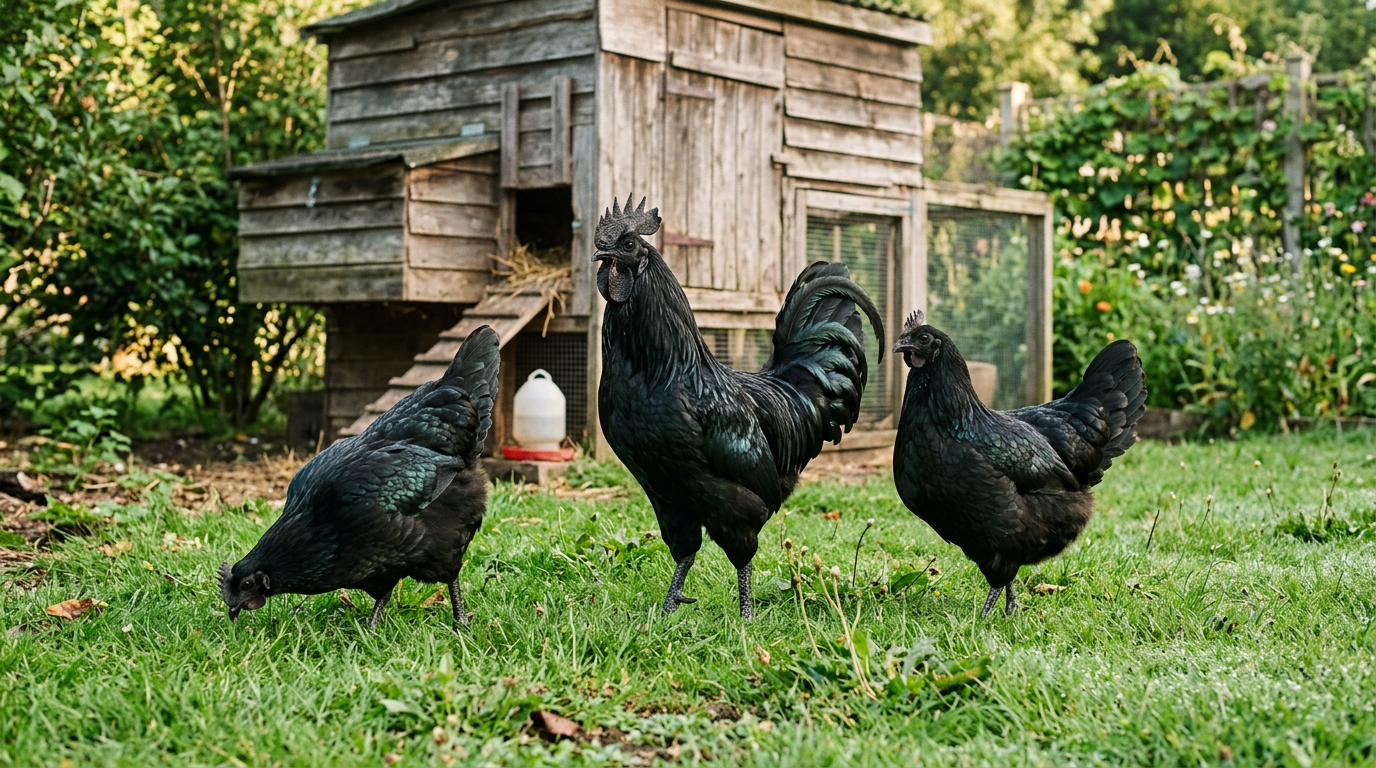
Imagine walking into your backyard and seeing a chicken that looks almost entirely black.
Not just black feathers.
A black comb, black wattles, black legs, black skin, and even dark pigmentation beneath the surface.
That's the Ayam Cemani.
Originating from the Indonesian island of Java, Ayam Cemani chickens are among the most visually unusual poultry breeds in the world. Their glossy black feathers can shimmer with green and blue in the sunlight, while their dark skin and internal tissues come from a genetic trait called *fibromelanosis*.
The appearance has helped make Ayam Cemani chickens desirable among specialty breeders and backyard poultry enthusiasts.
It has also created one particularly persistent misconception.
Despite their nearly all-black appearance, Ayam Cemani chickens do not lay black eggs.
Their eggs are actually cream-colored or lightly tinted.
And that's only the beginning of what makes these birds interesting.
Here's what to know about their unusual genetics, real egg production, temperament, rarity, price, and backyard care.
Ayam Cemani Chicken Quick Facts
| Trait | Ayam Cemani Chicken |
|---|---|
| Origin | Java, Indonesia |
| Breed type | Traditional Indonesian ornamental chicken |
| Primary appeal | Extensive black pigmentation |
| Pigmentation trait | Fibromelanosis |
| Feather color | Black, often with iridescent green sheen |
| Skin color | Black or very dark |
| Comb color | Black |
| Comb type | Single |
| Egg color | Cream, white-tinted, or light tan |
| Egg size | Generally medium |
| Annual egg production | Approximately 80–120 in commonly documented hatchery lines |
| Adult hen weight | Around 4–4.5 lb in breed-club and hatchery references |
| Adult rooster weight | Approximately 5–7 lb, depending on source and line |
| Temperament | Alert, generally manageable, sometimes shy |
| Broodiness | Variable; substantial differences between breeding lines |
| Foraging | Active and capable |
| Flight ability | Relatively good |
| Cold tolerance | Requires ordinary cold-weather precautions |
| Heat tolerance | Generally adaptable with appropriate management |
| APA recognition | Not currently recognized |
| Beginner-friendly | Possible, but specialty-breed ownership requires more research |
| Main consideration | Finding healthy, well-bred birds with consistent pigmentation |
One important distinction: Ayam Cemani is a distinct Indonesian chicken breed, not simply a name for any chicken with black feathers.
That matters when choosing birds from specialty breeders.
Do Ayam Cemani Chickens Lay Black Eggs?
No. Ayam Cemani chickens do not lay black eggs. Their eggs are typically cream-colored, white-tinted, or light tan.
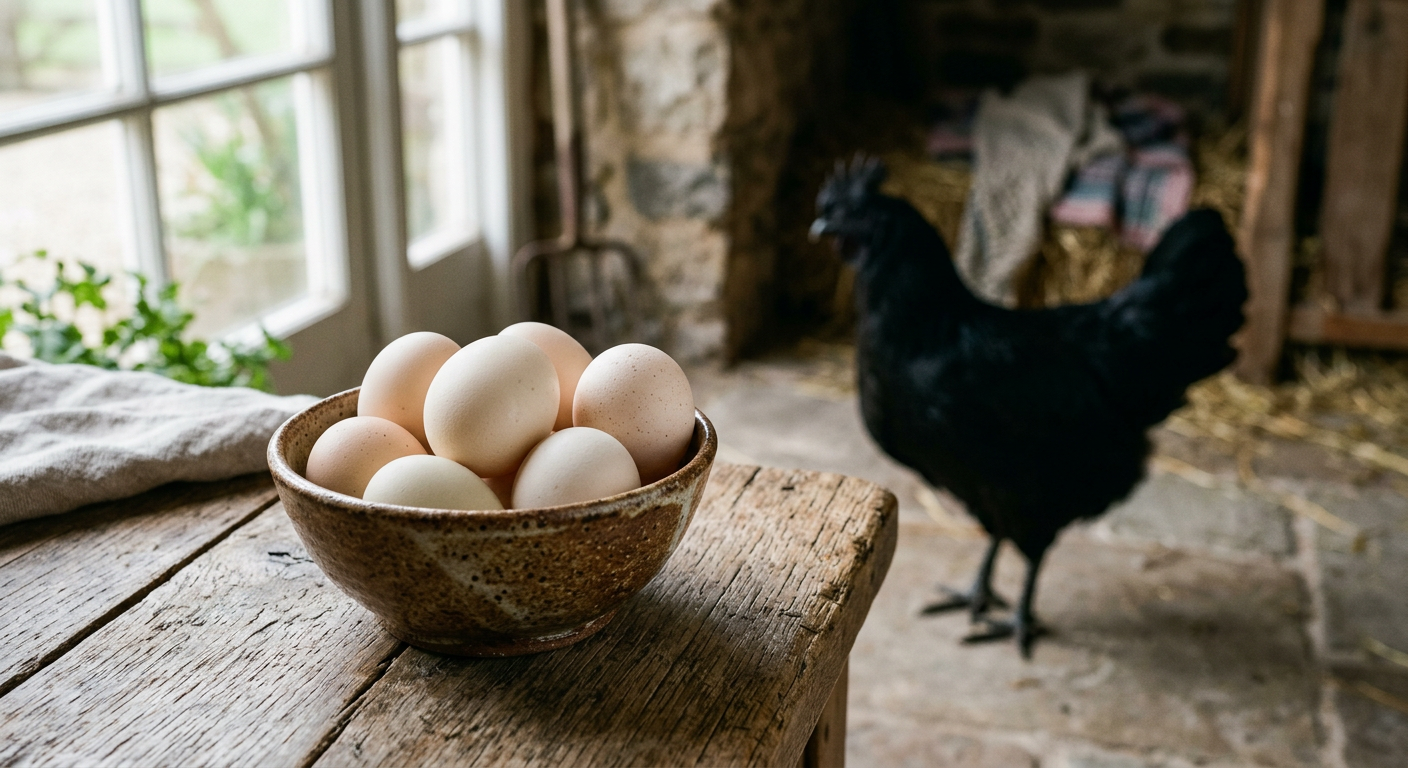
This is probably the most common misconception about the breed.
Because Ayam Cemani chickens are black on the outside and have unusually dark internal tissues, it's easy to assume their eggs must also be black.
But that's not how their pigmentation works.
The Ayam Cemani Breeders Association's proposed breed standard specifies white-tinted to cream-colored eggs.
Cackle Hatchery similarly identifies cream and light tan eggs.
These sources agree on the important point: black eggs are not a normal characteristic of Ayam Cemani chickens.
Why Don't Ayam Cemani Chickens Lay Black Eggs?
The short explanation is that the genetics responsible for dark body tissues are different from the mechanisms that determine eggshell color.
Ayam Cemani chickens carry a genetic condition called fibromelanosis.
That condition causes unusually extensive dark pigmentation in body tissues.
Eggshell color, however, develops through separate biological processes in the hen's reproductive tract.
A chicken can have highly pigmented skin and internal tissues without producing a dark-colored eggshell.
Can Ayam Cemani Eggs Be Pink?
Some Ayam Cemani eggs may have a light pinkish appearance.
The University of Veterinary and Animal Sciences describes their eggs as cream-colored with a slight pink tint.
That doesn't mean Ayam Cemani chickens are true pink-egg layers.
The shell is generally cream or lightly tinted, and subtle coloring can appear different depending on the individual egg and lighting.
Are Black Chicken Eggs Real?
You may encounter photographs online showing black chickens standing beside completely black eggs.
Those photographs are not reliable evidence that the birds produced those eggs.
Dark-painted eggs, digital alterations, and unrelated egg photographs can all create confusion.
Some chicken breeds produce exceptionally dark brown eggs, but dark brown is not the same thing as black.
If someone advertises Ayam Cemani chickens as natural black-egg layers, that's a reason to question the seller's understanding of the breed.
Roosted Note
If you're buying Ayam Cemani chickens because you want black eggs, save your money.
Their remarkable trait is the pigmentation of the bird—not the color of the eggshell.
The eggs are perfectly ordinary-looking compared with the chicken that laid them.
And that's what makes the contrast so interesting.
Why Are Ayam Cemani Chickens Completely Black?
Ayam Cemani chickens owe their unusual appearance to fibromelanosis, a genetic trait that causes excessive dark pigmentation in multiple body tissues.
Unlike the ordinary genes that determine whether a chicken has black, white, red, or patterned feathers, fibromelanosis affects pigmentation beyond the plumage.
That includes the skin and many internal tissues.
Researchers have identified a complex genetic rearrangement involving the EDN3 gene, also known as endothelin 3.
The EDN3 gene plays an important role in the development of pigment-producing cells.
What Is Fibromelanosis?
Fibromelanosis is an inherited form of extensive tissue hyperpigmentation.
In simple terms, the bird develops unusually high concentrations of melanin-related pigmentation in tissues that aren't normally so dark.
The result can include:
- Black skin
- Dark connective tissues
- Dark bones
- Dark internal organs
- Black facial skin
- Very dark combs and wattles
- Dark legs and feet
The bird's black feather color contributes to its overall appearance, while fibromelanosis explains much of the deeper tissue pigmentation.
What Does the EDN3 Gene Have to Do With It?
Research published in *PLOS ONE* compared the genomes of Ayam Cemani and Silkie chickens.
Scientists found that both share the same complex chromosomal rearrangement involving duplicated regions near the EDN3 gene on chromosome 20.
This genetic arrangement is associated with increased pigmentation in the affected tissues.
The researchers concluded that the fibromelanosis trait in these populations arose from a shared genetic origin.
In other words, Ayam Cemani chickens aren't black because someone feeds them a special ingredient.
Their appearance comes from inherited genetics.
Is Fibromelanosis a Disease?
Fibromelanosis is a genetic pigmentation trait.
Its presence alone does not mean the chicken is ill.
It should not be confused with a disease simply because the tissues appear unusual compared with ordinary chickens.
However, the trait also doesn't guarantee that a bird is healthy.
Ayam Cemani chickens can still develop common poultry illnesses, parasites, injuries, and nutritional problems.
Their pigmentation doesn't replace normal flock care.
Are Ayam Cemani Chickens Black Inside?
Yes. Ayam Cemani chickens have unusually dark pigmentation in many internal tissues, including connective tissues, bones, and organs.
This is one of the most fascinating characteristics of the breed.
A normal black-feathered chicken may have ordinary light-colored skin and internal tissues beneath its feathers.
An Ayam Cemani can have dark tissue pigmentation extending much deeper.
What Parts of an Ayam Cemani Are Black?
| Body Part | Typical Appearance |
|---|---|
| Feathers | Black, often with an iridescent sheen |
| Comb | Black |
| Wattles | Black |
| Beak | Black |
| Facial skin | Black |
| Legs | Black or very dark |
| Toenails | Black |
| Skin | Black or very dark |
| Connective tissue | Often heavily pigmented |
| Bones | Dark pigmentation may be present |
| Internal organs | Often unusually dark |
| Muscle tissue | May appear significantly darker than ordinary chicken meat |
| Blood | Red |
| Eggshell | Cream or lightly tinted |
The intensity of pigmentation can vary between individual birds and breeding lines.
Do Ayam Cemani Chickens Have Black Blood?
No.
Ayam Cemani chickens have red blood.
Blood color is determined primarily by hemoglobin and its oxygenation state, not the pigmentation that creates the bird's black skin and tissues.
The idea that every single part of the chicken is black is an exaggeration.
The blood and eggs are two important exceptions.
Is Ayam Cemani Meat Black?
The flesh and surrounding tissues can appear much darker than those of ordinary chickens.
Their meat is one reason Ayam Cemani chickens have attracted attention in traditional culinary settings.
However, tissue pigmentation shouldn't be confused with proof of unusual nutritional or medicinal properties.
Claims that Ayam Cemani meat has special healing powers go beyond what can be established confidently from the current evidence.
The breed's cultural history is real and worth respecting.
That doesn't mean every health claim associated with it has been scientifically demonstrated.
Where Do Ayam Cemani Chickens Come From?
Ayam Cemani chickens originated on the Indonesian island of Java.
They are associated with the country's traditional poultry populations, including chickens from the Kedu region.
Their history is tied to selective breeding for unusual pigmentation and the cultural significance of dark-colored poultry.
The breed became more widely known outside Indonesia as specialty breeders began importing and establishing breeding populations.
Are Ayam Cemani the Same as Ayam Kedu?
Not exactly.
Ayam Kedu refers to an Indonesian chicken population associated with the Kedu region.
Ayam Cemani are particularly distinguished by the extensive expression of black pigmentation.
The populations are historically related, but not every Kedu chicken has the appearance expected of a carefully bred Ayam Cemani.
That distinction matters if you're purchasing birds specifically for their dark pigmentation.
When Did Ayam Cemani Chickens Reach the United States?
The modern American specialty breeding population is relatively recent.
Greenfire Farms reports importing Ayam Cemani into the United States in 2014, with additional European bloodlines introduced in 2023.
Because of that relatively recent history, established American breeding populations are less widespread than those of common backyard breeds.
This helps explain some of the challenges surrounding availability and price.
Are Ayam Cemani Chickens Rare?
Ayam Cemani chickens are uncommon in the United States compared with popular backyard breeds such as Rhode Island Reds, Leghorns, or Barred Rocks.
They're available through specialty breeders and some established hatcheries, but they aren't a routine offering at every local feed store.
However, rarity is more complicated than simply counting online listings.
A breeder selling black chickens does not automatically mean those birds are well-bred Ayam Cemani.
What Makes a High-Quality Ayam Cemani?
Breeders selecting for traditional Ayam Cemani characteristics pay particular attention to pigmentation and body type.
Important features include:
- Consistent black plumage
- Dark facial skin
- A black single comb
- Black wattles
- Dark beak
- Dark legs and feet
- Black toenails
- Good body conformation
- General health and vigor
The Ayam Cemani Breeders Association's proposed standard places considerable emphasis on the depth and consistency of pigmentation.
For serious breeding purposes, color leakage or pale areas may be important faults.
For ordinary backyard ownership, a small color imperfection does not automatically make a bird unhealthy or unsuitable as a pet.
Are There Really Only a Few Thousand Ayam Cemani Chickens?
Some websites publish extremely specific worldwide population estimates.
I'd treat those figures cautiously.
There isn't a sufficiently reliable, current global census establishing exactly how many Ayam Cemani chickens exist in every breeding population.
The breed is clearly uncommon in many Western backyard poultry markets.
But that isn't the same thing as proving an exact worldwide population.
For Roosted, the useful distinction is uncommon specialty breed versus ordinary widely available breed, rather than repeating unsupported scarcity numbers.
Why Are Ayam Cemani Chickens So Expensive?
Ayam Cemani chickens often cost significantly more than common backyard chicks.
Several factors help explain the difference.
1. Limited Breeding Availability
Fewer breeders specialize in Ayam Cemani compared with common commercial egg layers.
That can make healthy, well-bred birds harder to find.
2. Selective Breeding
Maintaining consistent pigmentation takes deliberate breeding decisions.
Breeders may select birds based on plumage, comb color, leg pigmentation, conformation, and other characteristics.
3. Specialized Demand
Some buyers want Ayam Cemani chickens specifically because of their unusual appearance.
Others are interested in maintaining a breeding flock or participating in specialty poultry exhibitions.
That creates demand separate from ordinary egg production.
4. Breeding and Shipping Costs
Specialty breeding operations still have to pay for feed, housing, testing, flock management, hatching, and transportation.
Those costs can be spread across a smaller number of birds than at large commercial hatcheries.
How Much Does an Ayam Cemani Chicken Cost?
Prices vary considerably by breeder, age, sex, pedigree, and breeding quality.
As a recent U.S. hatchery example, Cackle Hatchery listed unsexed Ayam Cemani chicks starting around $45 each during our October 2026 research. The listing was marked temporarily unavailable at that time.
That is one seller's advertised starting price, not a universal market value.
Established breeding adults, selected pairs, and specialized bloodlines can cost considerably more.
If you're considering a purchase, compare live availability and breeder information rather than relying on an old viral story about an extraordinarily expensive chicken.
Roosted Note
Expensive doesn't automatically mean better.
A higher price might reflect careful breeding, but it can also reflect marketing.
Before buying, ask for current photographs of the actual breeding birds, information about their parentage, and clear details about the seller's health and shipping practices.
How to Buy Ayam Cemani Chickens Without Overpaying
Because these chickens can be expensive, I'd spend extra time evaluating the breeder.
Ask the following questions:
- Can I see photographs of the actual parent birds?
- Are the birds bred specifically for Ayam Cemani characteristics?
- Are their combs, wattles, legs, beaks, and visible skin consistently dark?
- What are the typical adult weights in this line?
- How many eggs do your hens actually lay?
- What is the temperament of your breeding flock?
- Are the chicks straight-run or sexed?
- What health-testing and biosecurity practices do you follow?
- What happens if shipped chicks arrive unhealthy or do not survive?
- Do you have a clear policy for birds that develop visible color leakage?
What Does Straight-Run Mean?
Straight-run chicks have not been separated into male and female groups.
If you purchase straight-run Ayam Cemani chicks, you may receive roosters.
Cackle Hatchery, for example, lists its Ayam Cemani chicks as unsexed.
This matters if your town or neighborhood doesn't allow roosters.
Make sure you understand what you're purchasing before placing an order.
Does NPIP Certification Guarantee a Purebred Ayam Cemani?
No.
The USDA's National Poultry Improvement Plan supports testing and certification related to certain poultry diseases.
That is valuable health-related information.
But NPIP participation is not a guarantee of breed purity, perfect pigmentation, or adherence to a specialty breed standard.
Health documentation and breeding quality are separate things.
A reputable breeder should be willing to explain both.
How Big Do Ayam Cemani Chickens Get?
Ayam Cemani chickens are generally small to medium-sized standard chickens.
They're not giant birds like Brahmas or Jersey Giants.
The Ayam Cemani Breeders Association's proposed standard specifies:
| Bird | Proposed Breed-Club Weight |
|---|---|
| Adult rooster | 5 lb |
| Adult hen | 4 lb |
| Cockerel | 4 lb |
| Pullet | 3 lb |
These are proposed specialty-breed standards, not accepted American Poultry Association weights.
Cackle Hatchery lists somewhat heavier mature birds, including approximately 4.5-pound hens and 7-pound roosters.
That difference demonstrates why breeder-specific information matters.
For backyard housing, consider the Ayam Cemani a relatively light, active chicken rather than a heavy dual-purpose breed.
What Do Ayam Cemani Chickens Look Like?
A well-pigmented Ayam Cemani has a striking, almost monochromatic appearance.
The body is relatively lean and upright.
Unlike a rounded Buff Orpington, an Ayam Cemani often has a more alert, athletic silhouette.
Typical characteristics include:
- Glossy black feathers
- Black single comb
- Black wattles
- Dark facial skin
- Black beak
- Dark eyes
- Dark legs
- Four toes
- Clean, unfeathered feet
- Relatively upright posture
- A well-developed tail
Why Do Ayam Cemani Feathers Look Green in Sunlight?
Their feathers can display an iridescent sheen.
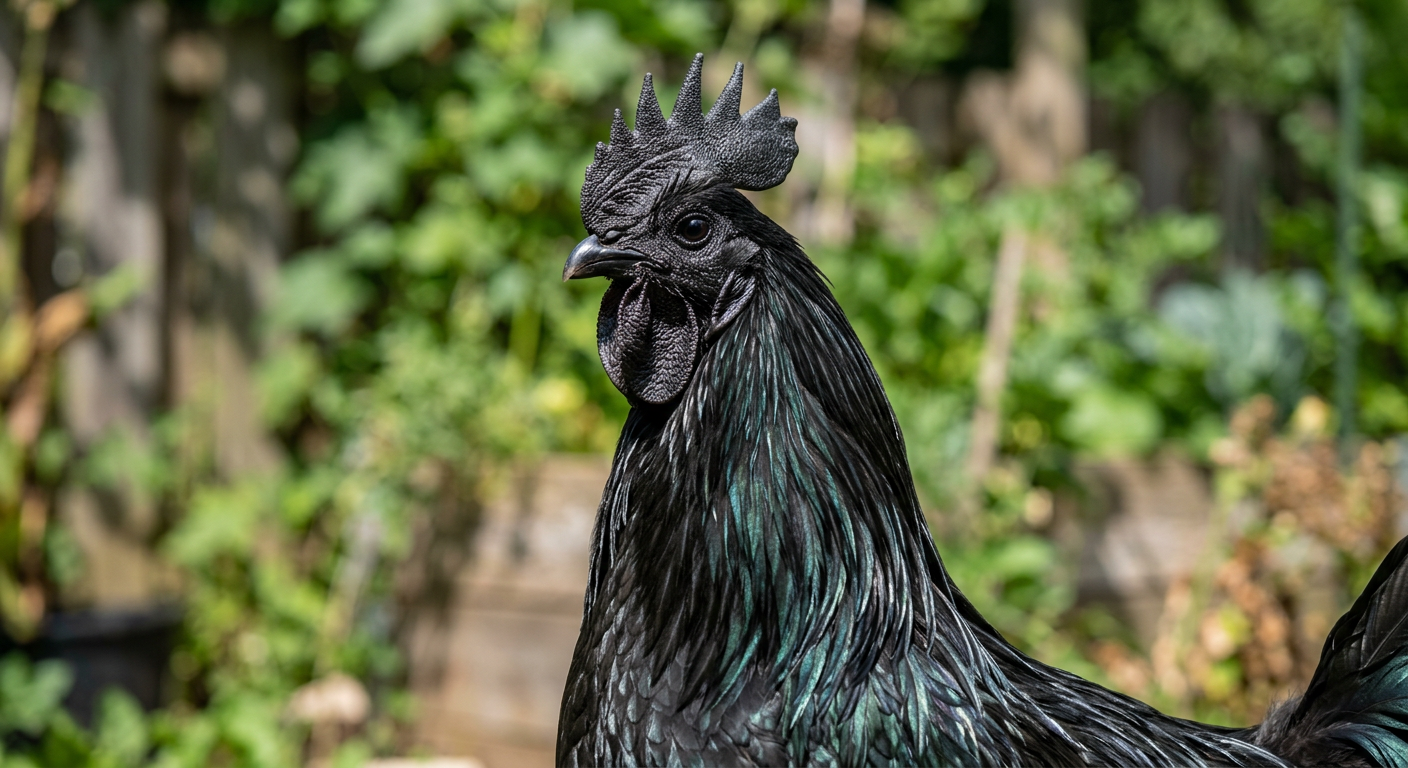
Depending on the lighting, black plumage may reflect green or blue-green highlights.
That doesn't necessarily mean the bird has green feathers.
It's a visual effect associated with the feather structure and how light reflects from the surface.
This is particularly noticeable on mature roosters.
Do Ayam Cemani Chicks Hatch Black?
They typically hatch with very dark down and skin.
However, visible coloring may develop as the bird grows.
Some chicks show lighter feathering or areas of less complete pigmentation.
Breeders selecting for strong fibromelanosis pay attention to how those characteristics develop.
The best way to evaluate a breeding line is not from one photograph of a newly hatched chick.
Look at the mature birds.
How Many Eggs Do Ayam Cemani Chickens Lay?
Ayam Cemani chickens are relatively low-production layers, with many breeders and hatcheries estimating approximately 80–120 eggs annually.
Cackle Hatchery provides an 80–120 annual estimate.
The University of Veterinary and Animal Sciences lists approximately 80–100 eggs per year.
Greenfire Farms discusses even lower estimates for some breeding lines.
These ranges are not necessarily contradictory.
They describe different breeding populations and management conditions.
For ordinary flock planning, 80–120 eggs annually is a useful estimate for a documented hatchery line, but individual hens can fall outside it.
How Many Eggs Do Ayam Cemani Lay Per Week?
Averaged across an entire year, 80–120 eggs works out to approximately 1.5–2.3 eggs per week.
However, that doesn't mean the hen follows a perfect two-eggs-per-week schedule.
Some Ayam Cemani hens may lay several eggs over a relatively short period and then take a longer break.
Broodiness, season, daylight, age, and breeding line all influence production.
Ayam Cemani Egg Production by Flock Size
| Hens | Estimated Annual Eggs | Average Weekly Eggs |
|---|---|---|
| 2 | 160–240 | About 3–5 |
| 4 | 320–480 | About 6–9 |
| 6 | 480–720 | About 9–14 |
| 8 | 640–960 | About 12–18 |
These are mathematical planning estimates based on the hatchery range, not guarantees.
The actual production pattern may be uneven.
For someone who primarily wants a steady household egg supply, this is an important disadvantage compared with productive breeds.
Our Chicken Egg Production Calculator can help compare how different flock sizes and breed choices affect overall egg production.
Are Ayam Cemani Good Egg Layers?
Not compared with breeds selected specifically for egg production.
A productive Leghorn or ISA Brown can produce substantially more eggs annually than most Ayam Cemani lines.
That's not necessarily a flaw.
The Ayam Cemani's main appeal is its distinctive pigmentation and traditional breed identity, not commercial laying efficiency.
If you're keeping one or two Ayam Cemani as ornamental flock members, their eggs can be a welcome bonus.
If your entire flock consists of Ayam Cemani hens and you need several dozen eggs weekly, you may find their output disappointing.
When Do Ayam Cemani Chickens Start Laying Eggs?
A precise, dependable breed-wide first-lay age for Ayam Cemani chickens is not well established.
For backyard chickens generally, first eggs commonly arrive around five to seven months of age, depending on breed and individual maturity.
Some Ayam Cemani pullets may begin within that general window, but others can take longer.
For this breed, I'd avoid promising eggs at one exact week.
Signs an Ayam Cemani Is Getting Ready to Lay
Watch for:
- A larger, more developed comb
- Increased interest in nesting boxes
- Squatting behavior
- Changes in vocalization
- Repeated visits to quiet nesting areas
- General physical maturity
One difference from many backyard breeds is that Ayam Cemani combs remain dark.
You can't rely on the familiar bright-red comb change used with Rhode Island Reds or Leghorns.
Instead, pay attention to comb development, overall behavior, and nesting activity.
Does Season Affect First Laying?
Yes.
Like other chickens, Ayam Cemani pullets can be affected by changing daylight hours.
A pullet approaching maturity during short winter days may begin laying later.
Nutrition, health, and individual genetics also matter.
For general guidance, read When Do Chickens Start Laying Eggs?.
The First Egg Calculator provides useful general planning guidance, but a validated Ayam Cemani-specific first-lay range should not be assumed until supported data is available.
Are Ayam Cemani Chickens Friendly?
Ayam Cemani chickens are generally described as alert, manageable birds, although temperament varies between breeding lines.
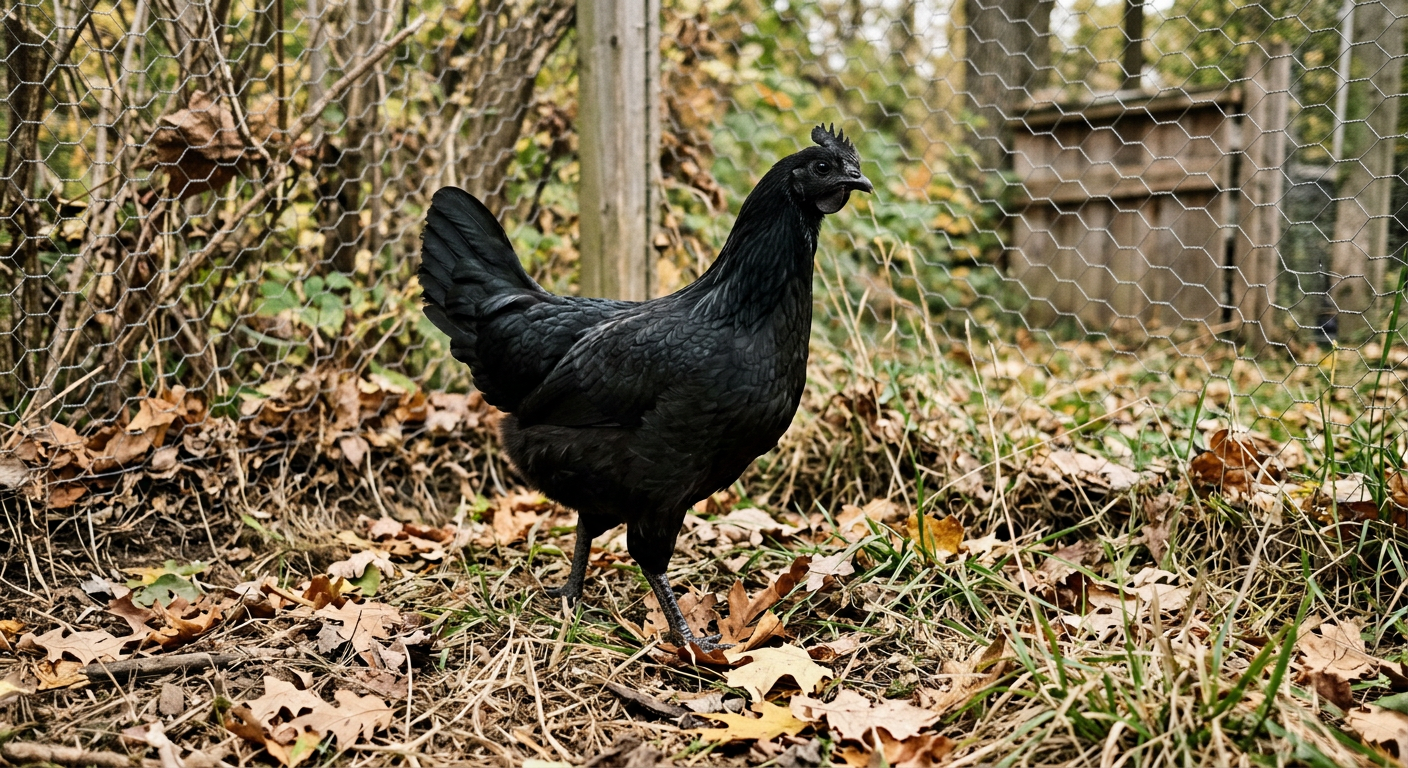
Some hatcheries describe them as docile.
Others note that they may be shy, independent, or somewhat flighty.
Meyer Hatchery describes Ayam Cemani as birds that tend to stay close to their flock, remain aware of their surroundings, and actively forage.
That gives a more useful picture than simply labeling every Ayam Cemani friendly or unfriendly.
Do Ayam Cemani Like Being Held?
Some become comfortable with gentle handling, particularly when accustomed to people from a young age.
Others may prefer to remain on the ground.
An Ayam Cemani that approaches you for feed but moves away when you try to pick her up isn't necessarily aggressive.
She may simply prefer to keep some distance.
Are Ayam Cemani Chickens Aggressive?
They're not universally regarded as an aggressive breed.
However, rooster behavior varies, and individual males can become territorial.
Don't assume a rooster is safe because a particular hatchery describes its hens as docile.
Evaluate the individual bird.
Are Ayam Cemani Good With Children?
They can be kept in family flocks, but I wouldn't select them solely because you're looking for especially calm companion chickens.
Their variable temperament, purchase price, and specialty breeding considerations make them a more deliberate choice.
If children want chickens that tolerate regular handling, consider both the individual bird and the temperament of its breeding line.
For a more conventional family-flock option, our Silkie Chicken Guide discusses a breed with a particularly strong companion-bird reputation.
Do Ayam Cemani Chickens Go Broody?
Broodiness in Ayam Cemani chickens appears to vary substantially between breeding lines, and published sources disagree about how common it is.
This is worth being clear about.
A 2024 scientific review describes Ayam Cemani hens as relatively poor setters that seldom hatch their own broods.
Cackle Hatchery lists its birds as occasionally broody.
Greenfire Farms, on the other hand, describes strong broodiness and maternal behavior in its breeding population.
Rather than choosing one description and presenting it as universal, I'd treat broodiness as a line-dependent characteristic.
Are Ayam Cemani Good Mothers?
Some hens may make attentive mothers.
Others may show little interest in sitting on eggs.
If natural hatching is important to you, ask the breeder how often its hens become broody and whether they successfully raise chicks.
Don't assume that every Ayam Cemani hen will behave like a Silkie.
Can Ayam Cemani Chickens Breed True?
A well-maintained Ayam Cemani breeding population can reproduce its characteristic traits through appropriate selection.
However, not every mating between two black chickens will produce offspring that meet the desired pigmentation and conformation standards.
Black feather color alone is not proof of Ayam Cemani genetics.
Breeders must pay attention to parentage, pigmentation, health, and the characteristics of the resulting offspring.
Are Ayam Cemani Chickens Hard to Raise?
For everyday care, Ayam Cemani chickens are not dramatically different from other backyard chickens.
They need appropriate poultry feed, clean drinking water, safe housing, sufficient space, and normal health management.
The biggest complications usually come from the ownership goals.
Someone keeping a single Ayam Cemani as an ornamental companion may have straightforward needs.
Someone building a breeding program around consistent pigmentation has a much more specialized task.
Everyday Care Requirements
| Area | What Ayam Cemani Need |
|---|---|
| Housing | Dry, ventilated, predator-resistant coop |
| Outdoor space | Secure run with room to forage |
| Feed | Complete diet appropriate to life stage |
| Water | Constant clean drinking water |
| Nesting | Standard nesting boxes |
| Roosts | Stable perches with safe access |
| Grooming | Normal feather and skin observation |
| Dust bathing | Dry, loose material |
| Health | Routine flock observation and parasite management |
| Enrichment | Scratching, foraging, perching, and exploration |
Their black pigmentation does not require special supplements or unusual skin treatments.
Don't buy a product simply because someone claims dark chickens need a different form of routine nutrition.
How Much Space Do Ayam Cemani Chickens Need?
For standard-size Ayam Cemani chickens, Roosted's ordinary backyard planning targets are appropriate starting points:
- Approximately 4 square feet of usable indoor coop space per hen
- Approximately 10 square feet of outdoor run space per hen
These are comfortable backyard planning targets rather than universal biological minimums.
Because Ayam Cemani can be active birds, extra run space is beneficial when practical.
Coop and Run Space Chart
| Number of Hens | Indoor Coop Space | Outdoor Run Space |
|---|---|---|
| 3 | 12 sq ft | 30 sq ft |
| 4 | 16 sq ft | 40 sq ft |
| 6 | 24 sq ft | 60 sq ft |
| 8 | 32 sq ft | 80 sq ft |
If the birds spend nearly all their time in a run, I'd favor a larger enclosure.
Our Chicken Coop Size Calculator helps you compare space requirements.
Do Ayam Cemani Need Tall Fences?
They're relatively active and capable of getting onto elevated perches.
Meyer Hatchery notes that some Ayam Cemani prefer high roosting locations and may seek out trees or fences.
That means containment deserves attention.
I'd favor a secure covered run rather than relying on a short fence.
A covered run also provides protection from hawks and other predators.
Use our Chicken Run Builder to plan an appropriately sized enclosure.
Nesting Boxes
Standard nesting boxes work for most Ayam Cemani hens.
A box around 12 inches in each dimension is a reasonable starting point.
Provide approximately one box for every four laying hens, with additional boxes when helpful for a small flock.
Keep nesting material clean and dry.
Our Chicken Nesting Boxes Guide explains sizing, placement, and bedding options.
Feeding Ayam Cemani Chickens
Ayam Cemani chickens don't require a special diet because of their pigmentation.
Their nutritional needs are determined primarily by age, development, body condition, and egg production.
| Life Stage | Feeding Approach |
|---|---|
| Chicks | Complete chick starter |
| Growing pullets | Appropriate grower ration |
| Laying hens | Complete layer ration or appropriately managed all-flock diet with calcium support |
| Adult non-layers | Suitable maintenance or all-flock ration |
| All stages | Clean water and appropriate grit when needed |
How Much Do Ayam Cemani Chickens Eat?
As relatively light standard-size chickens, they can be included in normal backyard flock feed planning.
Roosted's standard adult-hen estimate is approximately one-quarter pound of complete feed daily for purchasing calculations.
Actual consumption depends on body weight, activity, diet, season, and the individual chicken.
Use the Chicken Feed Calculator to estimate how much feed to purchase.
Treat the result as a buying estimate, not a strict feeding limit.
Can Ayam Cemani Free-Range?
Yes, they can forage like other chickens.
But their alert behavior and dark plumage don't make them predator-proof.
A bird with an unusual appearance is still vulnerable to the ordinary hazards of backyard chicken keeping.
Provide secure nighttime housing and appropriate protection during outdoor activity.
Are Ayam Cemani Chickens Cold Hardy?
Ayam Cemani chickens can be kept in climates that experience winter weather, but they still need appropriate protection.
Cackle Hatchery rates its Ayam Cemani line as cold hardy.
However, the breed's Indonesian origins and differences between breeding populations mean I wouldn't automatically assume every bird is equally comfortable in severe conditions.
Winter Care
Provide:
- Dry bedding
- Protection from rain and snow
- Proper coop ventilation
- No direct drafts across resting birds
- Unfrozen drinking water
- Appropriate nutrition
- Regular inspection of combs and wattles
Ayam Cemani chickens have single combs.
Their dark color doesn't make the comb immune to frostbite.
Read our Chicken Coop Ventilation Guide for winter airflow guidance.
Are Ayam Cemani Good for Hot Climates?
Ayam Cemani chickens originate from a tropical region, and some specialty breeders describe their birds as heat tolerant.
Greenfire Farms, for example, identifies heat hardiness among the breed's characteristics.
Still, tropical ancestry doesn't mean a chicken can safely withstand unlimited heat.
In hot weather, provide reliable shade, cool drinking water, ventilation, and enough space to avoid crowding.
Watch for persistent panting, unusual weakness, or other signs of heat stress.
The same normal summer precautions that protect the rest of your flock also apply to Ayam Cemani.
Ayam Cemani vs. Silkie: Are They Related?
Ayam Cemani and Silkie chickens share one important genetic characteristic: fibromelanosis.
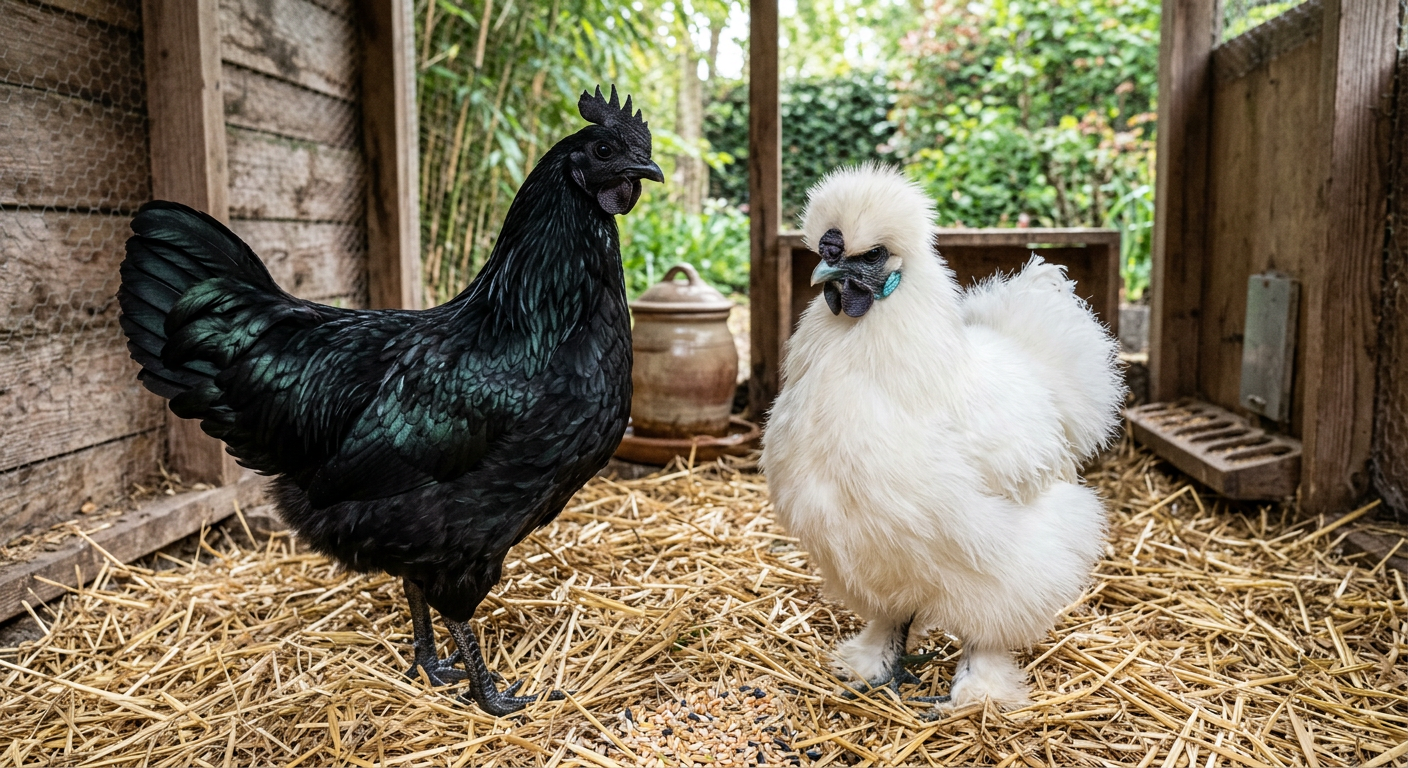
But they're very different breeds.
Scientific research has shown that both carry the same underlying chromosomal rearrangement associated with extensive tissue pigmentation.
That doesn't mean an Ayam Cemani is simply a black Silkie.
Ayam Cemani vs. Silkie Comparison
| Characteristic | Ayam Cemani | Silkie |
|---|---|---|
| Origin | Indonesia | Asian origin, traditionally associated with China |
| Main appeal | Extensive black pigmentation | Fluffy feathers and companion temperament |
| Feather structure | Conventional | Soft, silk-like |
| Skin | Very dark | Dark |
| Comb | Single | Walnut |
| Feet | Clean, normally four toes | Feathered, typically five toes |
| Egg color | Cream or light tan | Cream or tinted |
| Egg production | Generally low | Generally low |
| Broodiness | Variable by line | Usually very strong |
| Temperament | Alert, sometimes shy | Generally calm |
| Flight ability | Relatively good | Limited |
| Best suited for | Ornamental enthusiasts and specialty breeders | Companion flocks and natural broodiness |
Why Do Silkies Have Dark Skin but Fluffy Feathers?
Fibromelanosis and unusual feather structure are different inherited characteristics.
The Silkie's fluffy appearance is associated with its distinctive feather structure.
Its dark skin is associated with fibromelanosis.
An Ayam Cemani shares the deep pigmentation trait but retains ordinary feather structure.
That helps explain why the two birds can look so different despite sharing important pigmentation genetics.
Read our Silkie Chicken Guide for a closer look.
Ayam Cemani vs. Black Australorp
Black Australorps and Ayam Cemani can both have glossy black feathers with green iridescence.
But their similarities mostly end there.
| Characteristic | Ayam Cemani | Black Australorp |
|---|---|---|
| Feather color | Black | Black |
| Comb color | Black | Red |
| Skin pigmentation | Extensive dark pigmentation | Ordinary breed pigmentation |
| Main purpose | Ornamental and specialty breeding | Practical egg production |
| Egg color | Cream/light tan | Light brown |
| Annual egg production | Generally low | Generally high |
| Body type | Relatively light and upright | Heavier, rounded |
| Main attraction | Unusual pigmentation | Productive backyard utility |
If you want a black-feathered chicken that produces plenty of eggs, an Australorp is generally the more practical choice.
If you specifically want the unusual black pigmentation of an Ayam Cemani, an Australorp won't provide the same characteristics.
Ayam Cemani Chicken Pros and Cons
| Pros | Cons |
|---|---|
| Exceptionally unusual appearance | Limited egg production |
| Extensive natural dark pigmentation | Often expensive to purchase |
| Fascinating genetic background | Quality varies between breeding lines |
| Glossy black plumage | May be hard to find locally |
| Can be active foragers | Some individuals are flighty |
| Relatively manageable body size | Straight-run chicks may include roosters |
| Interesting specialty breeding potential | Requires careful selection to maintain desired traits |
| Can fit into ordinary backyard poultry housing | Not the most practical breed for household egg production |
| Distinctive ornamental value | No guaranteed temperament or broodiness |
Who Should Raise Ayam Cemani Chickens?
Ayam Cemani chickens make the most sense for people who genuinely appreciate unusual poultry.
I'd consider them if:
- You want a distinctive ornamental chicken.
- You're interested in poultry genetics.
- You enjoy maintaining specialty breeds.
- You're comfortable paying more for carefully bred birds.
- Egg production isn't your primary goal.
- You have a secure backyard setup.
- You're willing to evaluate breeder quality rather than buying based on appearance alone.
Who Might Prefer Another Breed?
Consider other chickens if you want:
- High annual egg production
- An inexpensive starter flock
- A particularly predictable companion temperament
- Birds available at most local feed stores
- Strong, consistent broodiness
- Dark brown, blue, green, or black-looking eggs
- A standardized American exhibition breed
For most beginners, a productive and widely available backyard breed may be a simpler place to start.
But someone who's already comfortable with chicken keeping and wants an unusual addition could find Ayam Cemani chickens particularly rewarding.
The Bottom Line: Are Ayam Cemani Chickens Worth Raising?
Ayam Cemani chickens are genuinely extraordinary-looking birds.
Their black feathers, black combs, dark skin, and unusually pigmented internal tissues make them unlike the typical chickens found in a backyard flock.
And unlike many unusual-looking animals that have inspired exaggerated stories, the genetics behind their appearance are well documented.
Fibromelanosis is a real inherited trait associated with changes near the EDN3 gene.
But the claims that Ayam Cemani chickens lay black eggs are not true.
Their eggs are cream or lightly tinted.
They're also relatively modest layers, and purchasing quality birds can be expensive.
That means they aren't the most efficient choice if your main goal is filling an egg carton.
The best reason to raise Ayam Cemani chickens is that you appreciate the breed itself—not because you expect black eggs, magical properties, or unusually high production.
For chicken enthusiasts interested in genetics, rare poultry, and extraordinary natural appearances, that's more than enough reason to find them fascinating.
Ayam Cemani Chicken FAQ
Why are Ayam Cemani chickens black?
Ayam Cemani chickens have a genetic pigmentation trait called fibromelanosis. Research has linked this characteristic to a complex chromosomal rearrangement involving the EDN3 gene, resulting in extensive dark pigmentation throughout many body tissues.
Are Ayam Cemani chickens black inside?
Yes. Ayam Cemani chickens have unusually dark pigmentation in tissues including skin, connective tissue, bones, and internal organs. However, their blood is red and their eggshells are not black.
Do Ayam Cemani chickens lay black eggs?
No. Ayam Cemani chickens lay cream, white-tinted, or light tan eggs. Their extensive black body pigmentation does not cause them to produce black eggshells.
What color eggs do Ayam Cemani chickens lay?
Their eggs are generally cream-colored or lightly tinted. Some have a faint pinkish or light tan appearance, depending on the individual hen.
How many eggs do Ayam Cemani chickens lay?
Many hatchery and breeder estimates range from approximately 80–120 eggs annually, although some lines produce fewer. Ayam Cemani are ornamental chickens rather than high-production layers.
Why are Ayam Cemani chickens so expensive?
Their high prices reflect relatively limited availability, specialty breeding, selective pigmentation standards, and demand from poultry enthusiasts. However, expensive birds aren't automatically healthy or well bred.
Are Ayam Cemani chickens rare?
They're uncommon in the United States compared with popular backyard breeds. Specialty hatcheries and breeders sell them, but reliable current worldwide population counts are limited.
Are Ayam Cemani chickens friendly?
Many can be manageable around people, although temperament varies. Some breeding lines are relatively docile, while others are shy, alert, or flighty.
Are Ayam Cemani chickens hard to raise?
Not necessarily. Their daily feed, housing, water, and general care needs are similar to those of other standard-size chickens. The greater challenges are finding reputable breeders, managing purchase costs, and maintaining breed characteristics if breeding.
How long do Ayam Cemani chickens live?
Published references give different estimates, and reliable breed-specific lifespan data is limited. Longevity depends on health, genetics, housing, nutrition, predator protection, and veterinary care. A single guaranteed lifespan should not be assumed.
Do Ayam Cemani chickens go broody?
Some do, but broodiness varies significantly. Certain breeders describe strong maternal instincts, while other sources describe hens that rarely sit. Ask about the behavior of the actual breeding line.
Are Ayam Cemani chickens recognized by the APA?
As of October 2026, Ayam Cemani are not listed among the American Poultry Association's accepted breeds. Breeders are working toward recognition, including participation in qualifying meets.
Keep Reading
Interested in unusual chicken breeds and flock planning? These Roosted resources can help:
- Silkie Chickens: Eggs, Temperament, Lifespan & Care — Learn about another chicken with fibromelanosis and dark skin.
- Easter Egger Chickens: Egg Colors, Temperament & Care — Understand how egg-color genetics differ between chickens.
- Chicken Breed Finder — Compare breed characteristics, egg production, temperament, and backyard suitability.
- Chicken Egg Production Calculator — Estimate egg output and compare flock-size scenarios.
- Chicken Coop Size Calculator — Plan coop and run space for your flock.
- Chicken Feed Calculator — Estimate feed purchases and ongoing costs.
- Chicken Run Builder — Plan a secure run for active backyard chickens.
- How Many Chickens Should I Get? — Choose a flock size that fits your space, goals, and budget.
- Chicken Dust Bath Guide — Create a natural grooming area for your flock.
Sources & Further Reading
- Dharmayanthi et al., PLOS ONE — The Origin and Evolution of Fibromelanosis in Domesticated Chickens — Primary genetic research linking Ayam Cemani and Silkie fibromelanosis to chromosomal changes involving EDN3.
- Dorshorst et al., PLOS Genetics — A Complex Genomic Rearrangement Involving the Endothelin 3 Locus — Genetic mechanism behind extensive tissue pigmentation in chickens.
- Ma and Andersson, Scientific Reports — Population Genomic Analysis of Fibromelanosis — Additional genetic evidence on the fibromelanosis locus.
- Ayam Cemani Breeders Association — Standard of Perfection — Proposed breed standards, pigmentation requirements, body type, egg color, and target weights.
- Siddiqui et al., Tropical Animal Health and Production — Comparative Review on Ayam Cemani Chickens — Scientific review of breed origin, pigmentation, egg characteristics, and rarity.
- University of Veterinary and Animal Sciences — Ayam Cemani — Veterinary university reference for eggs, body size, pigmentation, and general breed traits.
- Cackle Hatchery — Ayam Cemani Chickens — Hatchery-specific egg production, weights, temperament, egg color, and selling conditions.
- Meyer Hatchery — Breed Spotlight: Ayam Cemani — Appearance, temperament, foraging behavior, mature size, and special care considerations.
- Greenfire Farms — Ayam Cemani — Specialty breeder information, breeding history, egg production, and line-specific broodiness.
- American Poultry Association — Accepted Breeds and Varieties — Current official breed-recognition directory.
- American Poultry Association — 2026 Qualifying Meets — Ayam Cemani participation in the breed-recognition process.
- USDA APHIS — National Poultry Improvement Plan — Disease-testing and certification program information, distinct from breed-purity verification.
- University of Minnesota Extension — Raising Chickens for Eggs — Everyday laying-hen nutrition, housing, and management.