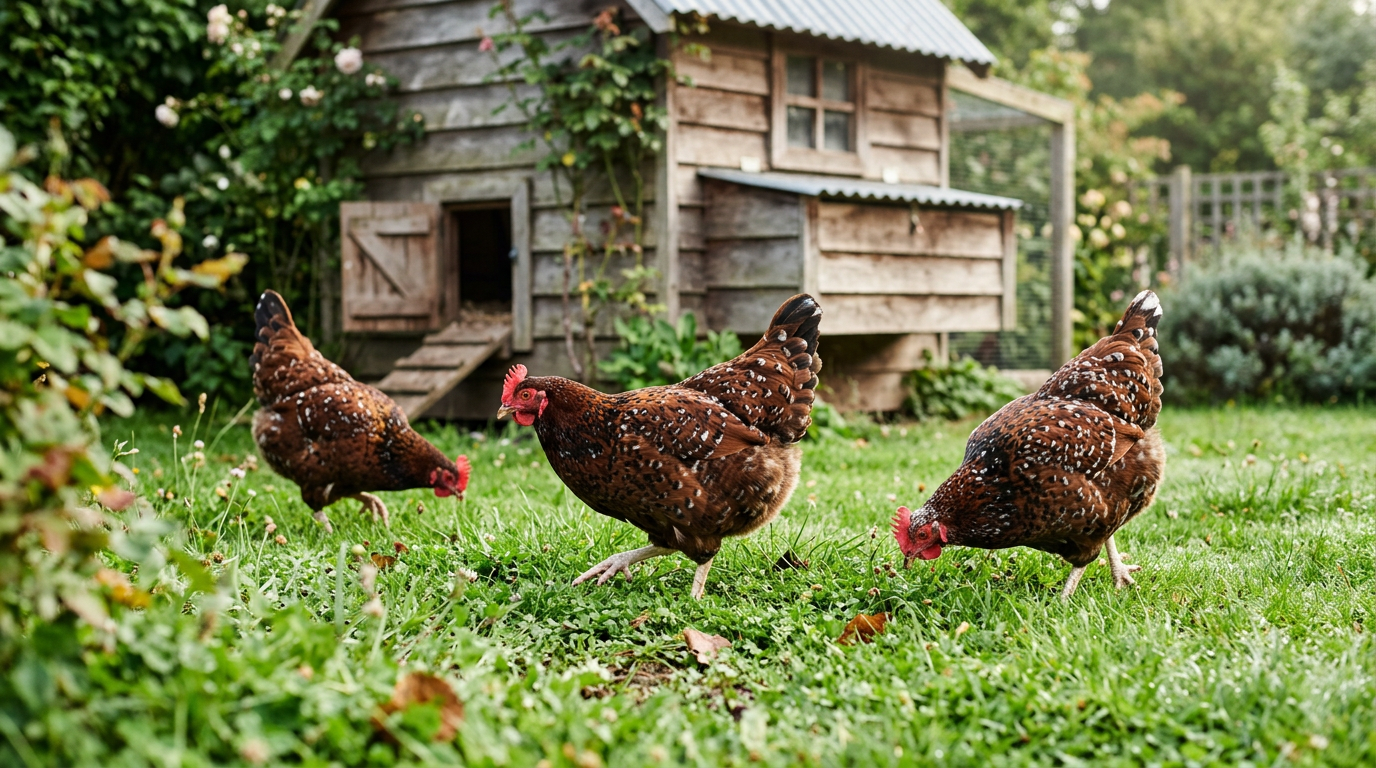
Some chickens are content to go about their day without paying much attention to what you're doing.
Speckled Sussex chickens tend to be a little more interested.
Walk into the run to refill a feeder, move some bedding, or work on the coop, and you may find a curious Sussex hen standing nearby, inspecting your progress.
That people-oriented personality is one of the reasons this traditional English breed has become a favorite among backyard chicken keepers.
But their appearance is just as memorable.
Speckled Sussex chickens have rich mahogany feathers decorated with black markings and white tips. Their plumage can become increasingly speckled after successive molts, meaning an older hen may look noticeably different from the bird you originally brought home.
Combine that with useful brown egg production, good foraging ability, and a reputation for being gentle around people, and the breed has plenty to offer.
So are Speckled Sussex chickens good for beginners? How many eggs do they lay? And are they a good choice for families?
Here's what to know before adding them to your flock.
Speckled Sussex Chicken Quick Facts
| Trait | Speckled Sussex |
|---|---|
| Origin | Sussex, England |
| Breed type | Traditional dual-purpose breed |
| Variety | Speckled Sussex |
| APA class | English |
| APA recognition | 1914 |
| Hen weight | Approximately 7 lb |
| Rooster weight | Approximately 9 lb |
| Egg color | Tan to brown |
| Egg size | Large |
| Annual egg production | Approximately 200–250 |
| Weekly egg production | Around 4–5 during productive periods |
| First laying age | Often around 5–7 months; individual variation |
| Temperament | Calm, curious, generally friendly |
| Broodiness | Moderate to high potential; varies by hen |
| Mothering ability | Generally good |
| Cold tolerance | Very good |
| Heat tolerance | Requires careful summer management |
| Foraging | Very good |
| Confinement | Handles a properly sized run well |
| Comb | Single |
| Feathered feet | No |
| Beginner-friendly | Yes |
| Family-friendly | Yes, with normal supervision |
| Main appeal | Friendly temperament and distinctive speckled plumage |
| Main consideration | Summer heat, body condition, and mixed-flock dynamics |
Speckled Sussex chickens are a good example of why choosing a breed based solely on egg production can be misleading.
Their greatest value is the combination of qualities they bring to an ordinary backyard flock.
Why Are Speckled Sussex Chickens So Popular?
The Speckled Sussex has three characteristics that make it particularly attractive to backyard chicken owners.
First, the temperament.
The Livestock Conservancy describes Sussex chickens as calm, curious, and interested in people. They're the kind of birds that often want to investigate whatever is happening nearby.
Second, the appearance.
Few traditional dual-purpose breeds have a feather pattern quite like the Speckled Sussex. The combination of mahogany, black, and white gives each bird a distinctive appearance.
Third, the practicality.
These aren't ornamental chickens that contribute little to the egg basket.
Speckled Sussex hens can produce a useful number of large brown eggs while retaining the body size, foraging ability, and traditional characteristics of an established farm breed.
That balance is what makes them interesting.
You don't necessarily have to choose between a beautiful chicken, a friendly chicken, and a useful egg layer.
With Speckled Sussex chickens, you can get all three.
What Do Speckled Sussex Chickens Look Like?
A Speckled Sussex has one of the more distinctive feather patterns in the chicken world.
Its plumage combines several colors across individual feathers.
The base color is typically a rich reddish-brown or mahogany.
Many feathers include black markings and a white tip, creating the recognizable speckled appearance.
In good lighting, the darker feather areas may show a subtle greenish sheen.
Typical physical characteristics include:
- Deep mahogany or reddish-brown plumage
- Black feather markings
- White feather tips
- Broad, rectangular body
- Full breast and substantial frame
- Red single comb
- Red wattles and earlobes
- White or pale legs
- Clean, unfeathered feet
- Four toes
- White skin
Their body shape reflects their history as dual-purpose farm chickens.
They're more substantial than lightweight egg specialists such as Leghorns, but they don't have the exaggerated bulk of giant breeds such as Brahmas.
Do Speckled Sussex Chickens Get More Speckled With Age?
Yes. Many Speckled Sussex chickens develop increasingly noticeable white speckling after successive molts.
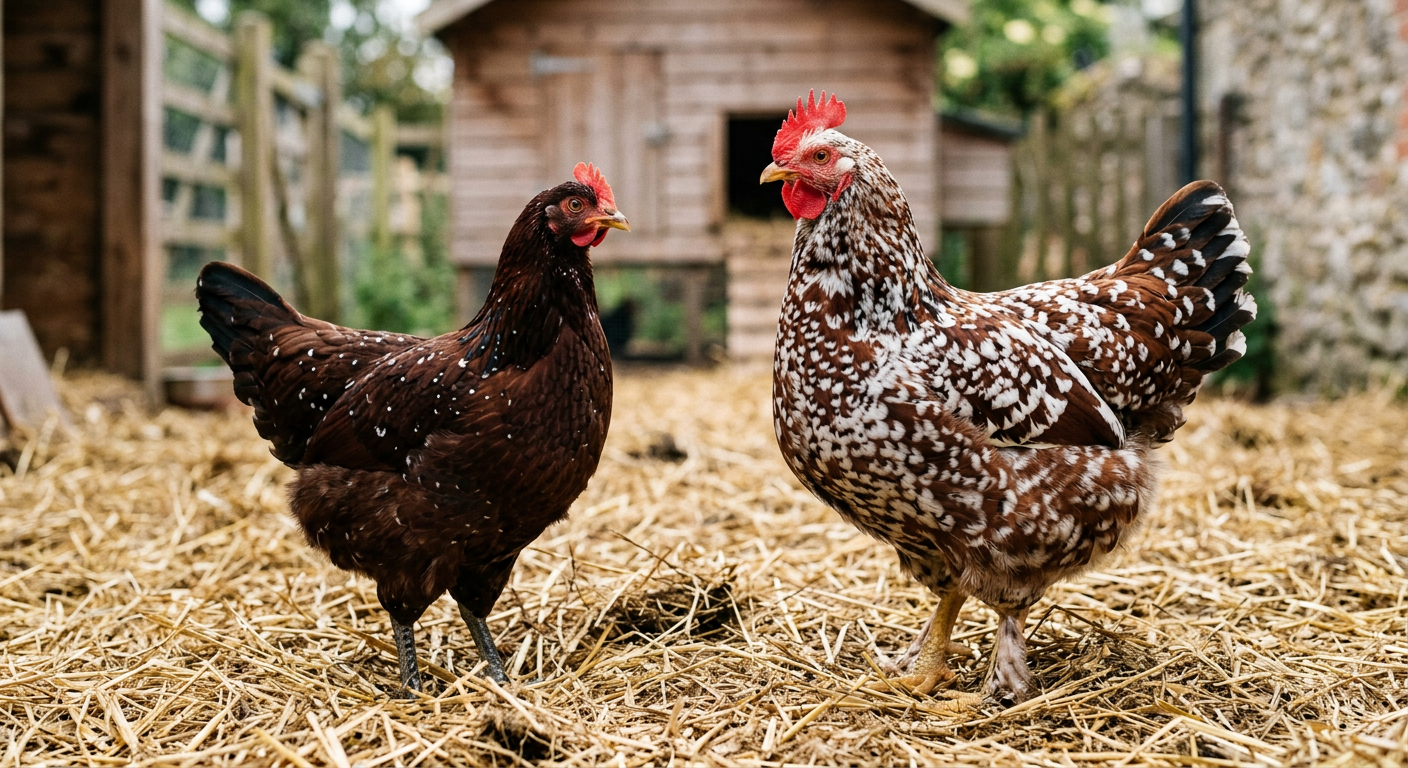
This is one of the most interesting things about the variety.
A young Speckled Sussex pullet may have relatively subtle white markings scattered throughout her dark plumage.
As she grows older and replaces feathers during normal molting, the white-tipped pattern can become more pronounced.
Some older hens develop a substantially lighter, more heavily speckled appearance.
Cackle Hatchery specifically describes this tendency in its Speckled Sussex breeding line.
The change isn't identical in every bird, though.
Genetics, individual feather patterns, and breeding selection influence how much white develops.
Why Does the Pattern Change?
Chickens replace their feathers during molting.
When new feathers grow, they may display different amounts of white within the bird's inherited speckled pattern.
Over successive molts, the visible white markings can become more extensive.
It's part of the variety's normal plumage development rather than necessarily a sign of a nutritional problem or disease.
Roosted Note
If you want to see how much your Speckled Sussex changes over time, photograph her when she's young and again after each major molt.
You may be surprised by how different the feather pattern looks a few years later.
It's one of the more interesting breeds to document as your flock ages.
Speckled Sussex vs. Light Sussex: What's the Difference?
Speckled Sussex and Light Sussex chickens belong to the same breed.
Sussex is the breed name.
Speckled and Light describe different recognized color varieties.
In the United States, the American Poultry Association recognizes three large-fowl Sussex varieties:
- Speckled
- Light
- Red
The Speckled and Red varieties entered the American Standard of Perfection in 1914, followed by the Light variety in 1929.
Other Sussex colors exist internationally, but they aren't all recognized under the American standard.
Speckled Sussex
Speckled Sussex chickens have dark mahogany feathers with black and white markings.
Their appearance is colorful and heavily patterned.
Light Sussex
Light Sussex chickens have predominantly white plumage with black markings around the neck, wings, and tail.
Their appearance is much lighter and more sharply contrasted.
Comparison
| Characteristic | Speckled Sussex | Light Sussex |
|---|---|---|
| Breed | Sussex | Sussex |
| Main appearance | Mahogany, black, and white speckles | White with black markings |
| Egg color | Brown | Brown |
| Standard body type | Large dual-purpose | Large dual-purpose |
| Comb | Single | Single |
| Temperament | Generally calm and curious | Generally calm and curious |
| Cold hardiness | Good | Good |
| Primary distinction | Color pattern | Color pattern |
Neither variety is automatically better simply because of feather color.
Breeding line, individual temperament, and the breeder's selection priorities matter more for egg production and behavior.
If you love the distinctive appearance of the Speckled Sussex, that's a perfectly reasonable reason to choose it.
How Big Do Speckled Sussex Chickens Get?
Speckled Sussex chickens are large, substantial birds.
According to Oklahoma State University and the University of Wisconsin Extension, standard Sussex weights are:
| Bird | Standard Weight |
|---|---|
| Adult rooster | 9 lb |
| Adult hen | 7 lb |
| Cockerel | 7.5 lb |
| Pullet | 6 lb |
These are breed-standard weights, not guaranteed weights for every individual chicken.
The breed's size reflects its traditional purpose.
Sussex chickens were historically valued as table birds as well as egg layers.
Today, that larger frame is still useful for people who want a traditional dual-purpose chicken.
Are Speckled Sussex Bigger Than Rhode Island Reds?
Generally, yes.
A standard Sussex hen weighs approximately 7 pounds compared with roughly 6.5 pounds for a Rhode Island Red hen.
The difference isn't enormous, but Speckled Sussex chickens tend to have a broader, substantial appearance.
They're smaller than giant breeds such as Jersey Giants and Brahmas.
Are Speckled Sussex Chickens Friendly?
Yes. Speckled Sussex chickens are widely known for being friendly, curious, and generally comfortable around people.
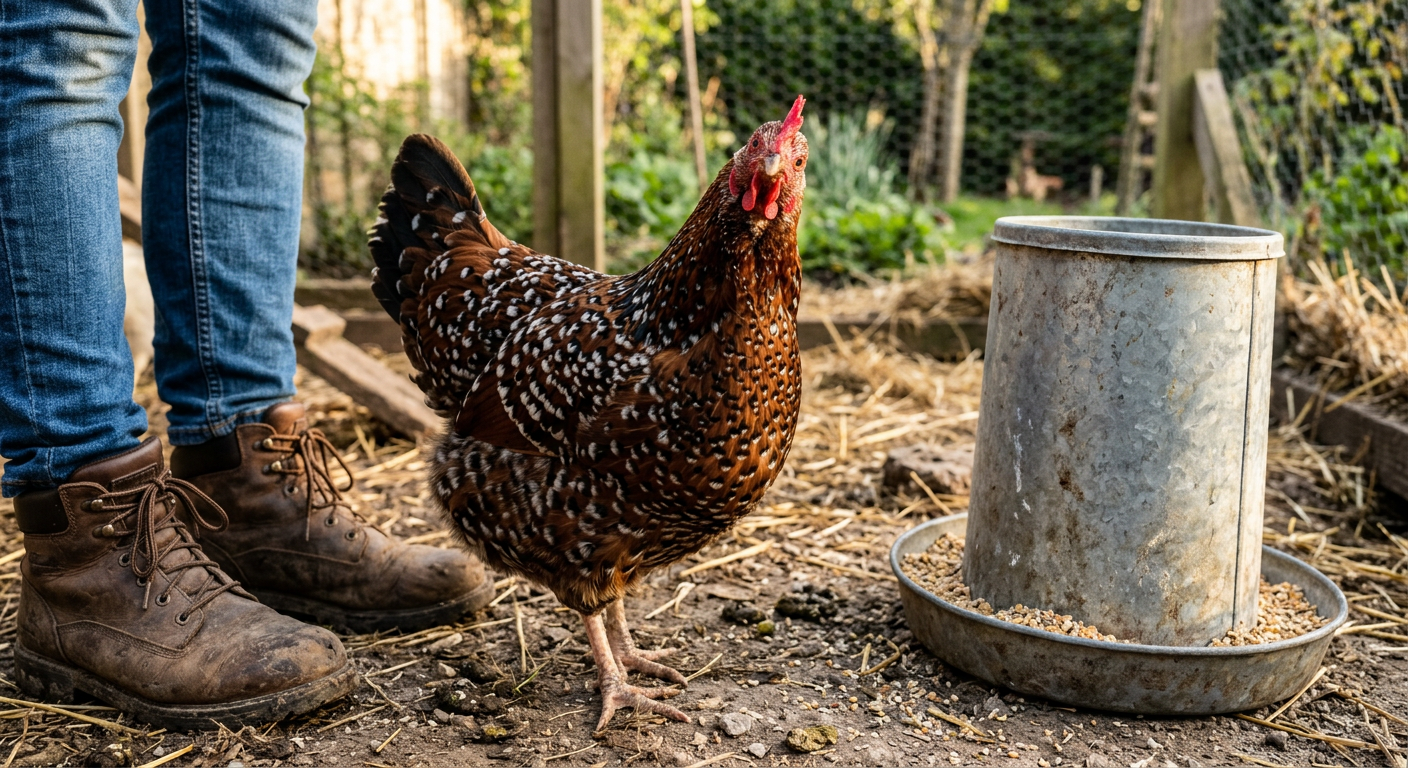
This is arguably the breed's greatest advantage for many backyard keepers.
The Livestock Conservancy specifically identifies Sussex chickens as a good choice for families and beginners.
Unlike some highly active breeds that prefer to keep their distance, many Speckled Sussex chickens seem interested in whatever their keepers are doing.
They may follow you around the run, approach when you arrive, or investigate new objects in their environment.
That behavior makes them enjoyable chickens to keep, even when they're not laying eggs.
Do Speckled Sussex Chickens Like Being Held?
Some do.
But it's important to distinguish a friendly chicken from one that enjoys being picked up.
A Speckled Sussex may willingly approach you, accept treats, and spend time nearby without wanting to sit in your arms.
Other individuals may become comfortable with gentle handling.
Temperament depends on:
- Individual personality
- Breeding line
- Early socialization
- Handling experience
- Flock dynamics
- Previous interactions with people
A chicken that's comfortable approaching you has already developed a useful level of trust.
You don't need to turn every bird into a lap chicken.
Are Speckled Sussex Good With Kids?
Yes, Speckled Sussex chickens are one of the traditional breeds worth considering for a family flock.
Their generally calm, curious behavior can make them easier for children to observe and interact with.
However, supervision is still important.
Teach children to:
- Approach chickens slowly and calmly.
- Avoid chasing or cornering birds.
- Let chickens move away when they want to.
- Support the chicken's body properly when handling.
- Avoid pulling feathers, wings, or tails.
- Wash hands after handling chickens or their equipment.
The CDC recommends handwashing and appropriate supervision around backyard poultry because healthy-looking birds can still carry germs.
A friendly breed makes chicken keeping more enjoyable for families, but it doesn't eliminate the need for sensible handling practices.
Roosted Note
If you're selecting chickens for children, I'd pay attention to how the individual birds behave rather than relying only on the breed's reputation.
A calm Speckled Sussex that willingly approaches people may be an excellent choice.
A particularly nervous individual might need more time and gentle interaction.
Breed tendencies help you choose where to start. The individual bird still matters.
Are Speckled Sussex Chickens Aggressive?
Speckled Sussex chickens are generally not characterized as aggressive.
The Livestock Conservancy describes Sussex chickens as confident but not especially aggressive toward other breeds.
However, individual behavior can vary.
Some hens may be more assertive within the pecking order.
Others may be relatively submissive.
Are Speckled Sussex Roosters Friendly?
Speckled Sussex roosters may share the breed's generally manageable temperament, but rooster behavior should always be evaluated individually.
A mature rooster can weigh approximately 9 pounds.
That's a substantial bird.
Watch for:
- Charging people
- Repeated aggressive pecking
- Spur strikes
- Territorial behavior
- Excessive aggression toward flockmates
- Aggression around children
A calm rooster may be a useful flock member.
An aggressive rooster should never be assumed safe simply because Sussex chickens have a friendly reputation.
Do Speckled Sussex Chickens Get Bullied?
They can.
The Livestock Conservancy notes that Sussex chickens may need monitoring around more assertive breeds.
A gentle chicken can sometimes end up lower in the flock's social hierarchy.
This doesn't mean Speckled Sussex chickens can't live in mixed flocks.
They often can.
Just watch for repeated chasing, feather pulling, blocked access to feed, or birds hiding away from the group.
Provide enough space and more than one feeding or watering location when necessary.
How Many Eggs Do Speckled Sussex Chickens Lay?
Speckled Sussex hens can produce approximately 200–250 large brown eggs annually under favorable conditions.
That's a useful level of production for a traditional dual-purpose breed.
The Livestock Conservancy estimates 200–250 eggs per year for Sussex chickens.
Cackle Hatchery provides a slightly narrower estimate of approximately 200–240 eggs for its Speckled Sussex line.
Utah State University Extension lists a higher estimate of 250–300 for Sussex chickens more broadly.
These figures illustrate the importance of breeding-line differences.
For a general backyard planning estimate, Roosted would use approximately 200–250 annually rather than promising the upper end of all published figures.
How Many Eggs Do Speckled Sussex Lay Per Week?
Around four to five eggs per week is a reasonable broad expectation during productive periods.
However, that doesn't mean every hen will lay exactly five eggs every week.
Production varies with:
- Age
- Breeding line
- Daylight
- Molting
- Broodiness
- Nutrition
- Health
- Weather
- Stress
A young, healthy hen may produce regularly during spring and summer.
That same hen might slow down considerably during winter or while molting.
How Many Eggs Would Four Speckled Sussex Hens Lay?
Using an annual planning range of 200–250 eggs per hen:
| Number of Hens | Estimated Annual Eggs |
|---|---|
| 2 | 400–500 |
| 4 | 800–1,000 |
| 6 | 1,200–1,500 |
| 8 | 1,600–2,000 |
These are mathematical projections, not guaranteed results.
They assume productive hens performing within the estimated annual range.
For a household that uses eggs regularly, four to six Speckled Sussex hens could provide a useful supply.
Use our Chicken Egg Production Calculator to estimate production while accounting for breed, age, daylight, and other variables.
What Color Eggs Do Speckled Sussex Chickens Lay?
Speckled Sussex chickens lay tan to brown eggs, usually in the large size category.

Many eggs are relatively light brown.
Some may have a warmer tint that appears slightly pinkish.
The exact shade depends on the individual hen and her genetics.
Do Speckled Sussex Chickens Lay Speckled Eggs?
Not typically.
The word *speckled* refers to the chicken's feathers, not a characteristic spotted eggshell.
Speckled Sussex eggs are generally tan to brown.
While individual eggs may occasionally show small variations in surface color, consistently dark, speckled eggs are more strongly associated with breeds such as Welsummers.
This is an important distinction if you're choosing chickens based on egg appearance.
If you want the beautiful feather pattern, choose Speckled Sussex.
If you're specifically looking for dark, spotted eggs, another breed may better match your goal.
Are Speckled Sussex Eggs Large?
Yes.
The Livestock Conservancy classifies Sussex eggs as large.
Young pullets may initially lay smaller eggs before reaching their normal mature egg size.
When Do Speckled Sussex Chickens Start Laying Eggs?
Many medium-to-large dual-purpose pullets begin laying somewhere around five to seven months of age.
That is a useful general expectation for Speckled Sussex owners, although there isn't a well-established breed-wide first-lay range precise enough to guarantee a particular week.
Individual Sussex pullets may begin earlier or later.
Several factors influence first laying:
- Genetics and breeding line
- Individual maturity
- Nutrition
- Health
- Seasonal daylight
- Environmental stress
Signs Your Speckled Sussex Is Getting Ready to Lay
Watch for:
- A larger, brighter red comb
- More developed wattles
- Increased nesting-box interest
- Squatting behavior
- Changes in vocalization
- More time spent investigating nesting areas
One sign doesn't guarantee that an egg will appear the next morning.
But several changes together may indicate that your pullet is approaching maturity.
Use our First Egg Calculator for a planning estimate based on hatch date and breed.
For more detail, read When Do Chickens Start Laying Eggs?.
Do Speckled Sussex Chickens Lay Eggs in Winter?
They can, but their cold hardiness doesn't guarantee consistent winter egg production.
Shorter daylight hours can reduce laying even when the birds are comfortable in cold temperatures.
Age, molting, nutrition, and broodiness also affect production.
A Speckled Sussex hen may handle winter weather well while producing fewer eggs than she does during spring.
That's normal for many backyard chickens raised under natural daylight.
Do Speckled Sussex Chickens Go Broody?
Yes. Speckled Sussex hens can become broody and have a reputation for being good mothers.
Both the University of Wisconsin Extension and The Livestock Conservancy identify Sussex hens as capable sitters and mothers.
However, broodiness still varies between individual birds and breeding lines.
Some hens may become broody regularly.
Others may rarely show the behavior.
What Does a Broody Sussex Hen Do?
A broody hen develops the instinct to sit on eggs and attempt to hatch them.
You may notice her:
- Remaining in a nesting box for long periods
- Becoming defensive when approached
- Making distinctive clucking sounds
- Leaving the nest less frequently
- Temporarily reducing or stopping normal egg production
If you want naturally raised chicks, broodiness can be useful.
If your primary goal is uninterrupted egg production, it can be inconvenient.
Are Speckled Sussex Good Mothers?
They have a good reputation for mothering.
Their traditional dual-purpose breeding history retained characteristics useful for natural reproduction.
A broody Speckled Sussex may incubate eggs and care for chicks successfully.
But don't assume every Sussex hen will become broody or reliably complete a hatch.
If you intend to hatch chicks, prepare appropriate nesting space, monitor the hen's health, and have a management plan.
Are Speckled Sussex Chickens Cold Hardy?
Yes. Speckled Sussex chickens are generally well suited to colder climates when provided with appropriate housing.
Utah State University Extension identifies Sussex among breeds suitable for cold weather.
The Livestock Conservancy also notes that Sussex chickens do well in winter.
Their substantial bodies and relatively close-fitting plumage help make them practical birds for climates with seasonal cold.
However, cold hardiness doesn't eliminate every winter concern.
Watch the Single Comb
Speckled Sussex chickens have upright single combs.
During severe freezing weather, exposed comb and wattle tissue can develop frostbite.
That means their combs require more attention than the compact rose comb found on breeds such as Wyandottes.
Winter Care for Speckled Sussex
Prioritize:
- Dry bedding
- Consistent ventilation
- Protection from rain, snow, and wind
- No direct drafts across sleeping birds
- Accessible, unfrozen drinking water
- Adequate complete feed
- Regular comb and wattle inspection
Don't seal the coop tightly in an attempt to make it warmer.
Trapped moisture can create additional frostbite and respiratory concerns.
Our Chicken Coop Ventilation Guide explains how to maintain airflow without creating direct drafts.
Can Speckled Sussex Chickens Handle Hot Weather?
Speckled Sussex chickens can live in warm climates, but summer management deserves serious attention.
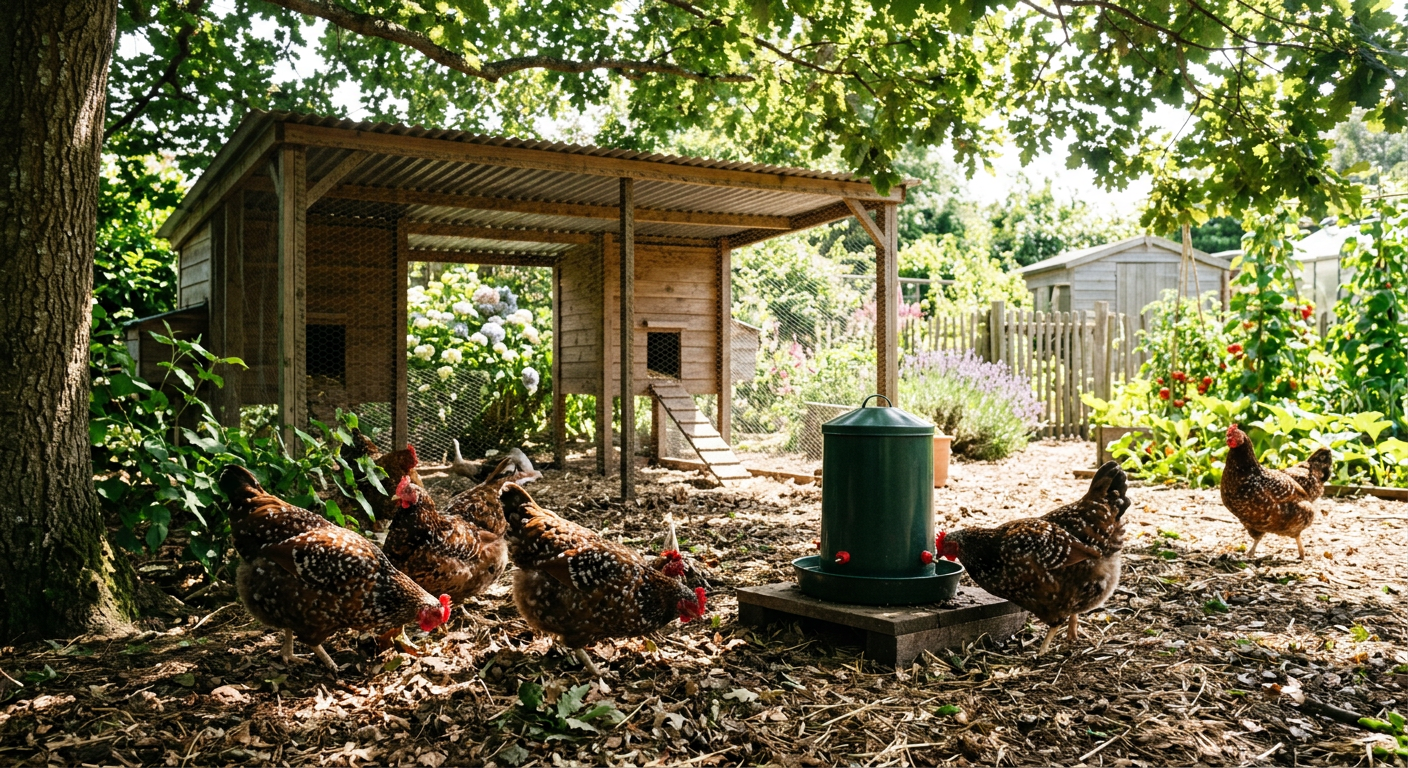
The Livestock Conservancy specifically notes that Sussex chickens are less comfortable in hot conditions than in winter.
Murray McMurray Hatchery rates its Speckled Sussex line relatively favorably for heat tolerance, illustrating that breeding lines and management may influence how birds perform.
I wouldn't treat them as a breed specifically developed for extreme heat.
Their substantial body size makes shade, ventilation, and water especially important.
Summer Care for Speckled Sussex
Provide:
- Reliable shade throughout the day
- Constant access to fresh drinking water
- Good ventilation through the coop
- Adequate airflow in the run
- Enough room to avoid crowding
- Dry, shaded ground where birds can rest
- Regular observation during extreme temperatures
Watch for signs of heat stress, including:
- Persistent open-mouth panting
- Wings held away from the body
- Unusual weakness
- Reduced activity
- Difficulty standing
- Lack of responsiveness
Severe heat stress requires prompt cooling and veterinary attention.
Roosted Note
A chicken can be cold hardy without being equally comfortable in extreme heat.
Speckled Sussex chickens are a good example.
If you're keeping them through a hot summer, I would spend more effort planning shade and airflow than assuming their traditional farm hardiness will handle everything.
Are Speckled Sussex Chickens Good Free-Range Birds?
Yes.
Speckled Sussex chickens are generally excellent backyard foragers.
The University of Wisconsin Extension identifies Sussex as good foragers, while The Livestock Conservancy notes that they appreciate opportunities to roam.
Their curious temperament makes this especially enjoyable to watch.
A Sussex hen may spend much of the afternoon investigating leaf piles, scratching through loose soil, and looking for insects.
What Makes Them Good Foragers?
Their traditional farm background is part of the explanation.
Sussex chickens were developed as useful birds capable of living in practical agricultural environments.
Modern Speckled Sussex chickens still retain an interest in exploring and searching for food.
They may investigate:
- Grass and vegetation
- Loose soil
- Fallen leaves
- Insects
- Seeds
- Compost areas
- Other natural forage
However, foraging shouldn't replace a nutritionally complete poultry ration.
The amount and nutritional value of natural forage vary considerably between properties and seasons.
Are Speckled Sussex Good in Confinement?
They can be.
The Livestock Conservancy describes Sussex chickens as capable of doing well in confinement when they have adequate space and opportunities to move.
That's encouraging for backyard keepers who don't have acreage.
But confinement tolerance doesn't mean a chicken should spend its entire life inside a tiny, empty enclosure.
Provide a properly sized run with opportunities for:
- Scratching
- Dust bathing
- Perching
- Exploring
- Moving away from flockmates
- Resting in shade
Leaf piles, stumps, and other safe enrichment features can help keep a run more interesting.
Can Speckled Sussex Fly?
They can fly, but they're not generally known for being especially strong or frequent flyers.
The Livestock Conservancy describes Sussex chickens as not particularly prone to flying.
Their substantial body size helps distinguish them from lightweight breeds such as Leghorns.
However, don't confuse limited flight ability with reliable containment.
A motivated chicken may still clear an inadequate barrier.
And a fence that keeps chickens inside doesn't necessarily keep predators outside.
A secure, covered run remains a good investment.
Housing and Space Requirements for Speckled Sussex
Speckled Sussex chickens don't require unusual housing.
But their adult size should influence how you design the coop and run.
A seven-pound hen is a substantial chicken, so I'd avoid designing everything around the smallest possible dimensions.
How Much Coop Space Do Speckled Sussex Need?
Roosted's general comfort targets for standard backyard chickens are:
- Approximately 4 square feet of usable indoor coop space per hen
- Approximately 10 square feet of outdoor run space per hen
For large or heavy birds, our Coop Size Calculator offers a more generous planning setting of:
- Approximately 5 square feet indoors
- Approximately 12 square feet outdoors
For a flock of full-size Speckled Sussex, I'd consider the more generous setting when building a new setup, especially if the birds will spend considerable time confined.
Space Planning for Speckled Sussex
| Hens | Standard Coop Target | Roomier Coop Target | Roomier Run Target |
|---|---|---|---|
| 3 | 12 sq ft | 15 sq ft | 36 sq ft |
| 4 | 16 sq ft | 20 sq ft | 48 sq ft |
| 6 | 24 sq ft | 30 sq ft | 72 sq ft |
| 8 | 32 sq ft | 40 sq ft | 96 sq ft |
These are Roosted planning targets, not universal biological minimums.
More space is beneficial when practical.
Use our Chicken Coop Size Calculator to plan the dimensions of your flock's housing.
Roosting Bars
Provide sturdy, comfortably sized wooden roosts.
Because Sussex chickens are relatively heavy, I'd avoid unnecessarily high perches above hard flooring.
A moderate roost height with safe landing space is a practical choice.
Nesting Boxes
Standard nesting boxes generally work well for Sussex hens, although they should be large enough for a seven-pound bird to turn and settle comfortably.
A box around 12 inches in each dimension is a common starting point.
For a small flock, one or two nesting boxes may be sufficient depending on flock size and behavior.
Read our Chicken Nesting Boxes Guide for placement and sizing recommendations.
Predator Protection
Speckled Sussex chickens are curious and may be relatively comfortable approaching people.
That doesn't mean they can distinguish every safe visitor from a dangerous animal.
Use predator-resistant fencing, secure openings, and a locked nighttime coop.
A covered run helps protect against aerial predators and reduces escape risks.
Feeding Speckled Sussex Chickens
Speckled Sussex chickens don't require a special breed-specific feed.
Their diet should be based on a complete poultry ration appropriate for their age and production stage.
Feeding by Life Stage
| Stage | Feeding Approach |
|---|---|
| Chicks | Complete chick starter |
| Growing pullets | Appropriate grower ration |
| Approaching laying age | Transition according to the feed program |
| Laying hens | Complete layer feed or correctly managed flock feed with calcium support |
| All stages | Constant access to fresh water |
Foraging can provide useful enrichment and supplemental nutrition.
But complete feed should remain the foundation.
Can Speckled Sussex Chickens Become Overweight?
Yes.
The Livestock Conservancy notes that Sussex chickens can put on excess body fat relatively easily.
It also warns that overconditioning can negatively affect egg production.
This is worth paying attention to because the breed is already naturally broad-bodied.
A healthy seven-pound Sussex hen should look substantial.
But body size alone doesn't tell you whether the bird has an appropriate body condition.
How to Manage Weight
Focus on:
- Providing complete, appropriate feed
- Keeping treats supplemental
- Encouraging movement and foraging
- Providing adequate run space
- Monitoring body condition
- Avoiding unnecessary overfeeding of energy-dense treats
Don't respond to a potentially overweight chicken by sharply restricting a laying hen's balanced nutrition.
Instead, evaluate the overall feeding program and activity level.
Our Chicken Feed Calculator can help estimate feed purchases and usage without treating the result as a strict ration.
Speckled Sussex vs. Other Backyard Chicken Breeds
Speckled Sussex chickens are especially useful to compare with Buff Orpingtons, Barred Rocks, and Rhode Island Reds.
All four are established dual-purpose breeds.
But each has a slightly different combination of temperament, appearance, and production characteristics.
| Characteristic | Speckled Sussex | Buff Orpington | Barred Rock | Rhode Island Red |
|---|---|---|---|---|
| Main appeal | Curious personality and speckled appearance | Gentle, heavy family chicken | Balanced backyard utility | Strong practical egg production |
| Hen weight | ~7 lb | ~8 lb | ~7.5 lb | ~6.5 lb |
| Egg color | Brown | Brown | Brown | Brown |
| Egg production | Good | Moderate to good | Good | Good to excellent by line |
| Temperament | Friendly and curious | Generally very calm | Calm and practical | Confident, sometimes assertive |
| Broodiness | Common enough to consider | Often broody | Variable | Variable |
| Foraging | Very good | Moderate | Good | Good |
| Cold tolerance | Very good | Very good | Very good | Good |
| Main consideration | Summer heat and body condition | Larger body and heat management | Standard single-comb care | Some individuals more assertive |
Speckled Sussex vs. Buff Orpington
Both breeds are strong choices for people who want friendly backyard chickens.
The Buff Orpington has a particularly calm reputation and a larger, rounder body.
The Speckled Sussex tends to be more actively curious and interested in exploring its surroundings.
If you want a laid-back, heavy chicken, an Orpington may be appealing.
If you want a friendly chicken that also spends plenty of time investigating the yard, the Sussex may be a better fit.
Read our Buff Orpington Chicken Guide.
Speckled Sussex vs. Barred Rock
Both are traditional dual-purpose birds with useful brown egg production.
Barred Rocks have the familiar black-and-white barred pattern.
Speckled Sussex chickens have the much more colorful mahogany, black, and white feather pattern.
Both are generally considered good beginner breeds.
For many backyard owners, choosing between them may come down to appearance and individual temperament.
Read our Barred Rock Chicken Guide.
Speckled Sussex vs. Rhode Island Red
Rhode Island Reds have a strong reputation for practical brown egg production.
Speckled Sussex chickens emphasize a somewhat different balance, combining good laying with a particularly curious and generally gentle personality.
If your primary goal is producing as many brown eggs as possible, compare actual hatchery laying lines.
If your priority is a friendly family flock with beautiful plumage and useful production, Speckled Sussex chickens deserve serious consideration.
Read our Rhode Island Red Chicken Guide.
Are Speckled Sussex Chickens Good for Beginners?
Yes.
Speckled Sussex chickens are among the traditional breeds worth recommending to first-time backyard chicken keepers.
Their generally friendly disposition, good foraging ability, reasonable egg production, and cold hardiness make them a practical choice.
They also don't require highly specialized equipment.
Normal backyard chicken infrastructure works well when it's properly sized and managed.
The main things I'd emphasize to a beginner are:
- Give these substantial birds enough room.
- Provide shade and ventilation during summer.
- Don't allow treats to replace balanced feed.
- Watch for bullying in mixed flocks.
- Understand that broodiness may interrupt egg production.
- Choose a reputable breeder or hatchery.
Are Speckled Sussex Good for Small Backyards?
They can be.
You don't need a large farm to keep a small Speckled Sussex flock.
However, the birds still need adequate indoor and outdoor space.
If you have a very small run, consider whether a heavy, curious dual-purpose breed is the best fit for your setup.
For many households, four to six hens is a manageable starting flock when adequate housing is available.
Our How Many Chickens Should I Get? guide can help you decide.
Speckled Sussex Chicken Pros and Cons
| Pros | Cons |
|---|---|
| Generally friendly and curious | Individual temperament varies |
| Good family-flock potential | Can be bullied by assertive birds |
| Beautiful speckled feathers | Not the highest-producing layer |
| Plumage may become more speckled with age | Broodiness may interrupt laying |
| Large brown eggs | Substantial birds need appropriate space |
| Very good cold hardiness | Single comb needs frostbite monitoring |
| Excellent foraging ability | Not especially suited to extreme heat |
| Traditional dual-purpose characteristics | Can gain excess body condition |
| Good beginner suitability | Still requires predator protection and daily care |
Who Should Choose Speckled Sussex Chickens?
I'd put Speckled Sussex chickens high on the list for someone who wants a friendly, interesting backyard flock.
They're particularly appealing if:
- You want chickens that enjoy being around people.
- You have children interested in backyard chicken keeping.
- You appreciate unusual feather patterns.
- You want large brown eggs.
- You want a traditional dual-purpose breed.
- You have room for chickens to forage.
- You live somewhere with cold winters.
- You like the possibility of hens raising chicks naturally.
Who Might Prefer Another Breed?
Consider other breeds if your strongest priority is:
- Maximum commercial-style egg production
- Blue or green eggs
- Very small birds
- Minimal broodiness
- Lightweight chickens for confined spaces
- A breed specifically selected for extreme summer heat
No breed is perfect for every backyard.
The goal is choosing chickens that match the way you want to keep them.
Recommended Setup for Four Speckled Sussex Hens
If I were planning a small backyard flock of four Speckled Sussex hens, I'd prioritize a roomy run and a comfortable coop.
| Area | Recommended Setup |
|---|---|
| Coop | Dry, secure, and properly ventilated |
| Indoor space | About 16–20 sq ft or more |
| Outdoor run | About 40–48 sq ft or more |
| Roosts | Strong wooden perches at moderate height |
| Nesting boxes | 1–2 comfortable boxes |
| Feeders | Enough access to reduce competition |
| Water | Constant fresh drinking water |
| Shade | Reliable summer shade |
| Ground | Dry, well-drained surface with scratching opportunities |
| Dust bath | Loose, dry material in a protected area |
| Enrichment | Leaf piles, safe perches, and areas to explore |
| Predator protection | Secure run and nighttime coop |
The biggest thing I'd add for this particular breed is opportunities to explore.
Speckled Sussex chickens have a curious personality.
Giving them a run with different safe areas to investigate can make confinement more engaging.
Speckled Sussex Care Checklist
Daily
- Provide complete, age-appropriate feed.
- Supply fresh drinking water.
- Collect eggs.
- Observe normal flock behavior.
- Confirm predator protection is secure.
- Check that every bird can access food and water.
Regularly
- Replace wet or dirty bedding.
- Clean nesting boxes.
- Inspect feeders and waterers.
- Monitor body condition.
- Watch for bullying.
- Check feet, legs, and combs.
- Inspect run fencing and coop hardware.
During Summer
- Provide reliable shade.
- Keep drinking water available and cool.
- Maintain proper airflow.
- Avoid crowding.
- Monitor for heat stress.
During Winter
- Maintain dry bedding.
- Keep ventilation open without direct drafts.
- Prevent water from freezing.
- Monitor exposed comb tissue.
- Protect birds from precipitation and strong winds.
During Molting
- Expect temporary changes in egg production.
- Provide appropriate complete nutrition.
- Monitor normal feather regrowth.
- Avoid unnecessary handling of sensitive new feathers.
- Notice how the speckled plumage changes.
During Broodiness
- Decide whether you're allowing the hen to hatch eggs.
- Monitor body condition.
- Ensure access to food and water.
- Provide a safe nesting environment.
- Manage the broody cycle appropriately if chicks aren't wanted.
The Bottom Line: Are Speckled Sussex Chickens Right for You?
Speckled Sussex chickens have a combination of qualities that's difficult not to appreciate.
They're beautiful without being purely ornamental.
They're productive without being specialized commercial egg layers.
And they're generally friendly without requiring unusual care.
Their rich mahogany feathers, white speckling, curious personalities, and large brown eggs make them appealing to a wide range of backyard chicken keepers.
They're particularly strong candidates for family flocks, beginners, and people who enjoy interacting with their chickens.
Their main compromises are manageable.
They need appropriate space, sensible summer heat management, good nutrition, and the same predator protection every backyard flock deserves.
But what really makes this breed stand out isn't any single number on a breed chart.
It's the experience of keeping them.
If you want chickens that produce useful eggs, bring beautiful color to the backyard, and seem genuinely interested in everything you're doing, Speckled Sussex chickens are worth a close look.
Speckled Sussex Chicken FAQ
Are Speckled Sussex chickens friendly?
Yes. Speckled Sussex chickens have a strong reputation for being friendly, calm, and curious. Many enjoy approaching their keepers and investigating activity around the yard, although individual temperament varies.
Are Speckled Sussex chickens good with kids?
They can be excellent family-flock chickens. Their generally calm and curious disposition makes them appealing for families, but children should always be supervised and taught gentle handling.
How many eggs do Speckled Sussex chickens lay?
Speckled Sussex hens commonly produce approximately 200–250 eggs annually under favorable conditions. Actual production depends on breeding line, age, season, nutrition, broodiness, and health.
What color eggs do Speckled Sussex chickens lay?
Speckled Sussex chickens lay tan to brown eggs, usually in the large size category. The word "speckled" describes their feathers rather than their eggshell color.
Are Speckled Sussex chickens good for beginners?
Yes. Their friendly reputation, useful egg production, good foraging ability, and straightforward care make them a strong traditional beginner breed.
Are Speckled Sussex chickens cold hardy?
Yes. Sussex chickens are generally well suited to cold climates. However, their upright single combs can still be vulnerable to frostbite, so dry housing and proper winter ventilation remain important.
How big do Speckled Sussex chickens get?
Standard Speckled Sussex hens weigh approximately 7 pounds, while adult roosters weigh around 9 pounds.
Do Speckled Sussex chickens go broody?
Yes. Sussex hens can become broody and have a reputation for being good mothers. The frequency of broodiness varies between individual hens and breeding lines.
Are Speckled Sussex chickens good free-range birds?
Yes. They're generally considered very good foragers and enjoy exploring outdoor areas. They can also live in properly sized runs with sufficient space and enrichment.
Do Speckled Sussex chickens get more speckled with age?
Many do. Their white feather markings often become more pronounced after successive molts, although the amount of change varies by individual bird.
Are Speckled Sussex chickens noisy?
There isn't enough reliable breed-specific evidence to assign them a standardized quietness rating. Expect normal chicken vocalizations, including egg announcements and social calls. Roosters will crow.
Are Speckled Sussex chickens rare?
The Livestock Conservancy currently lists the Sussex breed as Recovering on its conservation priority list. That conservation classification doesn't mean Speckled Sussex chicks are impossible to find; several established hatcheries sell the variety.
Keep Reading
Planning your backyard flock? These Roosted resources can help:
- Chicken Breed Finder — Compare chicken breeds based on temperament, climate, egg production, and family suitability.
- Buff Orpington Chickens: Egg Production, Temperament & Care — Compare Speckled Sussex chickens with another popular family-friendly breed.
- Barred Rock Chickens: Egg Production, Temperament & Care — Learn about another traditional dual-purpose chicken.
- Chicken Egg Production Calculator — Estimate how many eggs your flock might produce.
- Chicken Coop Size Calculator — Plan appropriate coop and run space.
- How Many Chickens Should I Get? — Choose a manageable starting flock.
- Chicken Coop Ventilation Guide — Maintain airflow and dry housing throughout the year.
Sources & Further Reading
- The Livestock Conservancy — Sussex Chicken — Breed history, temperament, egg production, body size, broodiness, conservation status, foraging, and climate suitability.
- University of Wisconsin Extension — Chicken Breeds & Varieties — Standard Sussex weights, recognized varieties, egg color, appearance, broodiness, and traditional utility.
- Oklahoma State University — Sussex Chickens — Breed characteristics, physical standards, feather varieties, origin, and eggshell color.
- Utah State University Extension — Managing Chickens From Chicks to Peak Egg Production — Sussex production estimates, climate suitability, family-flock characteristics, and general laying management.
- American Poultry Association — Accepted Breeds & Varieties — Official American recognition of Speckled, Light, and Red Sussex varieties.
- Cackle Hatchery — Speckled Sussex Chickens — Hatchery-specific production estimates, plumage changes after molting, broodiness, and breed characteristics.
- Murray McMurray Hatchery — Speckled Sussex — Breeding-line information, body weights, egg characteristics, foraging, and climate assessments.
- CDC — Backyard Poultry — Hygiene and safe handling of backyard chickens, particularly around children.