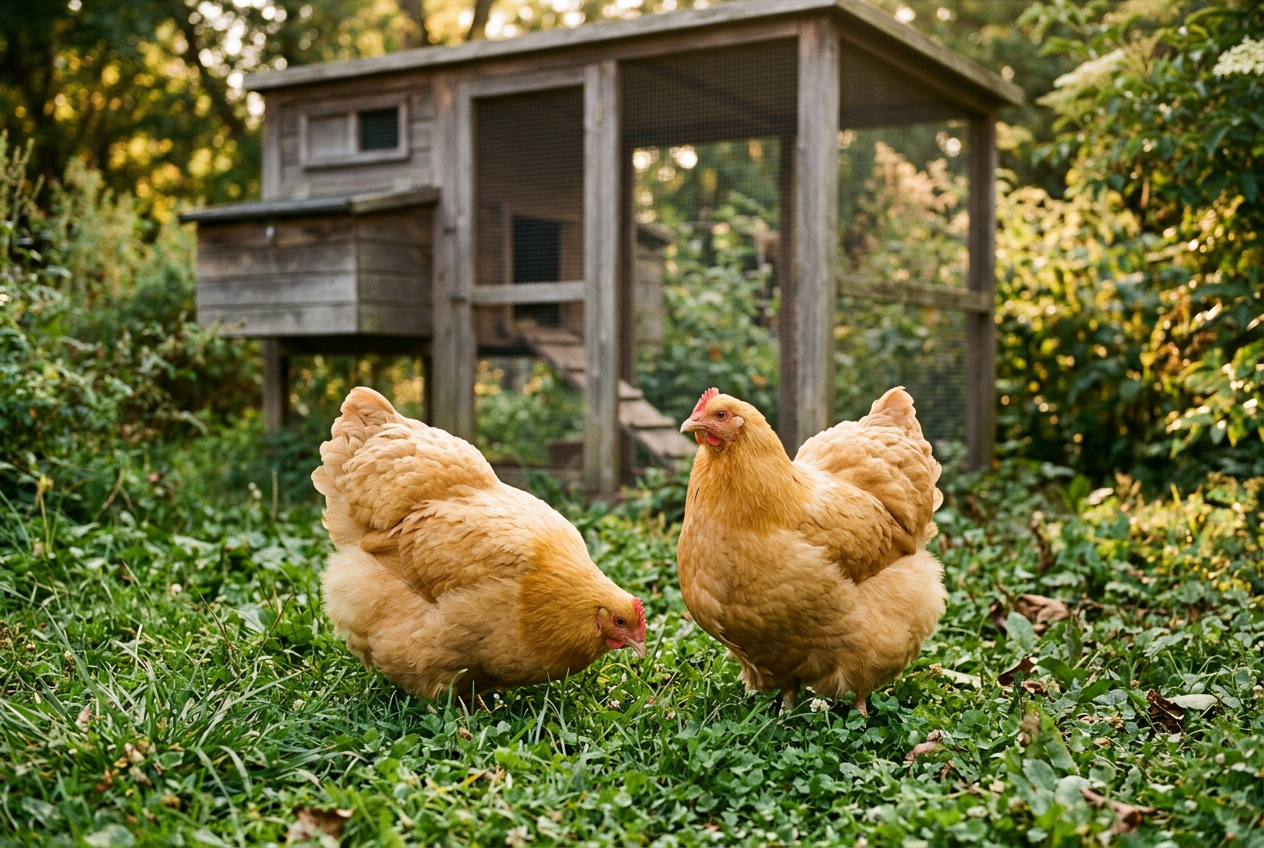
Buff Orpingtons look almost exactly like what many people picture when they imagine a classic backyard hen. They're large, round-bodied chickens covered in soft golden-buff feathers, with a reputation for being calm, useful, and relatively easy to live with.
But Buff Orpingtons weren't developed just to look good in a backyard. The Orpington was created as a practical dual-purpose chicken — a bird that could provide useful egg production while also carrying substantially more body weight than a specialized laying breed.
That history still shows in the modern Buff Orpington. A good Buff Orpington can provide large brown eggs, handle cold weather well, raise chicks naturally, and fit comfortably into many family and mixed flocks. Their large body size and heavy feathering, however, mean they need more consideration around housing, roosts, feed, and summer heat than smaller breeds.
Buff Orpington Quick Facts
| Trait | Buff Orpington |
|---|---|
| Primary use | Dual-purpose: eggs and meat |
| Origin | England |
| APA class | English |
| Hen weight | About 8 lb |
| Rooster weight | About 10 lb |
| Egg color | Brown |
| Egg size | Large to extra large |
| Egg production | Moderate to good; roughly 3–5/week is a practical planning range |
| Temperament | Generally calm, gentle, and docile |
| Broodiness | Moderate to high; varies by line |
| Mothering ability | Generally very good |
| Cold tolerance | Strong |
| Heat management | Needs shade, water, and ventilation in hot weather |
| Foraging | Capable, but not among the most active foragers |
| Best for | Families, mixed flocks, homesteads, brown eggs, dual-purpose flocks |
| Main care consideration | Large body size and heavy feathering |
The Buff Orpington's real strength isn't being the absolute best chicken in one category. It's being useful in several categories at once.
What Makes Buff Orpington Chickens Unique?
Buff Orpingtons come from a period when chicken breeds were expected to be practical. Farmers weren't necessarily looking for a bird that could produce the most eggs possible or grow the fastest possible — they wanted chickens that could do several jobs well.
The Orpington was developed around that idea. A good Orpington offered:
- useful egg production
- substantial body size
- calm temperament
- natural broodiness
- cold-weather durability
That combination still makes the breed relevant to modern backyard flocks. A Buff Orpington isn't simply a golden-colored egg layer. It's a large traditional farm chicken with a very different body type and management profile from lighter production breeds.
Buff Orpington History, Size & Appearance
Where Did Buff Orpingtons Come From?
The Orpington originated in Orpington, Kent, England, during the late 1800s. William Cook developed the breed as a practical dual-purpose chicken. The original Black Orpington was created using breeds including Minorcas, Black Plymouth Rocks, and clean-legged Langshans.
The goal was straightforward: create a substantial table bird that could also produce a useful number of eggs. The Black Orpington came first, followed by additional varieties, including the Buff Orpington. Orpingtons reached the United States during the 1890s, and the American Poultry Association recognized the Buff Orpington in 1902, according to The Livestock Conservancy.
What Does a Buff Orpington Look Like?
Buff Orpingtons are broad, deep-bodied chickens with abundant soft feathering. Their appearance is noticeably different from leaner, more athletic laying breeds. A typical Buff Orpington has:
- rich golden-buff plumage
- a broad body and deep breast
- relatively short, clean legs
- a single comb and red wattles
- white skin
- substantial feather volume
The heavy feathering exaggerates their round appearance. They aren't just fluffy, though — they're genuinely large chickens underneath it.
How Big Do Buff Orpingtons Get?
Standard adult weights, per Oklahoma State University, are approximately:
| Bird | Standard Weight |
|---|---|
| Rooster | 10 lb |
| Hen | 8 lb |
| Cockerel | 8.5 lb |
| Pullet | 7 lb |
An eight-pound hen needs more room around doors, roosts, feeders, and nest boxes than a small laying breed or bantam. That body size should influence how you design the coop.
Buff Orpington Egg Production
Egg production is one of the most inconsistently reported Buff Orpington traits online. Some breed descriptions make them sound like excellent layers; others describe their production much more conservatively. Both can be true.
How Many Eggs Do Buff Orpingtons Lay?
For backyard planning, I would expect roughly 3–5 eggs per week during good laying periods from a productive Buff Orpington hen. Treat that as a practical range rather than a guaranteed breed standard.
Production varies considerably based on bloodline, age, daylight, season, diet, health, molt, and broodiness.
The Livestock Conservancy describes Orpingtons as useful layers, while Mississippi State rates modern Orpington egg production more conservatively, and commercial hatcheries publish different estimates again. That tells us something important: strain matters. A Buff Orpington selected for backyard production may perform very differently from a heavy exhibition line selected primarily for body shape, feathering, and show characteristics.
Are Buff Orpingtons Good Egg Layers?
They're good enough for many backyard households, but I wouldn't classify them alongside specialized high-production breeds. The Buff Orpington's advantage is balance: a large bird, useful egg production, large eggs, calm temperament, broodiness, and dual-purpose utility.
If you only care about maximizing eggs per pound of feed, there are stronger choices. If you want a useful family flock bird that also produces a steady supply of eggs, the Buff Orpington makes much more sense. For realistic expectations across breeds, see How Often Do Chickens Lay Eggs? Daily, Weekly & Yearly Expectations.
What Color Eggs Do Buff Orpingtons Lay?
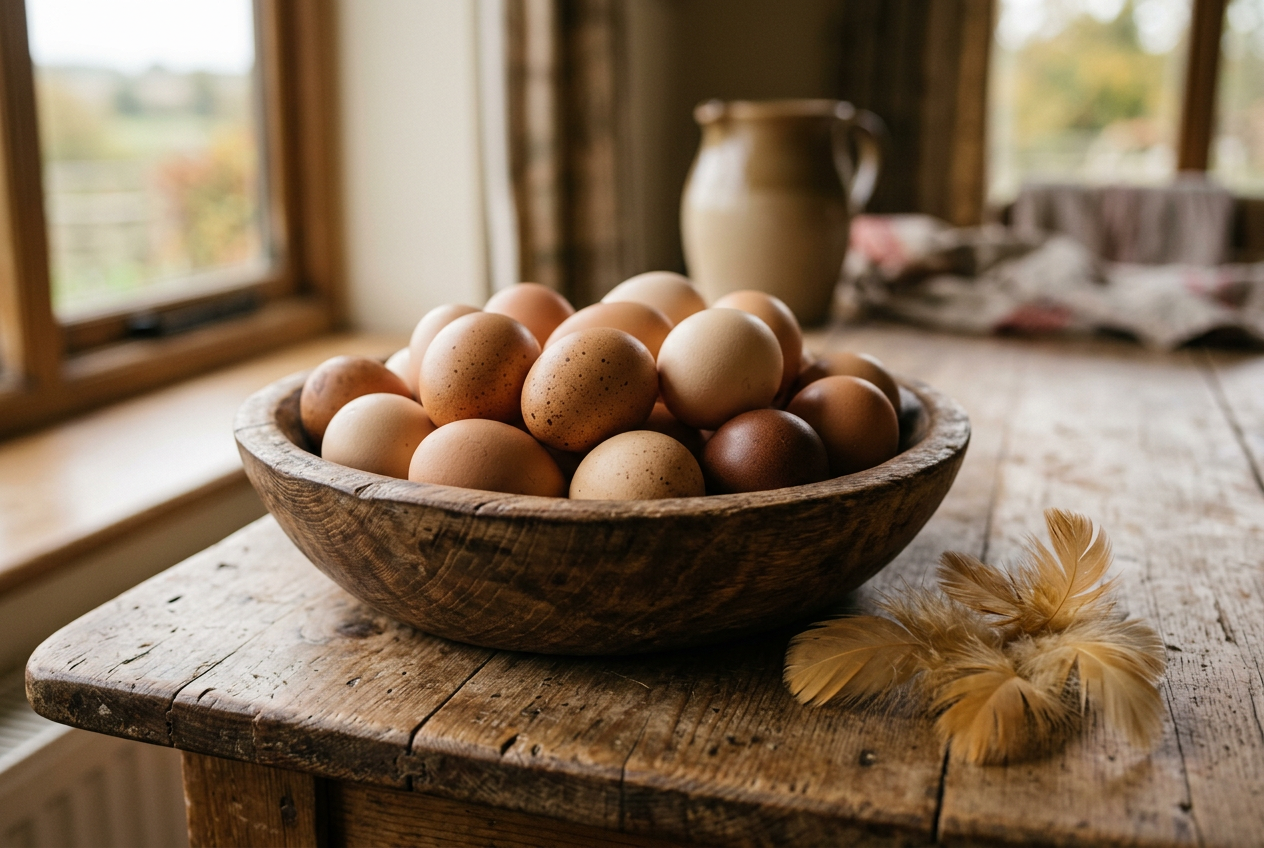
Buff Orpingtons lay brown eggs. Shell shade can vary by individual hen, and Mississippi State describes Orpington eggs as ranging from light to dark brown.
How Big Are Buff Orpington Eggs?
Egg size is one of the breed's more attractive production characteristics. The Livestock Conservancy lists Orpington eggs as large to extra large. A Buff Orpington may not produce as many eggs annually as a commercial-style layer, but the eggs she does produce are substantial.
When Do Buff Orpingtons Start Laying?
A reasonable planning range is approximately 5–7 months of age, with individual and seasonal variation. Large-bodied breeds don't always mature as quickly as specialized production hybrids. Short winter daylight, slower individual development, nutrition, illness, and season can all delay first lay.
Rather than treating a particular week as a deadline, watch for normal signs of approaching lay: a larger, redder comb, increased nesting-box interest, squatting behavior, pelvic development, and changes in vocalization and routine. For the broader timeline, see When Do Chickens Start Laying Eggs? Age, Signs & What to Expect.
Do Buff Orpingtons Lay in Winter?
They can continue producing during cooler weather, but I would not promise year-round eggs from every hen. Orpingtons are well known for tolerating cold climates, but cold tolerance and uninterrupted winter laying are not the same thing. Daylight, age, molt, genetics, and nutrition still apply — a Buff Orpington may handle winter beautifully and still reduce production when the days become short.
Buff Orpington Temperament & Flock Compatibility
Temperament is one of the strongest reasons to consider Buff Orpingtons. Oklahoma State describes Orpingtons as calm and gentle, while The Livestock Conservancy characterizes the breed as calm and friendly. That reputation has made them a popular choice for family flocks, first-time keepers, mixed backyard flocks, and people who enjoy interacting with their birds.
Individual chickens still have individual personalities — breed tendencies don't manufacture identical birds. But if calm temperament ranks high on your list, Buff Orpingtons deserve serious consideration.
Are Buff Orpingtons Friendly?
Generally, yes. Many Buff Orpingtons become comfortable around people, especially when they experience calm human interaction from a young age. Their larger size can also make them feel sturdier to handle than tiny bantam breeds. That combination of large body + calm disposition is part of their appeal.
Still, don't assume every hen wants to be picked up. One bird may happily follow you around the yard while another prefers staying a few feet away. Both can have perfectly normal Buff Orpington temperaments.
Are Buff Orpingtons Good With Children?
They can be an excellent family breed. Their calm nature and substantial size can make them easier for children to observe and interact with than nervous or flighty chickens. Children should still learn to approach calmly, avoid chasing, support the chicken's body, never pull feathers or wings, and wash hands after handling poultry. A calm breed makes interaction easier — it doesn't turn a chicken into a toy.
What Are Buff Orpington Roosters Like?
Buff Orpington roosters share the breed's general reputation for calmer temperament, but I would never guarantee an individual rooster's behavior based on breed alone. An adult rooster can weigh approximately 10 pounds — a substantial animal.
Watch males for charging, biting, repeated territorial behavior, excessive mating pressure, spur use, and aggression toward children. A calm Buff Orpington rooster can be an excellent flock bird. An aggressive one shouldn't get a free pass because his breed is normally considered gentle.
Are Buff Orpingtons Easily Bullied?
They can be. The same docile temperament people love may put an Orpington at a disadvantage around highly assertive flockmates, and Oklahoma State specifically notes that Orpingtons can be bullied by more aggressive breeds.
In mixed flocks, watch for repeated chasing, blocked feeder access, feather pulling, hens hiding, weight loss, and birds being pushed away from roosts. Plenty of Buff Orpingtons live successfully in mixed flocks — the key is matching personalities and providing enough resources.
Broodiness & Mothering Ability
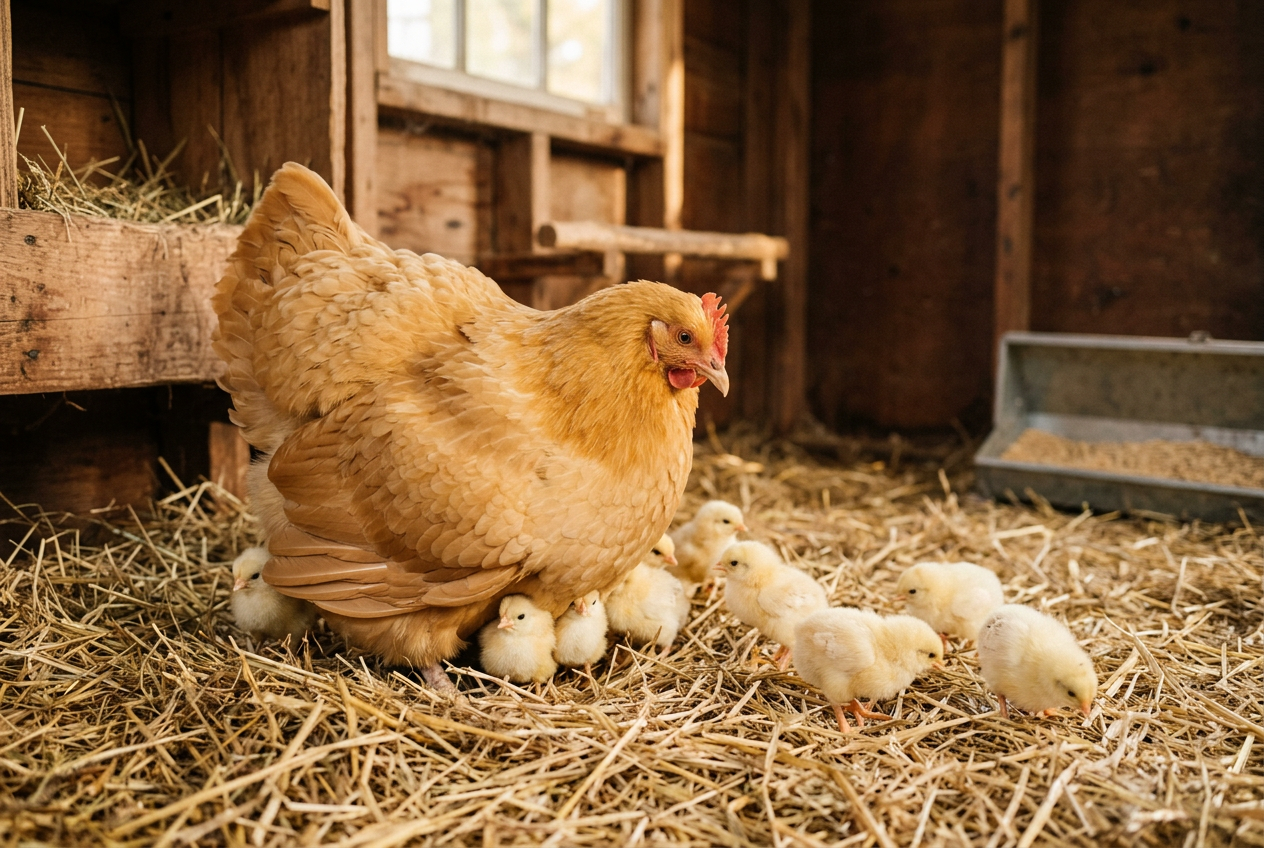
Buff Orpingtons retain another traditional farm trait: broodiness. Oklahoma State describes Orpington hens as sitters and good mothers, while Mississippi State gives the breed strong marks for mothering ability. That makes them attractive if you want to hatch chicks naturally.
Are Buff Orpingtons Broody?
They can be. Not every hen will behave the same way, and different breeding lines may show very different levels of broodiness. But compared with many modern production-oriented chickens, broodiness is a meaningful Buff Orpington trait. When a hen goes broody, she generally stops laying while she focuses on the nest — so broodiness affects egg production.
Are Buff Orpingtons Good Mothers?
They have a strong reputation for it. If you're interested in natural incubation, breeding, or hens raising their own chicks, a broody Buff Orpington may be a real advantage. If your priority is uninterrupted egg production, that same trait may become frustrating.
Buff Orpington Lifespan & Long-Term Production
I would be cautious with claims that Buff Orpingtons have one exact breed-specific lifespan. There isn't a strong longevity dataset showing that every Orpington should live a specific number of years, so general backyard-chicken guidance is more useful.
For planning purposes, 6–8+ years is a reasonable expectation for a well-managed chicken, while individual birds may live shorter or considerably longer lives. Genetics, disease, predators, housing, nutrition, accidents, and veterinary care all play a part.
Egg Production Doesn't Last as Long as the Chicken
This is important. A Buff Orpington can remain healthy and active long after her most productive laying years have passed. Anyone building a flock primarily around eggs should decide early what their philosophy will be toward older hens. For many backyard keepers, the answer is simple: they stay. They're still members of the flock even when the egg basket isn't as full.
Housing, Roosts & Space Requirements
Buff Orpington housing should account for one obvious fact: they're large chickens. An eight-pound hen takes up more physical room than a small production layer or bantam.
Coop Space
Our general Roosted planning target for standard backyard hens is about 4 square feet of usable indoor space per chicken. For Buff Orpingtons, I consider that a starting target rather than something I'd try to reduce. If you have room to build bigger, I would — large birds benefit from extra walking space, feeder and roost access, room to avoid flockmates, and dry bedding area.
For the complete calculator, see How Much Space Do Chickens Need? Coop & Run Size Chart + Calculator.
Run Space
Our general backyard planning target is about 10 square feet of run per standard chicken. Buff Orpingtons may be calm birds, but they still need room to scratch, walk, forage, dust bathe, and move away from one another. More room is usually easier to manage than designing the run around the smallest possible footprint.
Roosts
Buff Orpingtons can roost perfectly well — but they're heavy. I would use sturdy wooden roosts with generous perch width, secure mounting, moderate height, and adequate landing space.
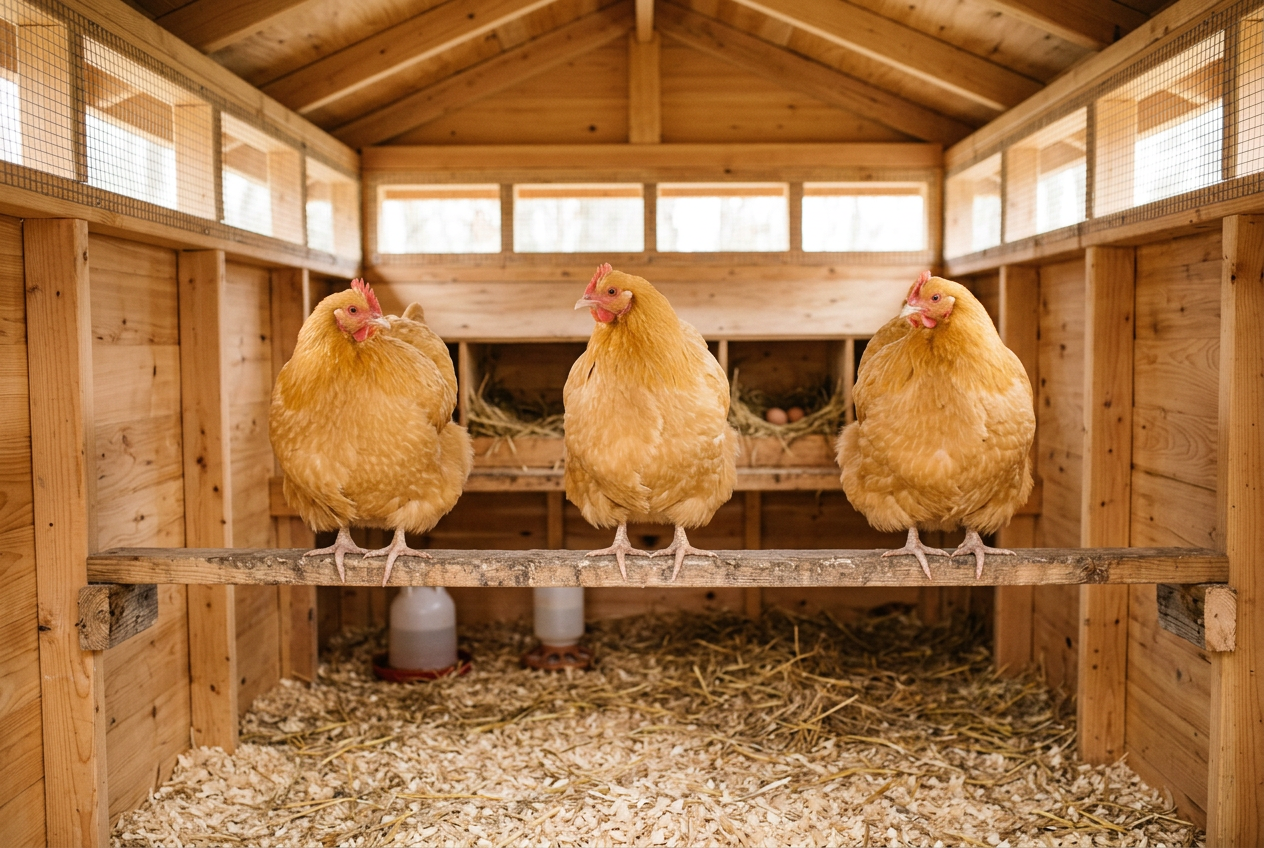
I would not design a system requiring an eight-pound hen to repeatedly launch herself from an unnecessarily high perch. The heavier the chicken, the more I care about safe landings.
Nesting Boxes
Nest boxes also need to fit a large hen comfortably. A box can technically be large enough for a chicken to enter while still being awkward once she tries to turn around, settle down, or stand back up. Build with adult body size in mind.
For complete nesting-box dimensions and placement, see Chicken Nesting Boxes: Size, Dimensions, How Many You Need & Where to Put Them.
Feeding Buff Orpington Chickens
Buff Orpingtons don't require special breed-specific feed. Their nutritional foundation should be a complete poultry ration appropriate to age and production stage.
Feed by Life Stage
Chicks: complete chick starter.
Growing pullets: an appropriate grower ration.
Laying hens: a complete layer ration or another properly managed flock ration.
All birds: constant access to clean, fresh water.
That's the foundation. You don't need a complicated Buff Orpington supplement routine.
Keep Treats Supplemental
Buff Orpingtons are large birds, but their size doesn't mean treats should replace balanced feed. Scratch grains, mealworms, and kitchen scraps should remain extras, with complete feed providing most of the nutrition.
Do Buff Orpingtons Eat More?
I would avoid claiming an exact breed-specific feed consumption rate without good data. But an eight-pound chicken is a much larger animal than a two-pound bantam. If you're comparing the cost of keeping four Buff Orpingtons with four tiny bantams, don't assume the feed bill will be identical — body size matters.
For a broader flock budget, see How Much Do Chickens Cost? Chicks, Coop Setup & Monthly Costs.
Cold Weather & Summer Heat
Buff Orpingtons are frequently recommended for cold climates, and their large bodies and abundant feathering work in their favor. But that doesn't mean weather management disappears.
Cold Weather
University of Minnesota includes Orpingtons among heavier breeds that overwinter well, and Oklahoma State likewise notes the breed's ability to tolerate cold temperatures.
Provide dry bedding, good ventilation, protection from precipitation and direct drafts, and unfrozen water. Don't seal the coop completely in an attempt to make it warmer — a dry, ventilated coop is generally more useful than a humid sealed box. See Chicken Coop Ventilation: How Much Does Your Coop Need?.
Hot Weather
Summer deserves more attention with this breed. Buff Orpingtons are large, heavily feathered, and substantial-bodied — characteristics that don't give them an obvious advantage during extreme heat.
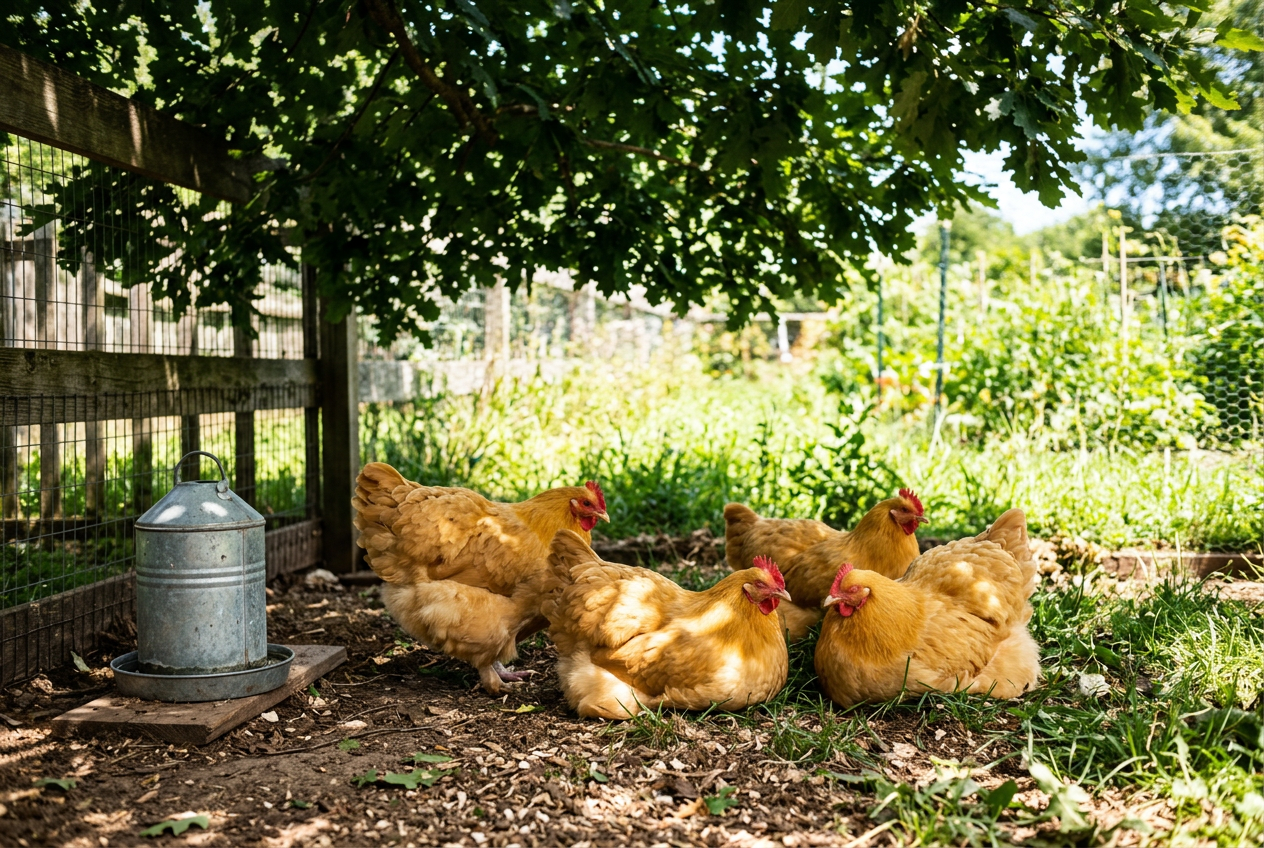
They can still be raised successfully in warm climates, but I would deliberately provide reliable shade, abundant cool water, strong ventilation and airflow, enough space, and no overcrowding.
Watch for heat-stress signs such as panting, wings held away from the body, reduced activity, reduced feed intake, and weakness. Buff Orpington owners hear plenty about cold tolerance; hot-weather management deserves equal attention. Our full guide covers it: How to Keep Chickens Cool in Summer: Signs of Heat Stress & 10 Ways to Help.
Free-Ranging & Foraging
Buff Orpingtons can free-range, but I wouldn't choose them specifically because I wanted the most energetic forager possible. Oklahoma State notes that Orpingtons can perform well in either free-range or confined systems, while Mississippi State rates their foraging ability more conservatively.
Those descriptions aren't necessarily contradictory. A Buff Orpington can happily spend the afternoon exploring the yard without being an especially intense range bird. Their style tends to be more calm backyard wanderer than high-speed acreage explorer — and for many suburban flock owners, that's actually an advantage.
Will Buff Orpingtons Tear Up the Yard?
They're still chickens. They will scratch, dig, dust bathe, investigate mulch, eat plants, and rearrange landscaping. A large Orpington can move a surprising amount of mulch when she decides you've clearly placed it in the wrong location. If keeping specific landscaping intact matters, use controlled run space or supervised access.
Buff Orpington vs. Similar Chicken Breeds
The Buff Orpington makes the most sense when you compare it with breeds that solve slightly different problems.
| Characteristic | Buff Orpington | Silkie | Rhode Island Red | Australorp |
|---|---|---|---|---|
| Main appeal | Calm dual-purpose family bird | Companion/broody ornamental | Practical egg-producing breed | Strong egg utility |
| Hen size | ~8 lb | ~2 lb (U.S. standard) | ~6.5 lb | ~6.5 lb |
| Egg color | Brown | Cream/tinted | Brown | Light brown/tinted |
| Egg size | Large–extra large | Small | Large | Medium–large |
| Egg production | Moderate to good | Relatively low | Strong | Strong |
| Temperament | Generally calm/docile | Generally calm/docile | More active; individual variation | Generally calm but active |
| Broodiness | Fairly common | Very high | Less defining | Variable |
| Cold tolerance | Strong | Good when kept dry | Good | Good |
| Main consideration | Size and summer heat | Wet feathering, limited flight | More assertive individuals | Greater activity |
Buff Orpington vs. Silkie
Choose the Buff Orpington if you want significantly larger eggs, much more body size, stronger dual-purpose utility, and a more conventional chicken body type. Choose the Silkie if you want a small ornamental breed with extreme broodiness, unusual feathering, and companion-bird appeal. Read the full breed guide: Silkie Chickens: Eggs, Temperament, Lifespan & Complete Care Guide.
Buff Orpington vs. Rhode Island Red
Buff Orpingtons make more sense if your priorities lean toward calm temperament, large body size, broodiness, and natural mothering. Rhode Island Reds may make more sense when practical laying performance is the stronger priority.
Buff Orpington vs. Australorp
This comparison is especially interesting because Australorps developed partly from Orpington stock that Australian breeders selected more heavily toward egg production, according to The Livestock Conservancy. That history explains the different modern roles.
Buff Orpington: a classic heavy dual-purpose family breed.
Australorp: an Orpington-derived breed with a stronger egg-production emphasis.
Are Buff Orpingtons Good for Beginners?
Yes. I consider them one of the stronger traditional breeds for a beginner backyard flock, and their compromises are easy to understand. They're large, generally calm, useful layers, cold tolerant, often broody, and manageable in many mixed flocks. Nothing about their normal care requires specialized equipment.
The biggest requirement is simply recognizing that you're keeping a large chicken, not a lightweight egg-producing machine. If you're still deciding on flock size, see How Many Chickens Should I Get? A Practical Flock Size Guide for Beginners.
Buff Orpington Pros & Cons
| Pros | Cons |
|---|---|
| Generally calm, friendly temperament | Large birds need more room |
| Useful brown egg production | Greater feed needs than tiny breeds |
| Large eggs | Not an elite production layer |
| Strong cold tolerance | Heavy feathering needs summer management |
| Dual-purpose heritage | Can be bullied by assertive birds |
| Frequently good mothers | Broodiness interrupts egg production |
| Good family-flock potential | Heavy body needs sensible roost design |
| Works in many mixed flocks | Not the most active forager |
Buff Orpingtons Are a Good Fit If You Want
- a calm family flock
- large brown eggs
- substantial chickens
- natural broodiness
- strong cold tolerance
- dual-purpose utility
- chickens comfortable around people
Consider Another Breed If You Want
- maximum possible egg production
- a very small chicken
- minimal feed consumption
- highly active free-ranging
- little or no broodiness
- a breed specifically selected for extreme heat
Recommended Setup for Four Buff Orpingtons
If I were starting with four Buff Orpington hens, I would design everything around their mature size from the beginning.
| Area | What I'd Provide |
|---|---|
| Coop | Dry, secure, well ventilated |
| Indoor space | At least around 16 sq ft; larger is welcome |
| Run | Around 40 sq ft minimum planning target, preferably more |
| Roost | Wide, sturdy wooden perch at moderate height |
| Nest boxes | Comfortable for a large-bodied hen |
| Feeder | Enough access to prevent resource guarding |
| Water | Reliable clean water, especially during heat |
| Shade | Significant warm-weather shade |
| Ground | Dry, well-drained surface |
| Dust bath | Loose dry soil/sand in a protected location |
| Predator protection | Secure run and nighttime coop |
Notice what isn't required: special Buff Orpington equipment. You simply need normal chicken infrastructure sized appropriately for a large chicken. For the dust bath, see How to Set Up a Dust Bath for Chickens.
Buff Orpington Care Checklist
Daily
- Provide fresh water
- Provide complete age-appropriate feed
- Collect eggs
- Observe flock behavior
- Check that housing remains predator-secure
Regularly
- Check bedding for moisture
- Monitor body condition
- Watch for bullying
- Clean feeders and waterers
- Inspect feet and legs
- Check roost condition
- Keep nesting boxes clean
During Summer
- Provide reliable shade
- Keep fresh water readily available
- Maximize safe airflow
- Watch for panting or lethargy
- Avoid overcrowding
During Winter
- Keep bedding dry
- Maintain ventilation
- Prevent drinking water from freezing
- Keep direct drafts off the roost
- Observe combs during severe cold
During Broodiness
- Decide whether you're allowing a hatch
- Make sure the hen eats and drinks
- Monitor body condition
- Provide a safe nest
- Manage the broody cycle if chicks aren't wanted
The Bottom Line: Are Buff Orpington Chickens Right for You?
Buff Orpingtons remain popular because the breed makes sense. They combine a generally calm temperament, substantial body size, useful brown egg production, large eggs, broodiness, strong mothering ability, good cold tolerance, and traditional dual-purpose utility — without requiring highly specialized care.
They're not the best chicken for every goal. If you want the highest possible egg production from the least feed and space, a production-focused breed will probably serve you better. If you want a tiny ornamental bird, the eight-pound Buff Orpington is clearly not that either. And in very hot climates, you'll need to take shade, water, and ventilation seriously.
But if someone told me, "I want a friendly backyard chicken that gives us useful eggs and feels like a classic farm hen," the Buff Orpington would be high on my list.
Its biggest strength isn't being number one at a single job. It's being good at a lot of jobs at the same time — which is exactly what the breed was created to do.
Buff Orpington Chicken FAQ
How many eggs do Buff Orpingtons lay?
A practical backyard expectation is roughly 3–5 eggs per week during productive periods. Actual production varies by bloodline, age, season, daylight, molt, and broodiness.
What color eggs do Buff Orpingtons lay?
Buff Orpingtons lay brown eggs. Individual shell color can range from lighter to darker brown.
How big are Buff Orpington eggs?
Orpington eggs are generally considered large to extra large.
Are Buff Orpington chickens friendly?
They're widely known for a generally calm and gentle temperament. Individual personality still varies, but friendliness is one of the breed's strongest characteristics.
How big do Buff Orpingtons get?
Standard hens weigh approximately 8 pounds, while adult roosters reach around 10 pounds.
When do Buff Orpingtons start laying?
A practical range is roughly 5–7 months, although some individuals begin earlier or later. Season and daylight can also affect first lay.
Are Buff Orpingtons good for beginners?
Yes. Their generally calm temperament, useful egg production, and straightforward care requirements make them a strong beginner breed as long as their large body size is accounted for.
Are Buff Orpingtons cold hardy?
Yes. Their large bodies and abundant feathering make them well suited to cooler weather when they have dry, properly ventilated shelter.
Are Buff Orpingtons heat tolerant?
They can live successfully in warm climates, but their large bodies and heavy feathering mean summer management deserves attention. Provide shade, airflow, plenty of fresh water, and adequate space.
Do Buff Orpingtons go broody?
They commonly can. Broodiness varies by bloodline and individual hen, but Orpingtons have a longstanding reputation as sitters and mothers.
Are Buff Orpingtons good mothers?
Yes. Strong natural mothering ability is one of the traditional traits associated with the breed.
Can Buff Orpingtons free-range?
Yes. They can make good backyard free-range birds, although they aren't usually considered among the most active or efficient foraging breeds.
Can Buff Orpingtons live with other chicken breeds?
Yes. They generally fit mixed flocks well, but their docile nature means especially aggressive flockmates should be monitored carefully.
Want to estimate what your flock could produce? Try the Chicken Egg Production Calculator →
Have a young Buff Orpington? Estimate when she may lay her first egg →
Not sure whether this breed is right for you? Try the Chicken Breed Finder →
Keep Reading
Comparing another calm backyard breed? Silkie Chickens: Eggs, Temperament, Lifespan & Complete Care Guide
Deciding how many hens to start with? How Many Chickens Should I Get? A Practical Flock Size Guide for Beginners
Planning room for a large breed? How Much Space Do Chickens Need? Coop & Run Size Chart + Calculator
Wondering how often hens normally lay? How Often Do Chickens Lay Eggs? Daily, Weekly & Yearly Expectations
Waiting for your first eggs? When Do Chickens Start Laying Eggs? Age, Signs & What to Expect
Want a hardy, productive brown-egg layer? Rhode Island Red Chickens: Eggs, Temperament & Complete Care Guide
Sources & Further Reading
- The Livestock Conservancy — Orpington Chicken
- Oklahoma State University — Orpington Chickens
- Mississippi State University Extension — Choosing the Right Breed for Your Backyard Flock
- University of Minnesota Extension — Raising Chickens for Eggs / Caring for Chickens in Cold Weather
- The Livestock Conservancy — Australorp Chicken
- Meyer Hatchery — Breed Spotlight: The Orpington
- Cackle Hatchery — Buff Orpington
- Want a colorful egg basket instead? Easter Egger Chickens: Egg Colors, Temperament & Care Guide
Want an even bigger calm breed? Brahma Chickens: Size, Egg Production, Temperament & Care
Want a trimmer, more productive cousin? Australorp Chickens: Egg Production, Temperament & Care
Looking for a calm dual-purpose breed that forages harder? Barred Rock Chickens: Egg Production, Temperament & Care